Power to quash criminal proceedings should be used very sparingly: Supreme Court
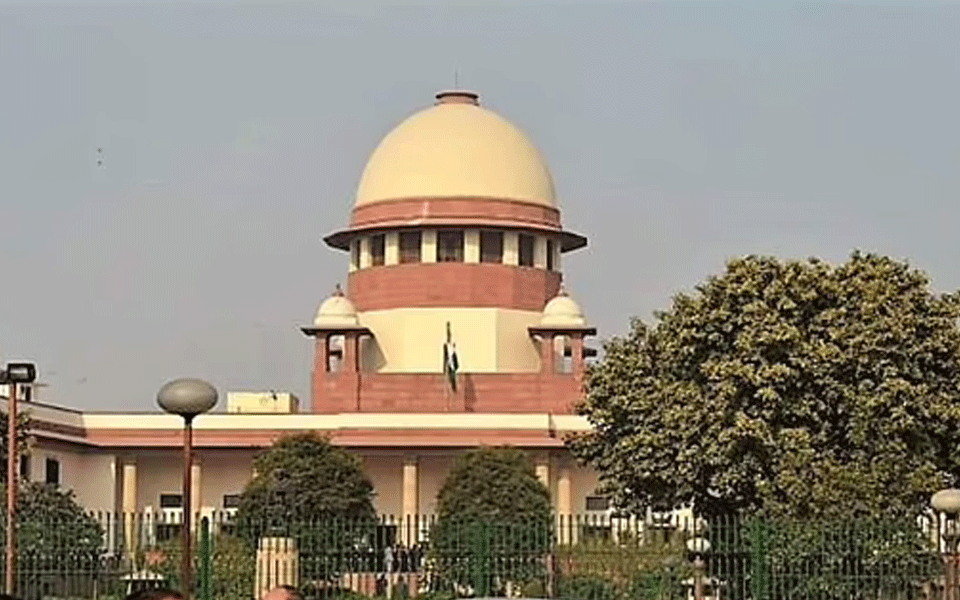
New Delhi (PTI): The power to quash criminal proceedings should be exercised very sparingly and with circumspection and that too in the rarest of rare cases, the Supreme Court has said.
A bench of Justices B R Gavai and S Ravindra Bhat made the observation while quashing a case of forgery and cheating against three individuals in a property dispute.
"This court has cautioned that, power to quash criminal proceedings should be exercised very sparingly and with circumspection and that too in the rarest of rare cases, it has specified certain category of cases wherein such power can be exercised for quashing proceedings," the bench said.
The apex court said that one of the categories where this power can be used is where a criminal proceeding is manifestly mala fide or maliciously instituted with an ulterior motive for wreaking vengeance on the accused and with a view to spite him due to private and personal grudge.
The top court said that in the present case, the complaint has been filed against the accused with an ulterior motive of harassing the appellants.
The apex court said that the magistrate while passing the order under Section 156 (3) of the CrPC has totally failed to consider the law laid down by the highest court.
The power under Section 156 (3) of the Criminal Procedure Code, 1973 (CrPC) can be exercised by the magistrate to direct the police to conduct investigation only in respect of a cognisable offence.
"In any case, when the complaint was not supported by an affidavit, the Magistrate ought not to have entertained the application under Section 156 (3) of the CrPC.
"We are, therefore, of the considered view that, continuation of the present proceedings would amount to nothing but an abuse of process of law," the bench said.
Let the Truth be known. If you read VB and like VB, please be a VB Supporter and Help us deliver the Truth to one and all.
Congress using hijab issue to pacify minority anger, alleges Karnataka LoP R Ashoka

Bengaluru: Leader of Opposition in the Assembly R. Ashoka has accused the Congress government of using the hijab issue to placate what he described as discontent among minority voters after the Davanagere by-election.
In a post on X on Wednesday, Ashoka alleged that the state government, instead of addressing issues such as price rise, corruption, farmers’ distress and law and order, was attempting to retain its minority vote base by reviving the hijab issue.
Referring to the 2022 dress code introduced by the BJP government, which prohibited hijab in schools and colleges, Ashoka said the Karnataka High Court had upheld the policy and emphasised the importance of discipline in educational institutions.
He questioned the Congress government’s move to revisit the issue and asked whether setting aside the court-backed policy to benefit one community could be described as secularism.
Ashoka further alleged that while the government was willing to permit hijab, it continued to prohibit saffron shawls.
He accused the government of dividing students on religious lines rather than treating schools and colleges as spaces of equality.
Drawing a comparison with Mamata Banerjee’s government in West Bengal, Ashoka claimed that excessive appeasement politics had harmed the state and warned that the Congress in Karnataka could face a similar political response.
He said voters in Karnataka would teach the Congress a lesson for what he termed “vote-bank politics” and for compromising constitutional and judicial principles.