Prakash Karat to be coordinator of CPI(M)'s Politburo, Central Committee as interim measure
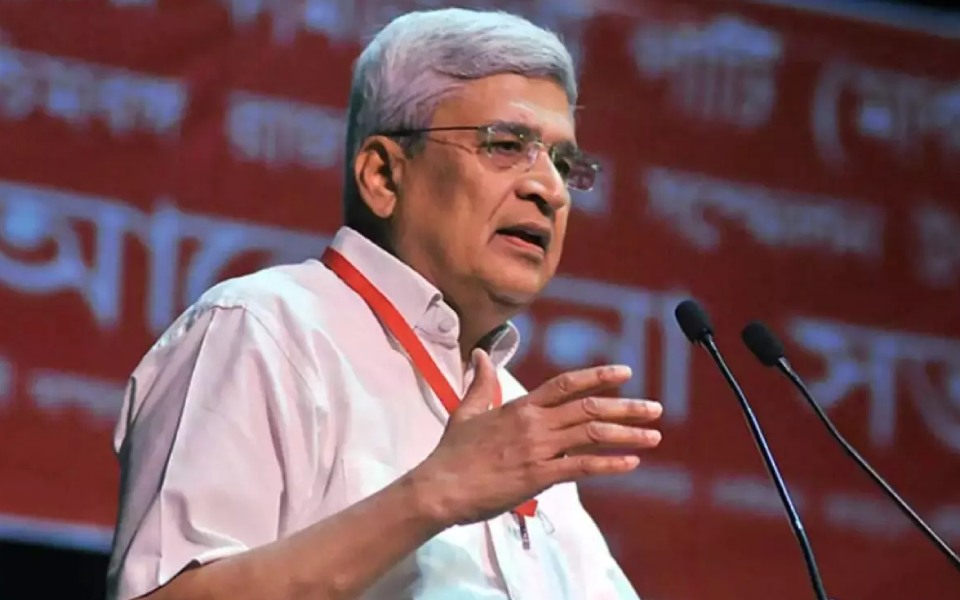
New Delhi, Sep 29: Senior CPI(M) leader Prakash Karat will be the coordinator of the party's Politburo and Central Committee as an interim arrangement until the 24th party Congress to be held in April next year, the Left party said on Sunday.
The decision comes in the wake of CPI(M) general secretary Sitaram Yechury's death on September 12 at the age of 72.
"The Central Committee of the Communist Party of India (Marxist), now in session in New Delhi, has decided that Comrade Prakash Karat will be the coordinator of the Polit Bureau and the Central Committee, as an interim arrangement until the 24th party Congress to be held in April 2025 at Madurai," the CPI(M) said in a statement.
"This decision was taken due to the sad and sudden demise of the sitting general secretary of the CPI(M), Comrade Sitaram Yechury," it added.
Karat, one of the seniormost leaders of the Communist Party of India (Marxist), was its general secretary from 2005 to 2015.
Karat was born on February 7, 1948 in Letpadan in present-day Myanmar, where his father, C P Nair, was employed with the Burma Railways and later, at the Burma Oil Pipeline Project.
He studied in the Madras Christian College Higher Secondary School in Chennai and later, went to the University of Edinburgh in the United Kingdom for a master's degree in politics. He became active in student politics at the university.
He returned to India and joined the Jawaharlal Nehru University (JNU) in 1970 and also worked as an aide to veteran CPI(M) leader A K Gopalan.
One of the founders of the Students' Federation of India (SFI), Karat was elected as the third president of the JNU Students' Union. He also became the second president of the SFI between 1974 and 1979.
He was the secretary of the Delhi state committee of the CPI(M) from 1982 to 1985, was elected to the Central Committee of the party in 1985 and became a member of its Politburo in 1992.
One of the key faces of the party for decades, Karat was at the helm of the CPI(M) when it decided to withdraw support to the Congress-led United Progressive Alliance government at the Centre in 2008. The following years saw a decline in the strength of the Left in Parliament.
The CPI(M) had 43 MPs in the Lok Sabha in 2004, which came down to nine in 2014. As a part of the INDIA opposition bloc, the Left party won four seats in the Lok Sabha polls held earlier this year.
Let the Truth be known. If you read VB and like VB, please be a VB Supporter and Help us deliver the Truth to one and all.
Trump orders US military to 'shoot and kill' Iranian small boats choking Strait of Hormuz
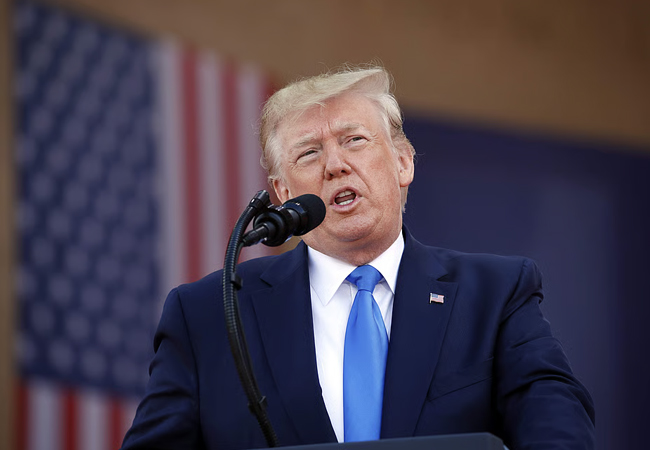
Dubai (AP): President Donald Trump said Thursday he has ordered the US military to “shoot and kill” small Iranian boats that deploy mines to choke traffic through the Strait of Hormuz.
Trump's post on social media came shortly after the US military seized another tanker associated with the smuggling of Iranian oil, ratcheting up a standoff with Tehran over the strait through which 20 per cent of all crude oil and natural gas traded passes.
“I have ordered the United States Navy to shoot and kill any boat, small boats though they may be...that is putting mines in the waters of the Strait of Hormuz,” Trump posted. “There is to be no hesitation. Additionally, our mine sweepers' are clearing the Strait right now.”
“I am hereby ordering that activity to continue, but at a tripled up level!” Trump added.
He also said the military is intensifying mine clearing operations in the critical waterway.
The move comes a day after Iran's paramilitary Revolutionary Guards attacked three cargo ships in the strait, capturing two of them.
The Defence Department released video footage earlier on Thursday of US forces on the deck of the Guinea-flagged oil tanker Majestic X, which was seized in the Indian Ocean.
“We will continue global maritime enforcement to disrupt illicit networks and interdict vessels providing material support to Iran, wherever they operate,” a Pentagon statement said.
Ship-tracking data showed the Majestic X in the Indian Ocean between Sri Lanka and Indonesia, roughly the same location as the oil tanker Tifani, earlier seized by American forces. It had been bound for Zhoushan, China.
The vessel previously had been named Phonix and had been sanctioned by the US Treasury Department in 2024 for smuggling Iranian crude oil in contravention of US sanctions on the Islamic Republic.
There was no immediate response from Iran on the news of the seizure.
On Tuesday, Trump extended a ceasefire while maintaining an American blockade of Iranian ports. There was no immediate sign whether peace talks, previously hosted by Pakistan, would resume anytime soon.
The standoff between the US and Iran has effectively choked off nearly all exports through the strait with no end in sight.
On Thursday, Iran's exiled Crown Prince Reza Pahlavi was splattered with red liquid as he left a building after a news conference in Berlin. The alleged perpetrator was immediately detained by police.
During the event, Pahlavi criticised the ceasefire between the US and Iran, arguing that the agreement assumes the Iranian government's behaviour will change and “you're going to deal with people who all of a sudden have become pragmatists.”
Pahlavi, 65, has been in exile for nearly 50 years. His father, Iran's shah, was so widely hated that millions took to the streets in 1979, forcing him from power. Nevertheless, Pahlavi is trying to position himself as a player in his country's future.
Since the Feb. 28 start of the war between Iran, Israel and the United States, over 30 ships have come under attack in the waters of the Persian Gulf, the Strait of Hormuz and the Gulf of Oman.
The threat of attack, rising insurance premiums and other fears have stopped traffic from moving through the strait. Iran's ability to restrict traffic through the strait, which leads from the Persian Gulf to the open ocean, has proved a major strategic advantage.
The ceasefire has been strained by duelling US attacks on Iranian ships and those by Iran on commercial vessels. It also remains unclear when, or if, the two sides will meet again in the Pakistani capital Islamabad, where officials say they are still trying to bring the countries together to reach a diplomatic deal.
The conflict already has sent gas prices skyrocketing far beyond the region and raised the cost of food and a wide array of other products. Officials around the world have warned the impact to businesses, consumers and economies could be long-lasting.