Prashant Bhushan moves SC seeking right of appeal against conviction for criminal contempt of court
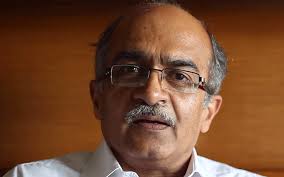
New Delhi: Activist-lawyer Prashant Bhushan, convicted and awarded one rupee fine for his contemptuous tweets against the judiciary, on Saturday moved the Supreme Court seeking the right of appeal against convictions in original criminal contempt cases to be heard by a larger and a different bench.
Bhushan on August 31 was directed to deposit the fine with the Supreme Court registry by September 15 and failure to comply would entail a three-month jail term and debarment from law practice for three years.
In a fresh plea filed through lawyer Kamini Jaiswal, he has sought a declaration that a "person convicted for criminal contempt by this court, including the petitioner herein, would have a right to an intra-court appeal to be heard by a larger and different bench".
Bhushan, in the plea, suggested procedural changes to reduce the chances of "arbitrary, vengeful and high-handed decisions" in criminal contempt cases saying that in such cases the top court is the aggrieved party, the "prosecutor, the witness and the judge" and hence they raise fear of inherent bias.
The petition said the right of appeal is a fundamental right guaranteed under the Constitution and is also guaranteed under international law and this would act as a "vital safeguard against wrongful conviction and would truly enable the provision of truth as a defence".
The plea, to which the Ministry of Law and Justice and the Registrar of the apex court have been made parties, has also sought a direction for framing rules and guidelines "providing for intra-court appeal against conviction in original criminal contempt cases".
Under the present statutory scheme, a person convicted for the criminal contempt has the right to file review petition against the judgement and that plea is decided in chambers by the bench usually without hearing the contemnor.
Bhushan said his petition has been filed for the enforcement of fundamental rights guaranteed under Articles 14 (right to equality), 19 (Freedom of speech and expression) and 21 (right to life) of the Constitution.
"That the existing Act and Rules, do not bar or prohibit the prayers as sought by the Petitioner. In fact, it is in the spirit of the Contempt of Courts Act, 1971 to lay down such a procedure. This Hon'ble Court has in the past framed special rules to deal with cases concerning death penalty and has also devised special remedy in the nature of 'curative petition' against a final judgment of the Supreme Court on certain limited grounds," it said.
The plea said it has been filed in order to bring important procedural safeguards when the top court considers cases of criminal contempt in original proceedings that is those proceedings where it does not act as an appellate court.
"In such cases, considering the fact that there is inherent unavoidable conflict of interest involved, and the fact that liberty of the alleged contemnor is at stake, it is of utmost importance that certain basic safeguards are designed which would reduce (though not obviate) chances of arbitrary, vengeful and high handed decisions.
"It is extremely important to minimise such decisions since they not only cause great injustice to the alleged contemnor, but also bring disrepute to the court itself and are likely to be harshly judged by legal historians," it said.
That the right to appeal against conviction in original criminal cases is a substantive right under Article 21 and flows from principles of natural justice. The absence of such a right thus violates right to life, it said.
"Right of Appeal is an absolute right according to Article 14(5) of International Covenant on Civil and Political Rights (ICCPR) which India has ratified and is therefore binding upon the Indian State. Under ICCPR, first appeal is a right even where trial is by the highest court and review is not a substitute for an appeal," it said.
Contempt proceedings are one in which the aggrieved party is the Supreme Court itself which acts as the "prosecutor, the witness and the judge" and hence raises the fear of inherent bias, it said.
"As a judge the power of the Supreme Court to convict and sentence the accused is unlimited and arbitrary... No one can be at once a suitor and a judge. Thus, there is a need for an intra-court appeal," it said.
It said that the contempt proceedings are "quasi-criminal in nature, akin to a criminal trial" and thus, similar procedural safeguards must apply as in criminal trials.
Besides the contempt case lodged for his tweets, Bhushan is facing another contempt case of 2009.
The apex court had in November 2009 issued contempt notices to Bhushan and Tarun Tejpal for allegedly casting aspersions on some sitting and former top court judges in an interview to news magazine 'Tehelka'. Tejpal was the editor of the magazine.
On September 10, the top court accepted the plea of Bhushan to seek assistance of Attorney General K K Venugopal in the case.
Let the Truth be known. If you read VB and like VB, please be a VB Supporter and Help us deliver the Truth to one and all.
Vijayanagara: One dead, 12 injured as trucks hits their vehicle from behind on NH 50
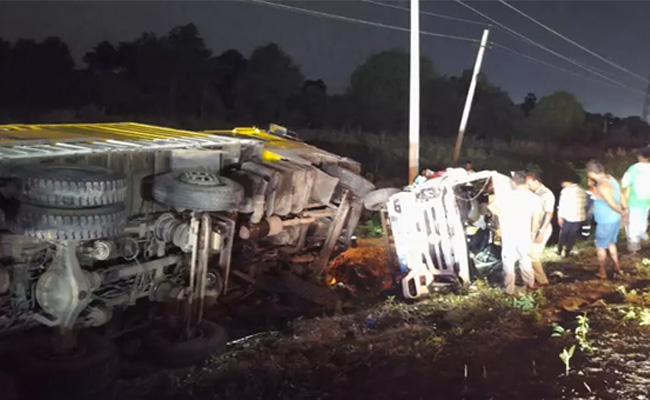
Vijayanagara: One man was killed and 12 others were injured after a truck hit vehicle they were traveling in on the National Highway 50 stretch on the outskirts of Koodligi in the district.
The accident victim, Madhu (27), is learned to have been an employee of Reliance Digital from Andhra Pradesh.
The vehicle was reportedly traveling from Bengaluru to Koodligi and the passengers are learned to have been seriously injured following the collision with the truck, which was found to have a Maharashtra registration.
Koodligi Deputy Superintendent of Police (DySP) Mallesh Dodmani and Circle Inspector Prahlad Channagiri arrived at the accident spot on being informed of the accident.
The police officers and locals rescued the injured passengers and got them shifted to the Koodligi Government Hospital. Some of the passengers were reportedly taken to the Ballari Trauma Care Centre for further treatment.
A case has been registered at the Koodligi Police Station and the officers are investigating the incident.