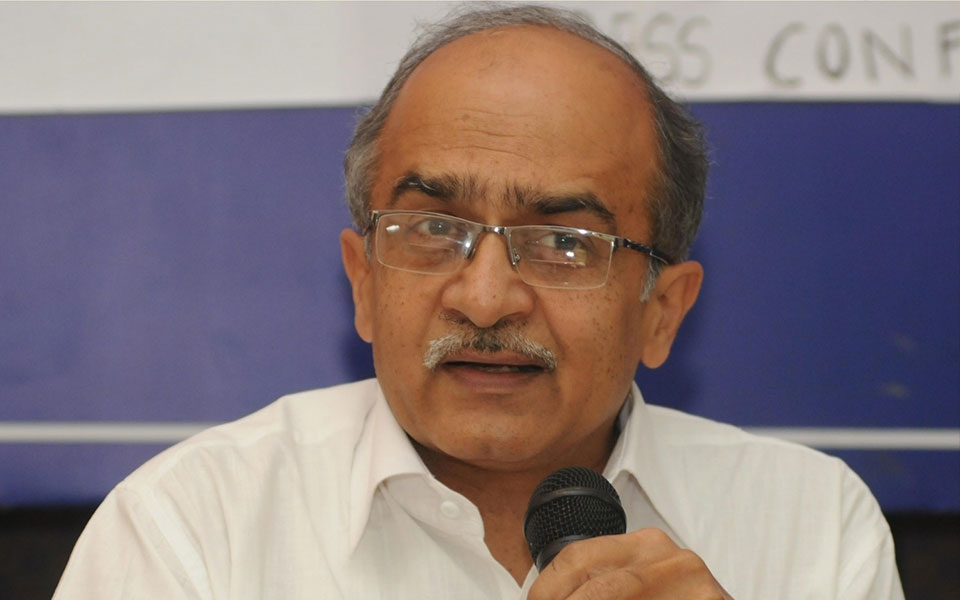
Ahmedabad, Sep 8 : Senior Supreme Court lawyer and activist Prashant Bhushan on Saturday alleged that to justify the changed Rafale deal, the Indian Air Force (IAF) officials were being forced to speak in praise of the new deal signed by the Modi Government.

The opposition parties and many activists have been questioning the change in the deal for the purchase of the Rafael fighter jets by the present government. The earlier deal by the UPA government to purchase 126 fighter planes from France's Dassault was allegedly altered to buy only 36 fighter planes for around Rs 60,000 crore.

"After the expose, the NDA government doesn't have anything to justify the change in the deal, so now IAF officials are being pressurized to speak in favour of the new deal," Prashant Bhushan told reporters.

Calling it a major scam, he alleged, "This is a scam of unimaginable proportions. The country has never witnessed a defence scam of such magnitude," he said.

"The Bofors deal involved a scam of only Rs 64 crore, but the present change in original UPA deal, points to a scam of at least Rs 21,000 crore. Not only that, but far more is the seriousness of compromising the country's security," he said.

Questioning the prime minister's motive, Bhushan asked, "Who gave the prime minister the permission to reduce the requirements of the IAF from 126 planes to only 36, overriding the IAF demands and theADefence Acquisition Council's decision?"

Let the Truth be known. If you read VB and like VB, please be a VB Supporter and Help us deliver the Truth to one and all.


Bengaluru (PTI): Bangalore Milk Union Ltd president D K Suresh on Saturday claimed that e-commerce giant Flipkart is selling milk for Re 1 through "investor-funded discount campaigns", accusing it of undermining the dignity of farmers and the cooperative movement built over decades.

He has lodged a complaint against Flipkart before the Competition Commission of India (CCI) and also written an email to Prime Minister Narendra Modi seeking investigation into "predatory pricing" of milk by the quick commerce platform and its impact on dairy farmers and cooperative institutions.

However, Flipkart said in a statement that it periodically runs limited promotional campaigns on select products available on the platform, often in partnership with banking partners, to enhance customer value.

ALSO READ:  316 domestic LPG cylinders used for commercial purposes seized in Karnataka

"Prices of products on the Flipkart marketplace are determined by individual sellers. All dairy partners and sellers continue to receive their full agreed price for the products they supply, and farmer procurement prices are not impacted in any way," a Flipkart spokesperson said.

Flipkart further said it remains committed to working with farmers, cooperatives and sellers across India to expand market access and support their growth.

Suresh, brother of Deputy Chief Minister D K Shivakumar and also a former MP, slammed Flipkart for its latest move.

Taking to social media platform 'X', the Bangalore Milk Union Ltd (BAMUL) president said that milk is not a Re 1 flash deal. It is the livelihood of millions of farmers.

"Behind every litre of milk is the sweat, labour, and livelihood of our farmers. Predatory discounting by companies like Flipkart weakens India's dairy cooperatives and hurts farmer incomes," he said.

He urged both the central and the state governments to act immediately to protect the farmers and the cooperative movement.

In another post, Suresh said that milk is not a marketing gimmick. It is the livelihood of millions of dairy farmers who work every day to feed this nation.

"Flipkart is selling milk for Re 1 through investor-funded discount campaigns and is undermining the dignity of farmers and the cooperative movement built over decades," he added, urging public to choose farmers, cooperatives and Nandini, a dairy brand owned by the Karnataka Milk Federation (KMF).

Speaking to reporters here earlier in the day, he said that a complaint would be lodged against Flipkart before the Competition Commission of India (CCI) under Section 19(1)(a) over the company's move to sell one litre of milk for Re 1.

He alleged that such competition aimed at capturing the market would hit farmers hard.

"Around Rs 2,000 crore has reportedly been spent on this initiative. It is not appropriate to misuse public shareholders' money in this manner," he said.

According to him, the move could undermine long-standing milk cooperative institutions that have existed since the pre-Independence period.

"Multinational companies are working against farmers' interests. They should clearly state in their advertisements how long they will sell milk at such low prices. Flipkart must withdraw from this move that harms the farming community," he added.

Suresh claimed that 14.5 lakh litres of milk had already been sold under the scheme and advertisements had been issued widely.

"Public money is being invested to attract customers. The company should disclose how long it plans to sell milk at this price," he said.

Responding to a question on whether the sales of Nandini milk had dropped, he said several brands operate in the market and not just Nandini.

"BAMUL's sales have dropped by about 40,000-50,000 litres. We need to ascertain how long this decline has continued," he said.

Asked if other entities were behind the scheme, he said information was still being gathered. "I have seen a couple of advertisements and will also discuss the matter with officials. Under the guise of business, it is not right to ignite a crisis for the farming community," he said.

Suresh said farmers are currently paid Rs 38-40 per litre for milk. "How can they sell it for Re 1? "We need to find out from whom they are purchasing the milk and where it is coming from," he said.

When asked whether farmers should be advised not to sell milk to such companies, Suresh said it was not clear where the company was procuring milk from, including bulk producers.

"We are also checking whether milk powder is being mixed. I have asked for samples and instructed that they be tested in laboratories. If cooperative institutions collapse, the direct impact will be on farmers," he added.