President to inaugurate SC's new annexe building Wednesday
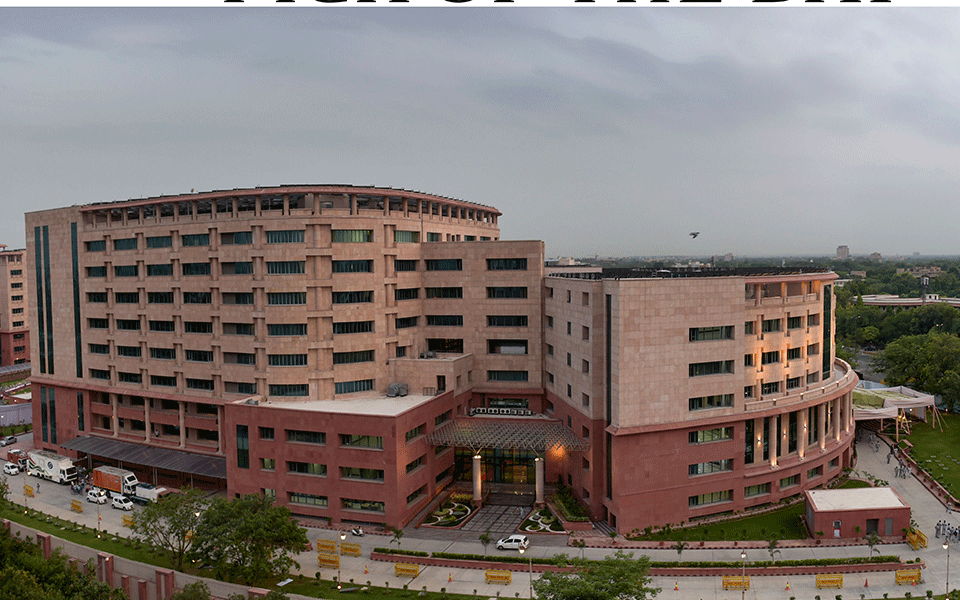
New Delhi, Jul 16: President Ram Nath Kovind will inaugurate a new state-of-the-art annexe building of the Supreme Court Wednesday.
The Chief Justice of India Ranjan Gogoi and other judges of the top court will be present at the inauguration.
The additional court complex, which embodied new and contemporary technology, was built in order to cope up with the space constraints in the old court complex.
The complex has been designed as GRIHA (Green Rating for integrated Habitat Assessment) compliant rated energy efficient building complex.
Its rooftop solar power grid connected system has the maximum solar power capacity--1400 kWp (kilowatt peak) than any building in Delhi-NCR has till date. The grid is capable of managing 40 per cent of the peak consumption.
The new building will have five functional blocks and one service block and these blocks are four to nine storeys high and have a three-level basement with car parking capacity of about 1800 units.
The basements are connected to the old complex of the apex court by three all weather underground passages.
The additional complex built with a total built-up area of 1,80,700 square metres and imbibed technology intensive features.
It consisted of two auditoriums having seating capacity of about 620 and 250 persons and it also housed a conference-cum-meeting room.
Let the Truth be known. If you read VB and like VB, please be a VB Supporter and Help us deliver the Truth to one and all.
Karnataka CM Siddaramaiah accuses EC of ‘bias’, defends state guarantee schemes ahead of bypolls
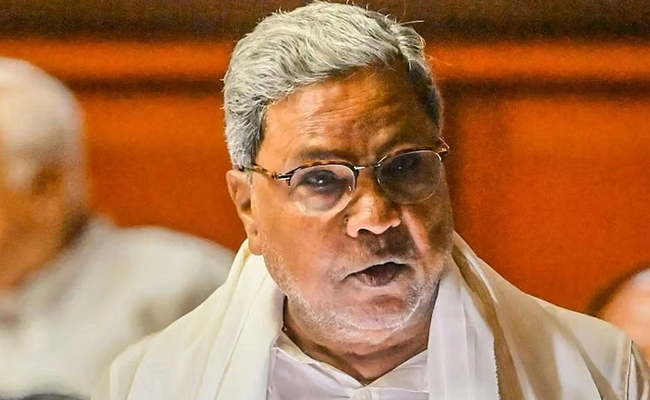
Bengaluru (PTI): Karnataka Chief Minister Siddaramaiah has accused the EC of "double standards" and "bias" after it sought details on the state’s guarantee schemes in Davanagere and Bagalkot districts, where bypolls are scheduled for Thursday.
In a post on 'X' on Wednesday, Siddaramaiah said the Election Commission of India had asked the Karnataka government for information on fund releases under five ongoing guarantee schemes in the constituencies going to polls.
The polls were necessitated following the deaths of senior Congress MLAs Shamanur Shivashankarappa and H Y Meti, respectively.
The schemes are Gruha Jyothi, which provides 200 units of free electricity to every household; Gruha Lakshmi, offering Rs 2,000 to women heading families; and Anna Bhagya, supplying 10 kg of rice per month to each member of BPL families.
In addition, Yuva Nidhi grants Rs 3,000 to unemployed graduates and Rs 1,500 to unemployed diploma holders aged 18–25 for two years, while Shakti enables women to travel free of charge within Karnataka on government non-luxury buses.
Siddaramaiah alleged that the ECI had remained silent when similar cash transfer schemes were announced in Maharashtra and Bihar ahead of elections, calling the scrutiny of Karnataka’s schemes a "clear case of bias".
"In states like Maharashtra and Bihar, cash transfer schemes were announced or fast-tracked just before elections, directly benefiting voters. Yet the ECI remained silent. This is not neutrality—it is complicity," he said.
The CM accused the BJP and NDA governments of "a double standard", noting that when they act, the ECI "looks the other way", but when Karnataka fulfils its promises, it faces "intense scrutiny".
He added that targeting the state’s guarantee schemes is "not just political but anti-poor, anti-women, and anti-Karnataka."
Siddaramaiah clarified that these schemes were not launched in connection with the bypolls but are ongoing programmes implemented as part of the Congress government’s commitments from the 2023 Assembly elections.
Funds are transferred regularly to beneficiaries in a transparent and structured manner, he added.
"The guarantees are part of governance—a direct investment in human dignity, household stability, and economic participation, not inducement," he said.
He also accused the BJP of "hypocrisy", saying that while it criticises Karnataka’s schemes as "freebies", it rolls out similar programmes in states it governs.
"The Karnataka model has set a benchmark for the country. What is deeply concerning, however, is the ECI’s selective approach," Siddaramaiah added.