Private doctors cease work in UP in protest against Kolkata medic's murder
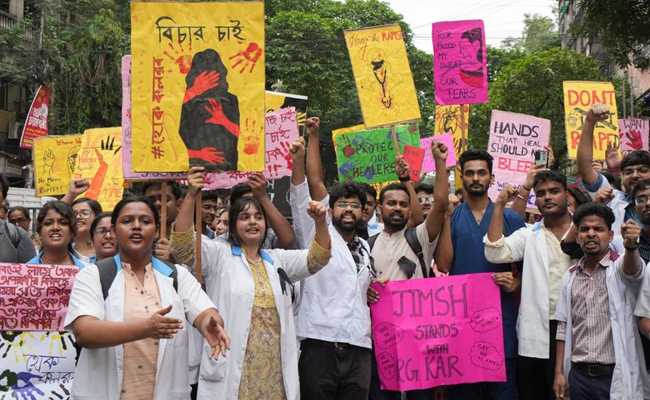
Lucknow (PTI): Doctors running private clinics and nursing homes associated with the Indian Medical Association of Uttar Pradesh on Saturday abandoned work in a protest against the alleged rape and murder of a female doctor at Kolkata's RG Kar Medical College and Hospital.
The absolute strike threw health care services across districts of UP out of gear and led to the crowding of patients at government hospitals.
Junior doctors from Lucknow's KGMU observed a 'Kala Rakshabandhan' by tying black bands on their hands.
The Provincial Medical Service Association (PMS), a body of government hospitals' doctors, continued work, but extended moral support to the striking doctors.
"Our demand from the government is to make a central law for the safety of doctors and declare hospitals as safe areas with mandatory security rights," UP IMA's provincial president Dr MM Paliwal told PTI.
"Our young doctors work in emergency services at night to save the lives of patients. But they themselves remain at risk of raped or killed," he said.
The service boycott, which started on Saturday morning, will continue till 6 am on Sunday, he said.
"We demand justice for the trainee doctor and condemn the vandalism done in the RG Kar Medical College and Hospital," Paliwal added.
In Lucknow, junior doctors of KGMU raised slogans like 'Suno Draupadi Shastra Utha Lo, Ab Govind Na Aayenge'. The strike impacted several other hospitals, including SPGI, Lohia.
UP Resident Doctors Association state president Dr Hardeep Jogi said, "The strike of junior doctors continued for the sixth day today. OPD and other services will remain suspended in all the state's medical colleges."
A huge crowd of patients was seen at all government hospitals in Lucknow and Balrampur, including Shyama Prasad Mukherjee Civil Hospital and Jhalkari Bai Hospital.
Dr Amit Singh, secretary of the Provincial Medical Service Association, said, "We morally support the striking junior doctors and private doctors associated with IMA and justify all their demands."
A postgraduate trainee woman doctor was allegedly raped and murdered while on duty at Kolkata's RG Kar Medical College and Hospital last week. Her body was found on the morning of August 9 in a bloodied state.
Let the Truth be known. If you read VB and like VB, please be a VB Supporter and Help us deliver the Truth to one and all.
Vartha Bharati–Sankalp predictions align closely with Karnataka bypoll results
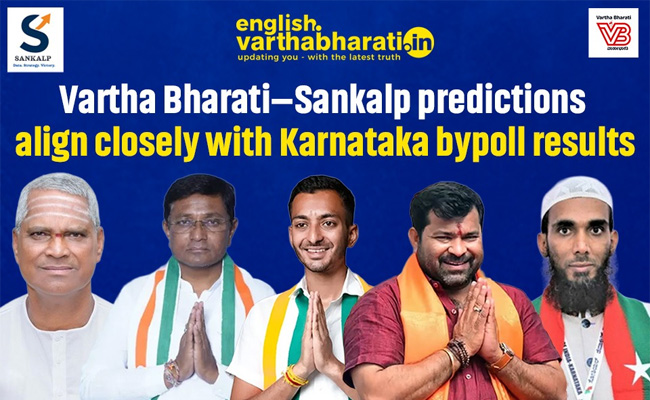
Bengaluru: The Vartha Bharati–Sankalp election analysis has shown a high level of accuracy in predicting the outcome of the recent Karnataka Assembly by-elections held in May 2026, correctly calling winners in both constituencies and closely estimating vote share trends.
The by-elections were held in Bagalkot and Davanagere South, drawing significant political attention as both seats were seen as key tests for the ruling Congress and opposition BJP.
According to the analysis, Vartha Bharati–Sankalp had made three major projections ahead of the results the winning party, vote share percentages, and margin of victory.
In both constituencies, the platform accurately predicted that the Congress would emerge victorious. The outcome matched the projections, with Congress candidates winning in Bagalkot and Davanagere South.
In terms of vote share, the predictions were largely in line with the final results. In Bagalkot, the BJP’s vote share was forecast in the range of 40 to 46 per cent, while the actual figure stood at 42.9 per cent. The Congress vote share, however, exceeded expectations, with the party securing 55.4 per cent against a projected range of 43 to 48 per cent.
The margin of victory in Bagalkot turned out to be significantly higher than anticipated. While the projection had placed the margin between 2,000 and 3,500 votes, the final margin was around 22,332 votes.
In Davanagere South, the predictions also remained largely accurate. The Congress vote share was projected between 43 and 51 per cent, and the final figure stood at 43.9 per cent. The BJP was expected to secure between 42 and 50 per cent but ended with 40.3 per cent.
The analysis had also identified the role of SDPI as a potential spoiler in the constituency. While its vote share was estimated around 6 per cent, the party eventually secured around 12 per cent of the vote.
The margin of victory in Davanagere South was predicted to be between 1,500 and 2,600 votes. The actual margin was higher at around 5,708 votes, though the contest remained relatively close as anticipated.
Overall, the performance of Vartha Bharati–Sankalp stood out for correctly identifying the winning parties in both seats and maintaining close accuracy in vote share estimates, with only limited deviations in specific cases.