Pro-Modi posts account for major chunk of fake news: BBC report
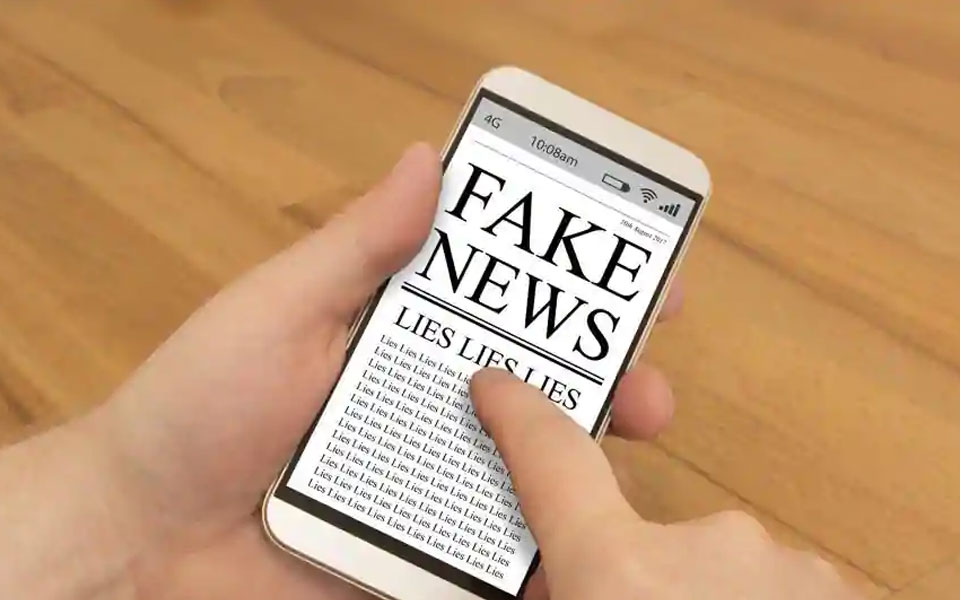
CHENNAI: A British Broadcasting Corporation report on fake news in the country suggests that pro-Modi political activity and fake news overlap, suggesting that the ruling party is actively and effectively peddling fake news about Prime Minister Narendra Modi across social media platforms such as Twitter, WhatsApp and Facebook.
In this end-to-end research initiative conducted by gaining access to phones from a wide demographic, the BBC found that fake news stories about India’s progress, Hindu power and revival of lost Hindu glory are widely being shared without fact-checking. It has been found that by sharing such messages, people feel like they are into nation-building.
“Whilst most discussion in the media has focussed on ‘fake news’ in the West, this piece of research gives strong evidence to suggest that a serious set of problems are emerging in the rest of the world where the idea of nation-building is trumping the truth when it comes to sharing stories on social media,” said Jamie Angus, Director, BBC World Service, in a release.
Interestingly, an overview of messages shared on WhatsApp alone suggests that almost 30 per cent of messages have a nationalistic flavour. Further, it has been found that more than two thirds of the messages considered to be nationalistic are about ‘cultural preservation’.
Speaking on challenges posed by fake news at the Beyond Fake News Conference organised by the BBC in the city on Monday, actor Prakash Raj attributed this phenomenon to the BJP. “They have intermingled nationalism, religion and patriotism and so they flood posts on social media blurring historical facts to push this agenda,” Prakash Raj said, drawing parallels to other majoritarian political propaganda and schemes over the last 100 years.
While BJP spokesperson Narayan Thirupathy, who also took part in the conference, denied that it was a BJP-driven agenda, big data analytics of networks within Twitter suggests that right wing sources of fake news are closely linked in comparison to left wing sources. This allows right-wing agenda to spread more effectively, thereby reaching a bigger audience.
Despite measures being taken by Google, Twitter and Facebook to combat fake news, activists and media leaders, who took part in the conference, agreed the onus was on the consumer to verify content that he or she receives on social media. “In this forest fire of fake news, the people who are trees are also responsible for the spread,” Prakash Raj said at the conference, encouraging, journalists and students to question a piece of information before forwarding it.
The conference also included a play by Theatre Nisha, highlighting the simple yet compulsive ways misinformation is spread on social media and advertising.
courtesy : newindianexpress.com
Let the Truth be known. If you read VB and like VB, please be a VB Supporter and Help us deliver the Truth to one and all.
EAM Jaishankar meets Jamaican PM, gifts over 10 BHISHM Cubes
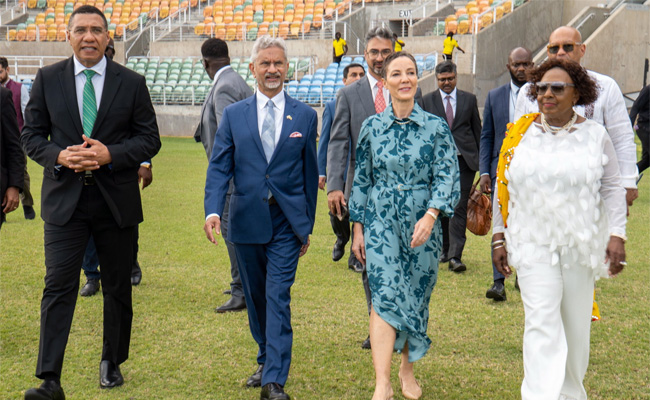
Kingston (PTI): External Affairs Minister S Jaishankar on Monday met Jamaican Prime Minister Andrew Holness and discussed ways to further deepen "political, economic and people-to-people cooperation."
Jaishankar also conveyed greetings from Prime Minister Narendra Modi to Holness.
"Pleased to call on Prime Minister @AndrewHolnessJM in Kingston. Conveyed the greetings of PM @narendramodi," Jaishankar posted on X.
"Discussed deepening our political, economic and people-to-people cooperation. Value his commitment towards further strengthening India-Jamaica relations," the post further read.
Also, the external affairs minister handed over 10 BHISHM (Bharat Health Initiative for Sahyog Hita & Maitri) Cubes as a gift to Jamaica.
"Formally handed over 10 BHISHM Cubes as a gift from India to Jamaica, in the presence of PM @AndrewHolnessJM, Health Minister @christufton and FM @kaminajsmith," Jaishankar posted on X.
"The BHISHM Cube mobile hospital system, designed for rapid deployment, will help Jamaica during disasters and emergencies. The gift of these cubes is a statement of friendship, a commitment to disaster preparedness, and an outcome of innovation," the post said.
Jaishankar arrived in Kingston on Saturday evening, marking the first leg of his nine-day tour of Jamaica, Suriname, and Trinidad and Tobago, aimed at further strengthening India's strategic and cultural ties with the Caribbean nations.
Earlier in the day, he interacted with the Indian diaspora and discussed India's ongoing transformation in infrastructure, human development and technology-driven governance and entrepreneurship with them.
He also highlighted the cricket bond between both countries as India gifted a scoreboard to Jamaica.
A scoreboard was dedicated at Sabina Park in Kingston. It is the home of the Jamaica cricket team and is the only Test cricket ground in the Caribbean island nation.
The minister expressed hope that the new scoreboard would witness many memorable innings, including those symbolising the enduring friendship between the two countries.
Cricket has long been a strong cultural bridge between India and Jamaica, which is part of the West Indies cricket team.
Jamaican players, including Chris Gayle, Courtney Walsh and Michael Holding, have played a major role in shaping the legacy of West Indies cricket in the international arena, contributing to its dominance in earlier decades and its continued global appeal.