Pro-talks faction of insurgent group ULFA signs peace accord with Centre
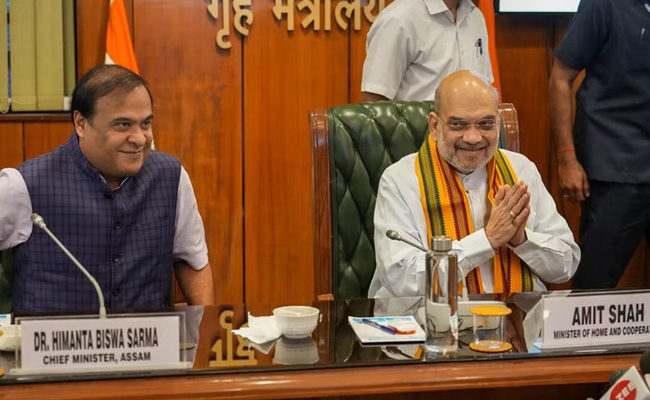
New Delhi (PTI): The pro-talks faction of the United Liberation Front of Asom (ULFA) on Friday signed a peace accord with the central and Assam governments, agreeing to shun violence, disband the organisation and join the democratic process.
Union Home Minister Amit Shah, who was present along with Assam Chief Minister Himanta Biswa Sarma at the signing of the accord here, said it was a very big day for the people of Assam.
"Assam has suffered for long due to the violence of the ULFA and 10,000 people lost their lives in this violence since 1979," he said.
Shah said the ULFA, the oldest insurgent group of Assam, agreed to abjure violence, disband the organisation and join the democratic process.
He said a big development package will be given to Assam as part of the accord. Every clause of the pact will be implemented fully, he said.
He said that now violence has come down in Assam by 87 per cent, deaths by 90 per cent and kidnappings by 84 per cent.
The chief minister termed the accord "historic" and said it has fructified due to the guidance and leadership of Prime Minister Narendra Modi and Home Minister Shah.
The accord came after 12 years of unconditional negotiations between the ULFA faction, led by Arabinda Rajkhowa, and the government, officials said.
The peace pact is expected to end decades-old insurgency in Assam.
However, the hardline faction of ULFA, headed by Paresh Baruah, is not a part of the agreement. Baruah is believed to be residing at a place along the China-Myanmar border.
The ULFA was formed in 1979 with the demand for a "sovereign Assam". Since then, it has been involved in subversive activities that led to the central government declaring it a banned outfit in 1990.
The Rajkhowa faction joined peace talks with the government on September 3, 2011 after an agreement for Suspension of Operations (SoO) was signed between the ULFA, central and state governments
Let the Truth be known. If you read VB and like VB, please be a VB Supporter and Help us deliver the Truth to one and all.
It's govt's responsibility to support youth who dare to dream: Omar Abdullah
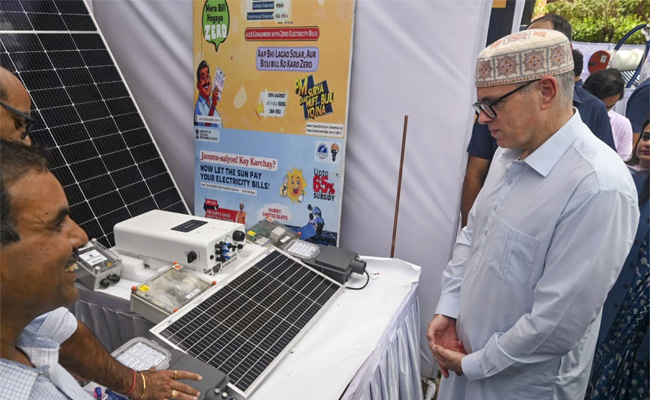
Jammu (PTI): Jammu and Kashmir Chief Minister Omar Abdullah on Monday said the government may not be able to provide jobs to everyone, but it can create an ecosystem for youngsters to become entrepreneurs and innovators.
It is the responsibility of the government to support youth who dare to dream, he said.
After inaugurating the 11th National Conference and Exhibition on Emerging and Innovative Trends in Engineering Technology (NCEEITET) at the Government College of Engineering and Technology (GCET) in Jammu, Abdullah said, “We may not be able to provide jobs to everyone, but we can certainly create an environment where our youngsters become entrepreneurs and innovators.”
The two-day conference is being organised by the GCET in collaboration with the Indian Institute of Technology-Kharagpur and the World University Consortium (WUC).
Addressing the gathering, Abdullah assured that all necessary steps would be taken to strengthen infrastructure and support systems at the GCET, ensuring that it continues to evolve as a premier institution.
The chief minister also inaugurated a new building for the School of Architecture in the college, built at Rs 19.71 crore.
Stressing the need to balance modernity with the region’s cultural and historical identity, Abdullah said, “Not every building needs to be made of glass and steel. Our structures must reflect our heritage and preserve our cultural ethos.”
Highlighting the role of emerging technologies such as artificial intelligence and machine learning, Abdullah said they could significantly improve tourism management, visitor experience and service delivery in Jammu and Kashmir.
However, he cautioned that technological advancement should complement human effort rather than replace jobs, especially in a region where unemployment remains a concern.
The chief minister said that attracting tourists to Jammu and Kashmir was not difficult, but ensuring repeat visits required consistently enriching experiences and better infrastructure across tourism segments, including pilgrimage, border and leisure tourism.
To address the infrastructure gaps in the college, Abdullah announced that funds would be provided this year for the construction of an auditorium.
He also assured support for setting up an incubation centre in GCET.
During the event, Abdullah also released the e-proceedings of the conference, comprising 28 shortlisted research papers.