Protest flags, slogans and marches as farmers observe ''black day'' to mark 6 months of stir
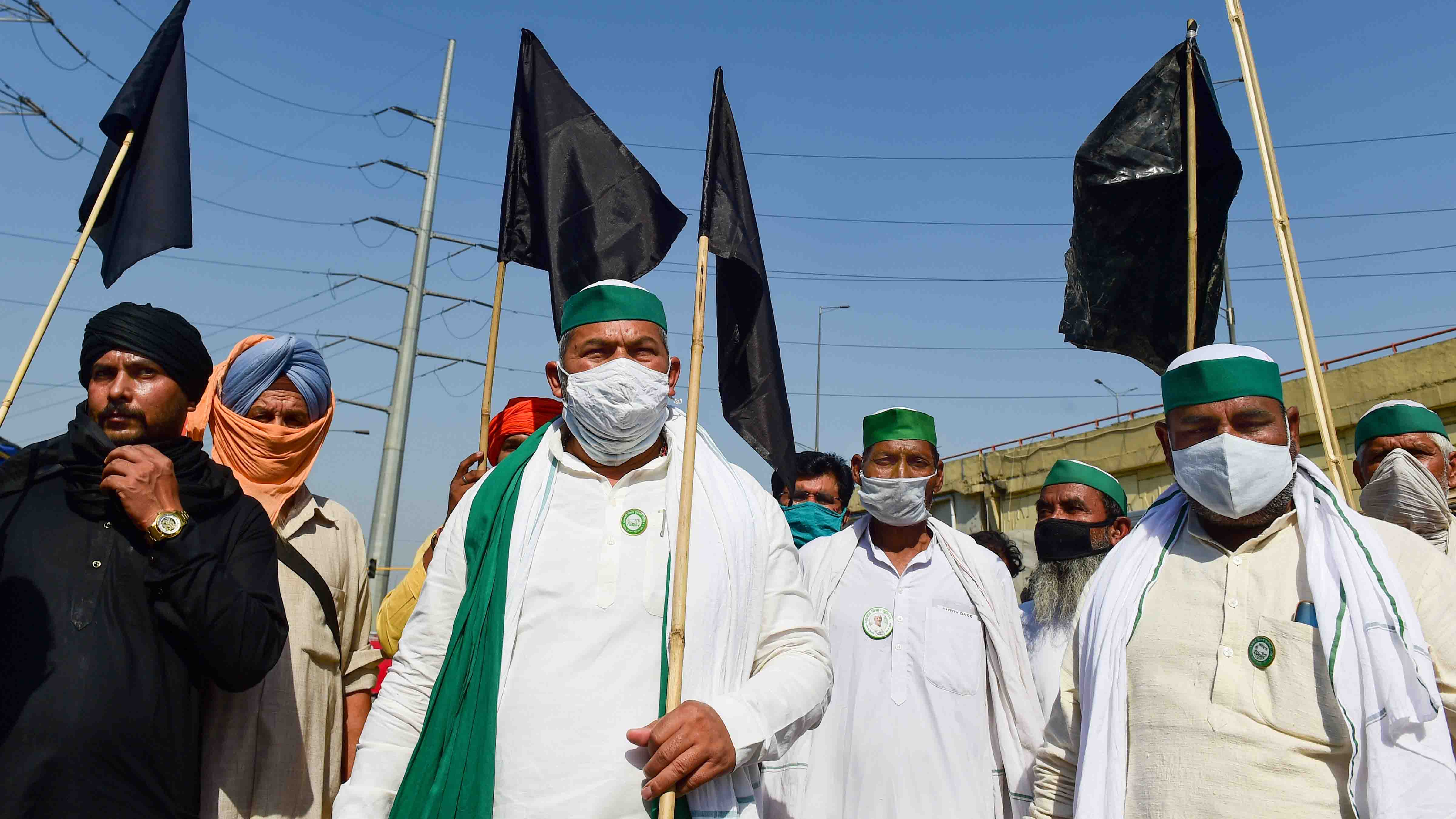
New Delhi, May 26: Farmers agitating at three Delhi border points raised black flags, shouted anti-government slogans, burnt effigies and took out protest marches as they observed 'black day' on Wednesday to mark the completion of six months of their stir against the three Central agri laws.
A brief ruckus was also reported from the Ghazipur protest site where farmers burnt an effigy of the central government amid heavy police deployment.
As part of their 'black day' protest, the farmers put up black flags and burnt effigies of government leaders at the three border points -- Singhu, Ghazipur and Tikri -- to register their protest against the three laws as well as the Centre.
The Delhi Police has urged people not to hold gatherings due to the COVID-19 situation and the ongoing lockdown and said it is keeping a tight vigil to deal with any situation at the protest sites.
Senior farmer leader Avtar Singh Mehma said that black flags have been hoisted not only at the protest sites but also in villages in Haryana, Punjab and Uttar Pradesh, adding that villagers have put up black flags atop their houses as well as on their vehicles.
"Effigies of government leaders were burnt. This day is to reiterate the fact that it has been six months since we have been protesting, but the government, which also completes seven years in office today, is not listening to us," said Mehma.
All those in solidarity of their movement also donned black turbans and dupattas.
At the Singhu border, protestors gathered at the Kajaria Tiles office, held meetings, and took out a march towards the stage.
Farmer leader Kulwant Singh said, "The protesters took out a march carrying black flags. They burnt Prime Minister Narendra Modi's effigy while raising slogans against the three farm laws.
"We are urging people to support farmers by putting black flag at their residence and other places," he said.
On Tuesday, the National Human Rights Commission (NHRC) had issued notices to Delhi, UP, Haryana on alleged flouting of COVID norms by the protesting farmers.
The Delhi Police too had urged people not to hold gatherings due to the COVID-19 situation and the ongoing lockdown.
However, Mehma said that the government shouldn't have introduced the three laws during the pandemic in the first place.
"If the government wants us to go back then it should listen to us and repeal the laws, because we are not going anywhere unless our demands are met.
"It is not our hobby to sit in the heat and the cold at the borders. We also want to go back home and be safe," the farmer leader told PTI.
Police force has been in place at all the borders points, including the protest sites of Singhu, Tikri and Ghazipur, since Tuesday.
At Ghazipur on the Delhi-Uttar Pradesh border, hundreds of farmers, led by Bharatiya Kisan Union (BKU) leader Rakesh Tikait, converged into groups as they burnt an effigy of the Centre in protest.
A ruckus briefly ensued between protestors and the local police, donning anti-riot gears, who had tried to stop them from burning the effigy at the UP Gate below the Delhi-Meerut Expressway.
While many BKU supporters held black flags in their hands, several others had placards that condemned the government and demanded withdrawal of the contentious laws, even as COVID-19 protocols on social distancing and face masks were largely amiss at the site.
Tikait, who has been leading the protest at Ghazipur since November 2020 and had become a prominent face of the protest after the January 26 violence in Delhi, was seen sporting a black-colour turban and a black flag.
The influential BKU spokesperson from western Uttar Pradesh was credited with reviving the protest that had lost sheen after the January 26 violence with his emotional pull that overnight drew support for the farmers on Delhi's outskirts.
Thousands of protesting farmers reached Delhi borders on November 26 last year to protest against the Centre's three new farm laws.
Let the Truth be known. If you read VB and like VB, please be a VB Supporter and Help us deliver the Truth to one and all.
Sujit Nair raises concerns over speculation of DMK-AIADMK understanding to block TVK
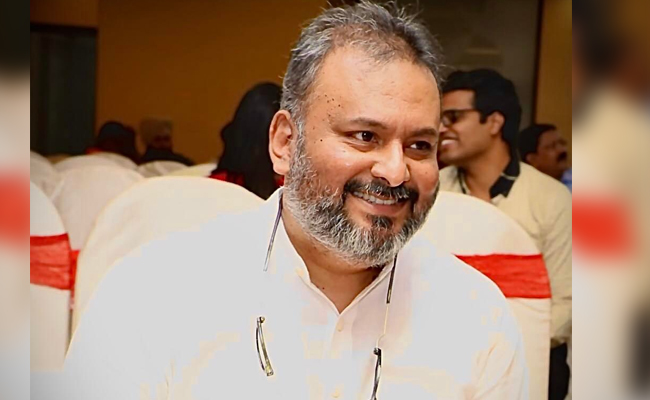
Chennai: Journalist and political commentator Sujit Nair has expressed concern over speculation that the Dravida Munnetra Kazhagam and the All India Anna Dravida Munnetra Kazhagam could explore a post-poll understanding to prevent Vijay-led Tamilaga Vettri Kazhagam from forming the government in Tamil Nadu.
In a social media post, Sujit Nair said the election verdict in Tamil Nadu reflected a clear public demand for political change and argued that the mandate should be respected irrespective of political preferences.
Referring to reports and political discussions surrounding a possible understanding between the DMK and AIADMK, he said he hoped such developments remained only speculative conversations and did not turn into reality.
Nair stated that if such an alliance were to take shape, it would raise serious questions about ideological politics in the country. He said TVK had emerged through a democratic electoral process and that the legitimacy to govern in a parliamentary democracy comes from the people’s verdict.
According to him, attempts to prevent an electoral winner from forming the government through unexpected political arrangements may be constitutionally valid, but many people could view them as politically opportunistic.
He further said that such a move could particularly affect the political image of the DMK, which has historically projected itself around ideology, social justice and opposition politics. Nair said that in ideological terms, the DMK appeared closer to TVK than to the AIADMK, and joining hands with its long-time political rival only to remain in power could weaken its broader political narrative.
He added that the same questions would apply to the AIADMK as well, as the party had spent decades positioning itself against the DMK and such an arrangement could create discomfort among its cadre and supporters.
Drawing a comparison with Maharashtra politics in 2019, Nair said he had expressed similar views when the Shiv Sena formed an alliance with the Indian National Congress and the Nationalist Congress Party after the Assembly elections.
He said post-poll alliances between long-standing political rivals often create a public perception that ideology and electoral mandates become secondary when political power equations come into play.
Nair also said such developments increase public cynicism towards politics and reinforce the belief among voters that ideology is often sidelined after elections.
He maintained that the Tamil Nadu verdict was emphatic and said respecting both the spirit and substance of the mandate was important for the credibility of democratic politics.