PSLC-C45 carrying India's EMISAT and 28 foreign satellites lifts off
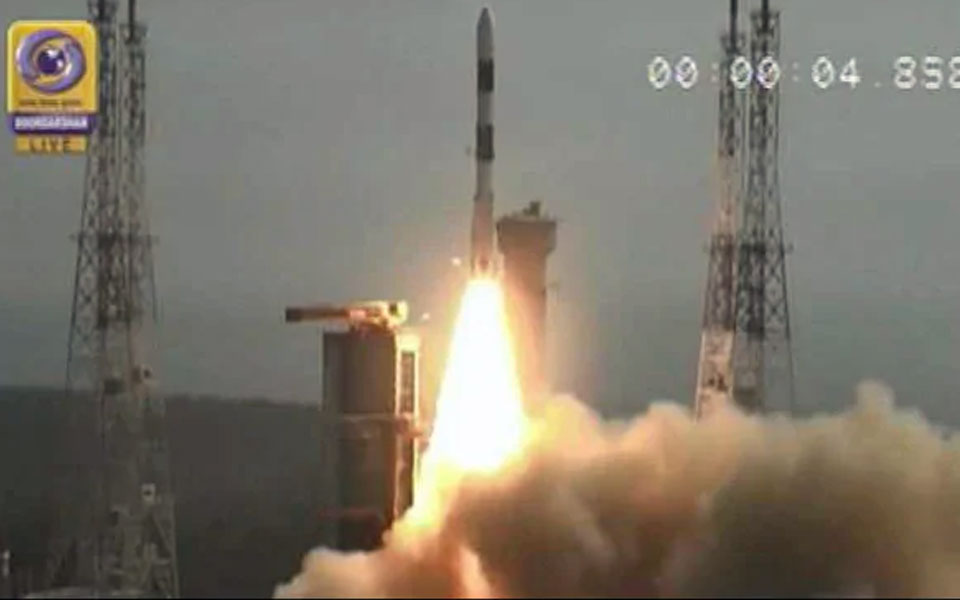
Sriharikota:ISRO's PSLV C45 lifted off from the Satish Dhawan Space Centre here on Monday, carrying India's EMISAT satellite along with 28 nano satellites of global customers.
As the 27-hour countdown concluded, the nearly 50-metre tall rocket, a new variant of ISRO's trusted work horse PSLV-QL, blasted off from the second launch pad at the spaceport of Sriharikota, about 125 km from here, at 9.27 am.
The EMISAT satellite is aimed at electromagnetic measurement.
The mission marks several firsts to the credit of the space agency as it would manoeuvre satellites in various orbits and orbital experiments, including on maritime satellite applications.
According to ISRO, a new variant of the rocket PSLV-QL equipped with four Strap-On motors in the first stage is used for the launch.
PSLV, also used in India's two key missions, "Chandrayan" in 2008 and Mars Orbiter in 2013, is a reliable and versatile launch vehicle for ISRO with 39 consecutive successful flights till June, 2017 and five-in-a-row from January 2018.
The rocket has encountered only two failures so far, its maiden developmental flight ended unsuccessful way back in 1993.
In September, 2017, the flight went off without any hitch but the IRNSS-1H Satellite could not be released into orbit after the PSLV-C39's heat shield failed to open on reaching the orbit.
In this mission, ISRO scientists would place the satellites and payloads in three different orbits, a first for the agency.
After injecting the 436 kg primary satellite EMISAT, intended for electromagnetic spectrum measurement, at around 17 minutes from lift off in a 749 km orbit, they would restart the fourth stage again.
ISRO said this was the first time it has been envisaged to provide a micro-gravity environment for research organisations and academic institutes to perform experiments.
The PS4-fourth stage hosts three payloads in this mission. They are automatic identification system from ISRO for maritime satellite applications capturing messages transmitted from ships.
Automatic Packet Repeating System from AMSAT (Radio Amateur Satellite Corporation), India to assist amateur radio operators in tracking and monitoring position data.
Advanced Retarding Potential Analyzer for lonospheric Studies (ARIS) from Indian Institute of Space Science and Technology (IIST) for the structural and composition studies of ionosphere.
The other 28 international satellites -- 25 3U type, two 6U type and one 2U type nano satellites -- are from Lithuania (two), Spain (one), Switzerland (one) and the United States (24).
All these satellites are being launched under commercial arrangements, the ISRO said.
In February, ISRO launched India's communication satellite GSAT-31 from the European launch service provider Ariane from French Guiana.
Let the Truth be known. If you read VB and like VB, please be a VB Supporter and Help us deliver the Truth to one and all.
Vijay''s TVK wins an impressive 108 seats in TN polls

Chennai (PTI): Vijay-led TVK secured an impressive 108 seats trouncing the incumbent DMK led by M K Stalin which finished with only 59 seats in the Tamil Nadu Assembly elections held on April 23, as per the final tally of the ECI on Tuesday.
The opposition AIADMK won 47 seats while its allies the PMK obtained 4 and the BJP and AMMK clinched one seat each respectively in the election, according to the data available on the Election commission of India's website.
The DMK's allies - the Congress managed to win 5 seats, the IUML, CPI, CPI (M), and VCK: 2 each and DMDK secured one seat, among a total of 234 Assembly constituencies in the state.
The votes were taken up for counting on May 4 and the final tally was announced on Tuesday.
Actor-politician Vijay's Tamilaga Vettri Kazhagam on Monday created a record of sorts in the electoral history of Tamil Nadu and emerged as the single largest party by delivering a shock defeat to DMK and its president Stalin in his Kolathur constituency, while the AIADMK was pushed to a distant third spot.
Vijay won from both Perambur and Tiruchirappalli East constituencies.
The TVK has clocked nearly 35 per cent (34.92) vote share in its debut polls.
This will be the first time in Tamil Nadu that a party will assume power a little over two years after its founding in February 2024.