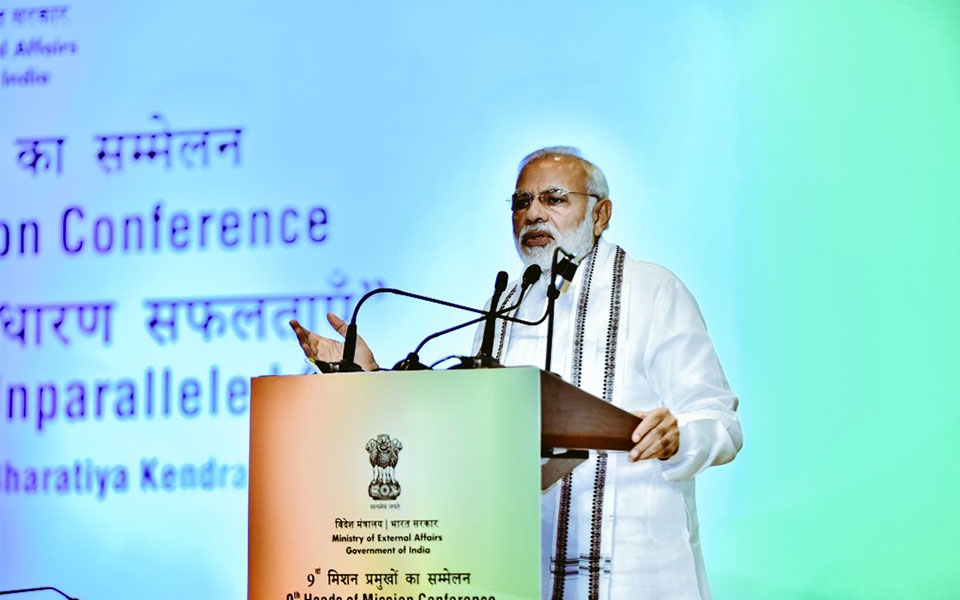
New Delhi, July 2: The NDA government in 2014 had got the economy in a much worse condition than expected, so much so that making its details public would have been widely damaging for the country, Prime Minister Narendra Modi has said, stressing that his government worked hard to bring the economy back on track bit by bit.

In an interview with the "Swarajya" magazine published on Monday, Modi also debunked the opposition's allegation of "jobless growth", pointing out that if state governments had been claiming of creating lakhs of jobs, how could one say the Centre was creating joblessness.

Asked why his government did not bring out a White Paper on Indian economy in 2014, as was being expected by many, Modi said: "The details about the decay in the Indian economy were unbelievable. It had the potential to cause a crisis all over. In 2014, the industry was leaving India. India was in the Fragile Five. Experts believed that the ‘I' in BRICS would collapse. Public sentiment was that of disappointment and pessimism.

"Now, in the midst of this, imagine a White Paper coming out giving intricate details of the extent of damage. Instead of being a mollifier, it would be a multiplier of the distress."

The Prime Minister said what the new government led by him saw (of the economy's condition) left them "shocked" as things were "terrible" and even the budget figures were "suspicious".

He said there were several "landmines" laid in various sectors and his government accepted this uncomfortable truth and hit the ground running from the very first day to stabilise things so that the Indian economy could be strengthened for the long haul.

Modi said the positive results of government's approach are for everyone to see.

"Today, India is the fastest growing large economy of the world with strong fundamentals to propel further growth. Foreign investment is at an all-time high, GST has revolutionised the tax regime, India is an easier place to do business than ever before and, most importantly, we are seeing unprecedented levels of trust and optimism," he said.

On the lack of jobs -- something that the opposition has been vociferously alleging to corner the government, Modi blamed a "lack of consistency" in the political debate around job creation.

"We have data put out by state governments on employment. For example, the previous Karnataka government claimed to have created 53 lakh jobs. The West Bengal government said it created 68 lakh jobs in the last term. 

"Now, if states are all creating a good number of jobs, is it possible that the country is not creating jobs? Is it possible that states are creating jobs but the Centre is creating joblessness?" Modi asked.

He said that more than a lack of jobs, the issue was a lack of data on jobs.

"Our opponents will naturally exploit this opportunity to paint a picture of their choice and blame us...no one has an accurate data on jobs," Modi said.

He said that the traditional matrix of measuring jobs is "simply not good enough to measure new jobs in the new economy of New India".

"For example, there are close to three lakh village-level entrepreneurs who are running Common Service Centres across the country and also creating more employment. Start-ups are working as job multipliers and there are around 15,000 start-ups which the government has helped in some way, and many more will be operational. Aggregators of various kinds employ thousands of youth.

"If we look at numbers for employment, more than 41 lakh formal jobs were created from September 2017 to April 2018 based on EPFO payroll data," Modi said.

The Prime Minister pointed out that job creation in the formal sector could have a "spinoff effect" on job creation in the informal sector too, which constitutes "around 80 per cent of all jobs". 

He also reiterated that his government had a "four-pronged strategy" to double farmers' income -- decrease the input costs, ensure proper prices for the produce, ensure minimal harvest and post-harvest losses, and create more avenues for income generation.

"Not only will the farmers get minimum support price of 1.5 times their cost, they also have more avenues to get the right price with the help of e-NAM (the electronic National Agricultural Market, which provides price, production and market information to farmers)," Modi added.

Let the Truth be known. If you read VB and like VB, please be a VB Supporter and Help us deliver the Truth to one and all.


Kathmandu (PTI): Rapper-turned-politician Balendra Shah's RSP is all set to form the next government in Nepal after securing sweeping victory in crucial general elections on Saturday, decimating the established parties in the politically fragile nation.

Popularly known as Balen, the 35-year-old prime ministerial candidate of the Rastriya Swatantra Party (RSP) defeated four-time prime minister KP Sharma Oli, the chair of Nepal's legacy party, the Communist Party of Nepal (Unified Marxist–Leninist) -- CPN-UML -- by a huge margin of about 50,000 votes in Jhapa-5 constituency.

Balen, 35, secured 68,348 votes against 74-year-old Oli's 18,734, the Election Commission (EC) said.

He is expected to be the next prime minister of Nepal, reflecting a public mood of rejection of established parties. The RSP, which was formed in 2022 by Ravi Lamichhane, has won 72 seats out of the 90 seats for which results were declared by 9:30 pm, according to the Election Commission (EC).

RSP's seats include a clean sweep in all 10 constituencies of Kathmandu district even as it is leading in 52 seats across the country, the EC data showed.

Legacy parties failed to convince voters for whom the major issues included fighting corruption and an end to nepotism apart from a generational change in political leadership of the Himalayan nation.

The Nepali Congress (NC) won 10 and was leading in eight seats; the CPN-(UML) won just four seats and is leading in eight; the Nepali Communist Party (NCP) won two seats and is leading in five, the Shrama Shakti Party (SSP) was leading in three seats, and the Rastriya Prajatantra Party (RPP) won one seat, the EC data showed. Among the winners is one independent.

Nepal witnessed about 60 per cent voter turnout during the March 5 elections to the House of Representatives. The counting of votes started late Thursday night and as of 9:30 pm Saturday, counting was in progress in the remaining of the total 165 constituencies, the Election Commission said.

The election was being closely watched by India, which is hoping for a stable government in the politically fragile Himalayan nation to take forward the developmental partnership between the two sides.

Prime Minister Narendra Modi on Saturday congratulated the people and government of Nepal for the successful conduct of elections. “It is heartening to see my Nepali sisters and brothers exercise their democratic rights so vibrantly. This historic milestone is a proud moment in Nepal's democratic journey,” Modi said in a post on X.

Modi also said that as a close friend and neighbour, India remains steadfast in its commitment to working closely with the people of Nepal and its new government to scale new heights of shared peace, progress and prosperity.

Oli, who too was projected as the PM face of the CPN-UML, wished Balen for a full five year tenure for his government in the Himalayan nation that has seen 14 governments in the last 18 years.

“Balen babu, congratulations for the victory. I wish your five year tenure be trouble free, successful and hearty congratulations,” Oli wrote in his social media post and attached a 2022 photo showing him gifting a tabla to Balen after the rapper-turned-politician won Kathmandu mayor's election as an independent.

The RSP, which projected Balendra Shah 'Balen' as its prime ministerial candidate and had organised its first election campaign in Janakpur in Madhesh, is heading towards a clean sweep of the province.

‘Balen’, as he is popularly known, projected himself as the “son of Madhesh” during the campaign, with the party launching the campaign with 'Ab ki bar Balendra Sarkar' (This time there will be Balendra’s government) tagline.

Of the total 32 seats in eight districts of Madhesh province, the RSP has won eight and is leading in 22 other constituencies, the EC said.

The party is also making a clean sweep in the Kathmandu Valley winning all 10 seats of Kathmandu district and two in Bhaktapur and two in Lalitpur district.

The party is also leading in the remaining one seat of the Kathmandu Valley with a huge margin, possibly as a result of a massive road show led by Balen in all 15 constituencies on the last day of the election campaign.

RSP chairman Lamichhane won with a huge margin from Chitwan-2 constituency, marking his third consecutive victory with 54,402 votes against his nearest rival NC's Mina Kumari Kharel, who received 14,564 votes.

According to the Election Commission, former prime minister and NCP leader Pushpa Kamal Dahal Prachanda won from Rukum Purba district by securing 10,240 votes against his rival Lilamani Gautam of CPN-(UML), who got 3,462 votes.

RPP's Gyanendra Shahi won from the Jumla constituency of Karnali province by defeating his closest rival Naresh Bhandari of the NCP and became the only candidate of the pro-monarchist RPP to have secured a seat in the House of Representatives.

The election also saw 10 women candidates win, nine of them from the RSP while one from NC.

Meanwhile, the RSP is also leading in proportional voting system with the party bagging 474,266 votes followed by Nepali Congress with 160,384. The CPN (UML) has received 127,841, Nepali Communist Party 65,363, the RPP 34,154, and Shrama Shakti Party 17,437 votes till now.

Out of a total of 275 members of the Parliament, 165 are being elected through direct voting, while the remaining 110 through a proportionate method.

Around 3,400 candidates were vying for 165 seats under direct voting, and 3,135 candidates for 110 seats through proportionate voting.

The Gen Z youth, through their two-day intensified protests on September 8 and 9 last year, ousted Prime Minister Oli of the CPN-(UML), who was heading a coalition government with the backing of Nepali Congress that enjoyed nearly two-thirds majority support.

Though Balen was a popular choice to lead the interim government after Oli's ouster, he declined to lead the interim administration, saying he would prefer to contest the parliamentary election for a full term.

In January, he joined the RSP and was soon declared the party's prime ministerial candidate.

The major issues raised by Gen Z before and during the election campaign were anti-corruption, good governance, an end to nepotism, generational change in political leadership, etc.

Sunil Babu Pant, former MP and a political analyst, said, “The victory of Rastriya Swatantra Party in the March 5 elections and the expectation that Balen Shah could emerge as Nepal's next Prime Minister reflects the people's deep rooted frustration with the old political order and their hope for a new direction.”

“As Balen assumes the country's leadership, his first responsibility must be to demonstrate that corruption will not be tolerated under any circumstances,” he said.

Balen will also face a complex geopolitical challenge, Pant said, adding, “He must prove that he is not a puppet of any external power, western or otherwise. Nepal's leadership must carefully balance relations with all global actors and pursue an independent foreign policy that prioritises the national interest.”