Punjab Speaker seeks Sushma's intervention
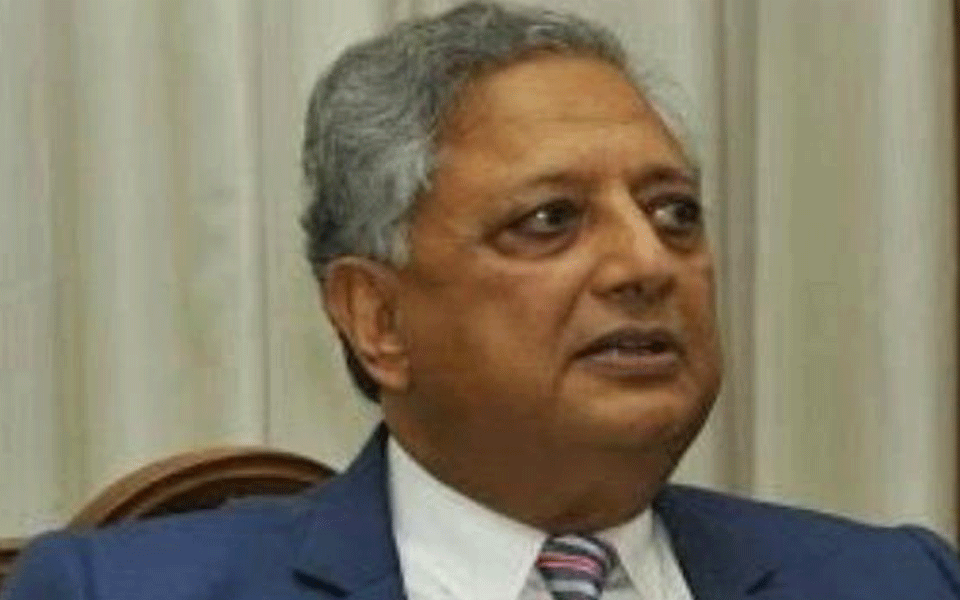
Chandigarh, July 28 : Punjab Assembly Speaker Rana K.P. Singh has written to External Affairs Minister Sushma Swaraj over Canada declining entry to two AAP legislators.
"All legislative bodies of India and Canada are branches of the Commonwealth Parliamentary Association (CPA) and members of the legislative bodies in both the countries are members of CPA," the Speaker wrote.
"On the one hand, we strive for increasing CPA activities and, on the other, our MLAs or public representatives are treated differently and humiliated," he said.
The Speaker said when the public representatives had disclosed their identity at the Ottawa Airport, the Canadian authorities must have facilitated them.
"I request you to take cognizance of this incident and take up this matter with the appropriate authorities of the Canadian government so that public representatives from our country are not subjected to such type of untoward and humiliating incidents in future."
Refused entry to Canada, both Aam Aadmi Party (AAP) legislators Kultar Singh Sandhwan and Amarjit Singh Sandoa returned home this week.
Let the Truth be known. If you read VB and like VB, please be a VB Supporter and Help us deliver the Truth to one and all.
Emotional tributes paid to cops killed in blast at gunpowder dump of Maoists in Chhattisgarh
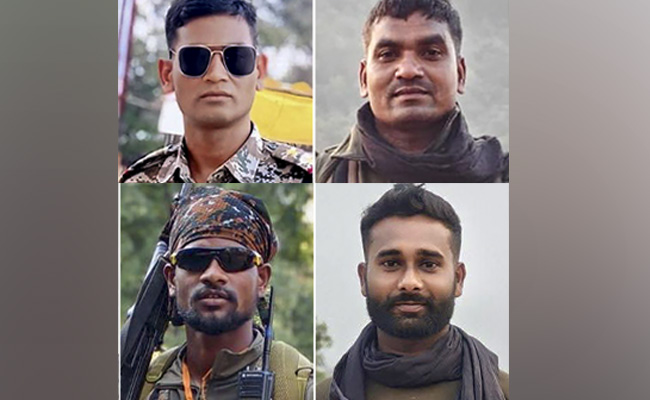
Narayanpur (Chhattisgarh) (PTI): Emotional scenes were witnessed on Sunday as wreaths were laid on the mortal remains of three of the four police personnel killed in an explosion in a gunpowder dump of Maoists in Chhattisgarh's Kanker district.
The grieving family members were inconsolable, while security personnel tried to comfort them.
Amid chants of "Bharat Mata ki Jai" and "Vande Mataram," public representatives, along with senior police and administrative officials, paid tributes to the deceased personnel.
The wreath-laying ceremony to pay homage to Inspector Sukhram Vatti (40), constables Krishna Komra (35) and Sanjay Gadhpale (29), killed in the explosion on Saturday, was held at the Police Lines in Narayanpur district, neighbouring Kanker.
The mortal remains of constable Parmanand Komra (29), who succumbed to injuries during treatment in Raipur, will be shifted to Kanker, where a separate wreath-laying ceremony will be held, police said.
Inspector General of Police, Bastar Range, Sundarraj Pattilingam, after paying homage, told reporters that the four police personnel made the supreme sacrifice while protecting the region.
"I pay my homage to them," he added.
The four personnel were killed while they were attempting to dispose of a gunpowder dump hidden earlier by Maoists in a forest near Aadnar village under Chhotebethiya police station limits in Kanker district, according to police.
It was the first explosion linked to Naxalites in the state since it was declared free from armed Maoists on March 31, and also the first instance this year in which security personnel engaged in anti-Naxal operations lost their lives.
District Reserve Guard (DRG) official Vatti, who was leading the team, hailed from Bijapur district. Constable Krishna Komra of the district force and constables Gadhpale and Parmanand Komra of the Bastar Fighters were residents of different villages in Kanker.