PV Sindhu surrenders to Okuhara in Singapore semifinals

Singapore: P V Sindhu looked awfully out of form as she surrendered without a fight to former world champion Japan's Nozomi Okuhara in the women's singles semifinals to draw curtains on India's campaign at the Singapore Open here on Saturday.
Sindhu, a Rio Olympics silver medallist, lost 7-21 11-21 to world no. 3 Okuhara in a lop-sided contest.
Sindhu had won the last two times they played each other and overall enjoyed a slight 7-6 advantage in the head-to-head record with Okuhara.
The duo had played an epic final at 2017 World Championship that had clocked 110 minutes and is considered one of the best women's singles match in the history of badminton.
Since that marathon World Championship final, Sindhu and Okuhara have played each other six times and the Indian won four times.
But Saturday, Sindhu looked completely out of sort as just 15 minutes into the match and she was crestfallen after meekly surrendering the first game following a heap of unforced errors, mainly at the net and sidelines.
While in-form Okuhara showed great control, Sindhu looked low in confidence and lacked the patience to engage her rival in long rallies.
After the change of sides, Sindhu lagged 1-3 but she recovered to made it 4-4. Okuhara then changed the pace of the rallies and gathered six straight points, which included two precise lifts at the backline and also a prompt net return.
The Japanese reached 11-5 at the interval.
With Sindhu continuing to commit simple errors, which included missing the lines and finding the net too often, Okuhara dominated the proceedings, gathering points at will.
Okuhara kept the pressure on Sindhu and eventually a round-the-head cross court return took her to 18-8.
Four wide shots delayed the inevitable before Okuhara grabbed nine match points with another superb cross court smash. Another cross court return and she sealed her place in the final.
Okuhara will face world no 1 Chinese Taipei's Tai Tzu Ying, who quite incredibly saved five match points to take the match against Akane yamaguchi to the decider and then came up trumps.
She won 15-21 24-22 21-19 in a 57-minute clash with Yamaguchi to enter the finals.
Let the Truth be known. If you read VB and like VB, please be a VB Supporter and Help us deliver the Truth to one and all.
CM Siddaramaiah alleges ‘criminal conspiracy’ in Sringeri recount, vows legal action
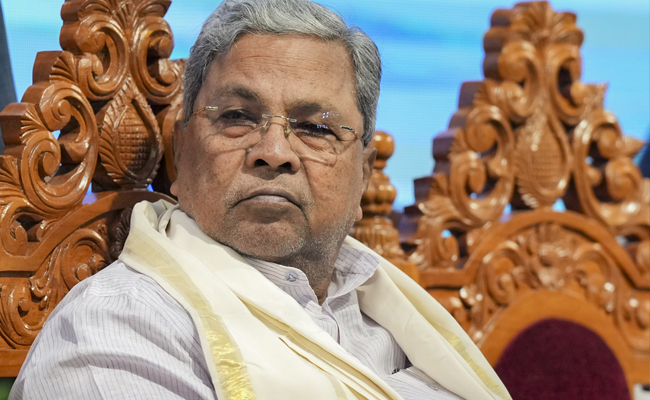
Bengaluru (PTI): Alleging a “criminal conspiracy” by BJP candidate D N Jeevaraj in the Sringeri Assembly poll recounting, Karnataka CM Siddaramaiah on Tuesday said the outcome was manipulated after valid postal ballot votes in favour of Congress leader T D Raje Gowda were tampered with during the recounting process.
Following a Karnataka High Court order on an election petition filed by Jeevaraj, challenging Raje Gowda’s election, the reverification and recounting were conducted on Saturday.
After the reverification and recount of postal ballots for the Sringeri Assembly constituency, votes polled in favour of Raje Gowda were reduced by 255, the returning officer said.
A report on the matter has been submitted to the Election Commission of India for further action, the officer added.
Congress leader Raje Gowda had won the 2023 Assembly polls from Sringeri by 201 votes, defeating his nearest rival Jeevaraj.
Addressing a press conference in Bengaluru, Siddaramaiah said the High Court had directed the recounting of postal ballots and that irregularities were noticed during the exercise conducted on May 2.
“This is a clear case of criminal conspiracy,” Siddaramaiah said, alleging that valid votes cast in favour of Raje Gowda were altered after being accepted by counting agents of all parties, including Congress, BJP, and JD(S).
He claimed that during the recounting of postal ballots, 255 votes were initially accepted as valid by all agents but were later tampered with by subordinate officials.
“There is a second mark on the votes polled in favour of Raje Gowda. They had accepted these as valid votes. Subsequently, another mark was made by officials. This is a clear case of criminal conspiracy,” he said.
When asked who was behind the alleged conspiracy, the CM replied, “It was hatched by Jeevaraj and others. It is planned.”
Siddaramaiah further alleged that the returning officer acted improperly by declaring the result despite the presence of an Election Commission observer during the recounting.
“Immediately after the counting, the returning officer announced the result. He should not have done so; this is against the law,” he said.
He pointed out that Raje Gowda had originally won by 201 votes, but after the recounting, the BJP candidate was declared the winner by 52 votes.
“The BJP has committed a criminal act of conspiracy. This is not vote chori but vote dacoity,” he alleged.
The CM said a police complaint had already been filed by Raje Gowda’s election agent, Sudhir Kumar, and emphasised the need for electoral integrity.
“We want transparency and free and fair elections. That is what our Constitution mandates,” he added.
Stating that the government would pursue legal remedies, Siddaramaiah said, “We are preparing an appeal challenging the returning officer’s announcement in a court of law.”
Responding to a separate query on elections in other states, the CM said there appeared to be an anti-incumbency factor in West Bengal, while results in Tamil Nadu were “surprising,” adding that Vijay’s party was emerging as the largest there.
Following the victory of party candidates in Bagalkote and Davanagere South, Siddaramaiah expressed confidence about future electoral prospects in Karnataka.
“Even in 2028, we will win the Assembly elections. We will come back,” the CM said.
Siddaramaiah added that he would order a forensic examination into the alleged tampering of postal ballots.