R-Day honours: Ashoka Chakra for space hero Shubhanshu Shukla
Shaurya Chakra for 2 women Navy officers
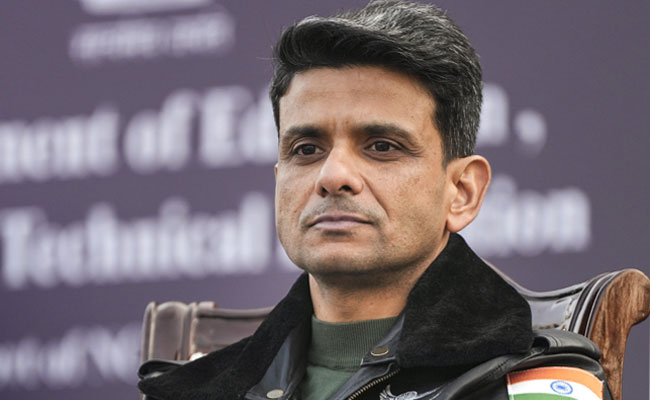
New Delhi (PTI): Group Captain Shubhanshu Shukla, who created history by becoming the first Indian to set foot on the International Space Station (ISS), was on Sunday awarded the Ashoka Chakra, India's highest peacetime gallantry award.
In June last year, Shukla became the second Indian to have gone to space and the first to visit the ISS as part of the historic Axiom-4 mission. His 18-day space odyssey came 41 years after cosmonaut Rakesh Sharma flew aboard the Russian Soyuz-11 space mission.
On the eve of the Republic Day, President Droupadi Murmu approved gallantry awards to 70 armed forces personnel, including six who would receive the honour posthumously.
These include one Ashoka Chakra, three Kirti Chakra, 13 Shaurya Chakra, including one posthumous, one Bar to Sena Medal (gallantry), 44 Sena Medals (gallantry), six Nao Sena Medals (gallantry) and two Vayu Sena Medals.
Two women officers of the Indian Navy -- Lieutenant Commander Dilna K and Lieutenant Commander Roopa A -- were honoured with the Shaurya Chakra award, months after they made history by completing an extraordinary expedition to circumnavigate the globe, covering 21,600 nautical miles (approx 40,000 km) over an eight-month period onboard Indian Naval Sailing Vessel (INSV) Tarini.
The Shaurya Chakra is India's third-highest peacetime gallantry award after the Ashoka Chakra and the Kirti Chakra.
The Kirti Chakra has been conferred on Major Arshdeep Singh from 1 Assam Rifles, Naib Subedar Doleshwar Subba from 2 Para (Special Forces) and Group Captain Prashanth Balakrishnan Nair.
Nair was one of the four astronauts who underwent training for India's first human spaceflight mission, Gaganyaan.
The decision to confer the Ashoka Chakra on Shukla is seen as the government's recognition of the importance of the space sector as the coveted honour is generally bestowed on military personnel for showing "most conspicuous bravery".
As a fighter pilot, Shukla has an impressive record of 2,000 hours of flight experience across various aircraft, including the Su-30 MKI, MiG-21, MiG-29, Jaguar, Hawk, Dornier and An-32.
Shukla served as the pilot for the Axiom Mission-4 (Ax-4) to the ISS and left an indelible mark on India's remarkable advancements in human space exploration.
After the successful space mission, Shukla became a household name as his contributions during the mission, including the conduct of sophisticated experiments, received recognition from global space experts.
The Axiom-4 mission was executed by US-based private firm Axiom Space and it involved the National Aeronautics and Space Administration (NASA), the European Space Agency (ESA) and the Indian Space Research Organisation (ISRO).
Shukla hails from Lucknow. He was commissioned into the fighter stream of the Indian Air Force in June 2006.
Of the 13 Shaurya Chakra awards, 10 were conferred on Army personnel (one posthumous), two went to the Navy and one to a paramilitary official.
The Shaurya Chakra awardees are Lieutenant Colonel Ghatage Aditya Shrikumar from 21 Para (special forces), Major Anshul Baltoo from 32 Assam Rifles, Major Shivkant Yadav from 5 Para (special forces), Major Vivek Mech from 42 Rashtriya Rifles, Major Leishangthem Deepak Singh from 11 Para (special forces) and Captain Yogendra Singh Thaku from 6 Para (special forces).
Subedar P H Moses from 1 Assam Rifles, Baldev Chand (posthumous) from 4 Rashtriya Rifles, Rifleman Manglem Sang Vaiphei from 3 Assam Rifles and Rifleman Dhruba Jyoti Dutta from 33 Assam Rifles were the other recipients of the Shaurya Chakra from the Army.
The president also approved 301 military decorations to armed forces and other personnel.
These include 30 Param Vishisht Seva Medals, four Uttam Yudh Seva Medals, 56 Ati Vishisht Seva Medals, nine Yudh Seva Medals, two Bar to Sena Medals (Distinguished), 43 Sena Medals (Distinguished), eight Nao Sena Medals (Distinguished), 14 Vayu Sena Medals (Distinguished) and 135 Vishisht Seva Medals.
Let the Truth be known. If you read VB and like VB, please be a VB Supporter and Help us deliver the Truth to one and all.
Karnataka launches state-led Centre of Excellence for Space Technology in Bengaluru
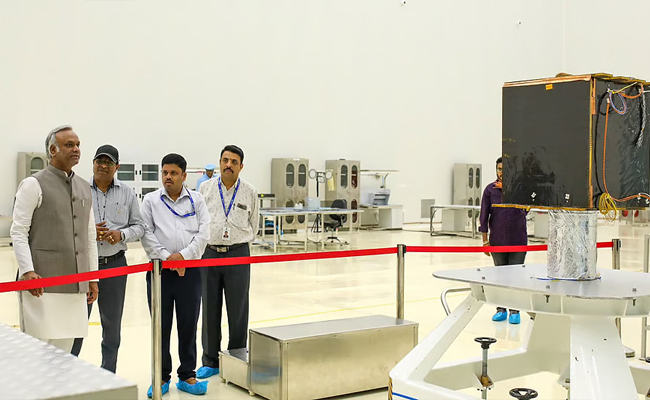
Bengaluru (PTI): In a significant boost to India’s rapidly expanding space economy, the Karnataka government on Friday launched the country’s first state-led Centre of Excellence for Space Technology here, officials said.
The initiative is aimed at strengthening India’s capabilities to translate space innovation into scalable commercial outcomes, they said.
The Centre, established by the Government of Karnataka through the Karnataka Innovation and Technology Society in collaboration with SIA (Satcom Industry Association India) -India, was inaugurated by Minister for Electronics, IT/BT, and Rural Development and Panchayat Raj, Priyank Kharge, in the presence of senior officials and industry leaders, officials said.
Speaking at the launch, Minister Kharge said that Karnataka has consistently been at the forefront of India's technology and innovation journey. With the launch of this Centre of Excellence for Space Technology, we are extending that leadership into one of the most strategic sectors of the future.
"Our focus is not just on advancing research, but on creating an ecosystem where innovation can translate into real-world applications, economic growth, and high-quality jobs. This Centre will play a critical role in positioning Karnataka as a key driver of India's space economy," he said.
According to an official statement, the CoE SpaceTech Foundation has been established under a Memorandum of Agreement between KITS and SIA-India to drive research and innovation in space technologies, industry-aligned training, startup incubation and cross-sector applications, it said.
The Centre has also formalised strategic MoUs with multiple industry and academic partners to support research in space biotech and microgravity, enable collaboration, build talent pipelines, and provide startups with training and market access, it added.