Raghuram Rajan Behind India's Declining Growth, Says NITI Aayog Vice-Chairman Rajiv Kumar
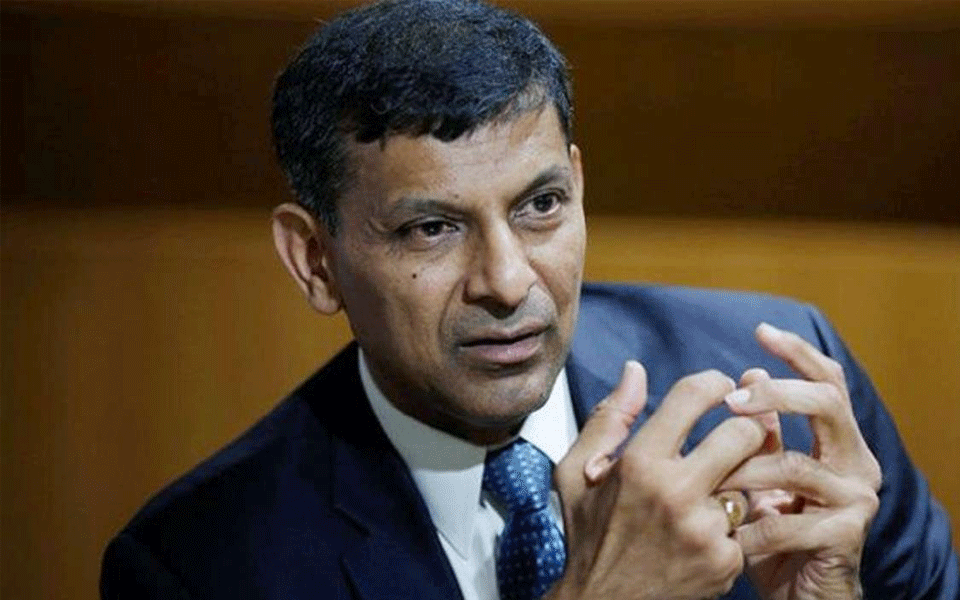
New Delhi sep 03: With Indian medium and small scale enterprises registering a 100 percent growth in loan defaults and non-performing assets surging on a year-on-year basis, Niti Aayog Vice Chairman Rajiv Kumar laid the blame on former RBI governor Raghuram Rajan, stating that his policies led to industries not receiving credits from banks.
“It is a continuation of a trend of a declining growth, and why was this growth declining, it was declining because of the rising NPAs in the banking sector. When this government came into office that figure was 4 lakh crore, it rose to 10.5 lakh crore by the middle of 2017 because under the previous RBI governor, Mr. Rajan, they had identified mechanisms to identify stressed and non-performing assets which is why the banks stopped giving credit to industries,” said Kumar on Monday.
He was responding to a question on why the growth had slowed down post demonetisation. He said the slowdown was not due to the decision to scrap old Rs 500 and Rs 1,000 notes but because of Rajan's policies. "There was already a declining trend in the economy. Starting from the last quarter of 2015-16, the growth rate had come down for six successive quarters," he said.
The banking sector crisis in India can be identified by Punjab National Bank (PNB), India’s second-largest state-owned lender, posting its financial results for the first quarter of 2018-19. It reported a net loss of Rs 940 crore.
In June 2018, the Reserve Bank of India (RBI) cautioned in its Financial Stability Report that things would worsen before they become better. In March 2018, gross non-performing advances of all scheduled commercial banks stood at 11.6 percent of gross advances. The RBI outlined what it expected to happen to them a year hence in three scenarios. At best, it projected gross NPAs of 12.2 percent (baseline scenario); at worst, 13.3 percent (severe stress scenario).
“Especially in the case of small scale business, their credit actually shrank. There was a negative growth in the years. Even for the large industries, their growth shrank to 1.5 percent to 2 percent and in some quarter even negative. This has been the highest deleveraging of India’s commercial sector in the country’s economic history. Never had we seen such a continuous year after year of deleveraging of credit. This has been the primary reason for falling growth. The current government ramped up the public capital expenditure for the very raseon,” added Kumar.
For the first quarter of the current financial year, investments grew at 10 percent, lower than the 14.4 percent in the last quarter of the preceding financial year, benefitting from a 27.4 percent rise in the central government’s capital expenditure in the first quarter.
Courtesy: news18.com
Let the Truth be known. If you read VB and like VB, please be a VB Supporter and Help us deliver the Truth to one and all.
Put petty politics aside; it's not about one party, but India: Rahul on TMC's loss in polls
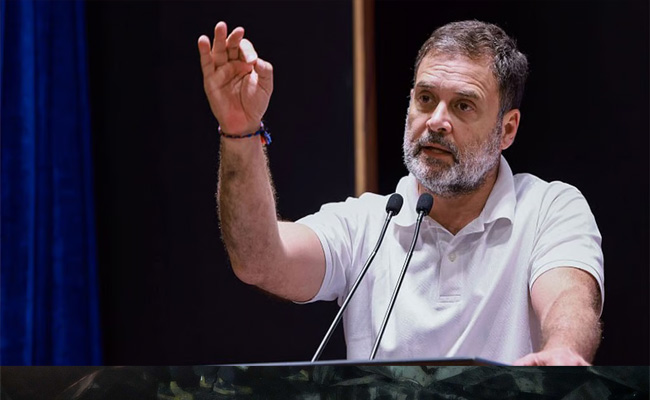
New Delhi (PTI): Congress leader Rahul Gandhi on Tuesday termed the BJP's victory in Bengal and Assam assembly polls a "theft" of the mandate, and a big step forward in the saffron party's mission to "destroy" Indian democracy.
Gandhi also came out in support of the TMC, which has been trounced by the BJP in the polls, and urged those gloating over the loss of Mamata Banerjee's party to put petty politics aside.
"Some in the Congress, and others, are gloating about TMC's loss.They need to understand this clearly - the theft of Assam and Bengal's mandate is a big step forward by the BJP in its mission to destroy Indian democracy," Gandhi said in a post on X.
"Put petty politics aside. This is not about one party or another. This is about India," he said in his post.
The BJP ousted Trinamool Congress from power in Bengal and captured power for the third time in a row in Assam in results of assembly polls declared on Monday.