Raghuram Rajan says he will return if there is an opportunity to be of use
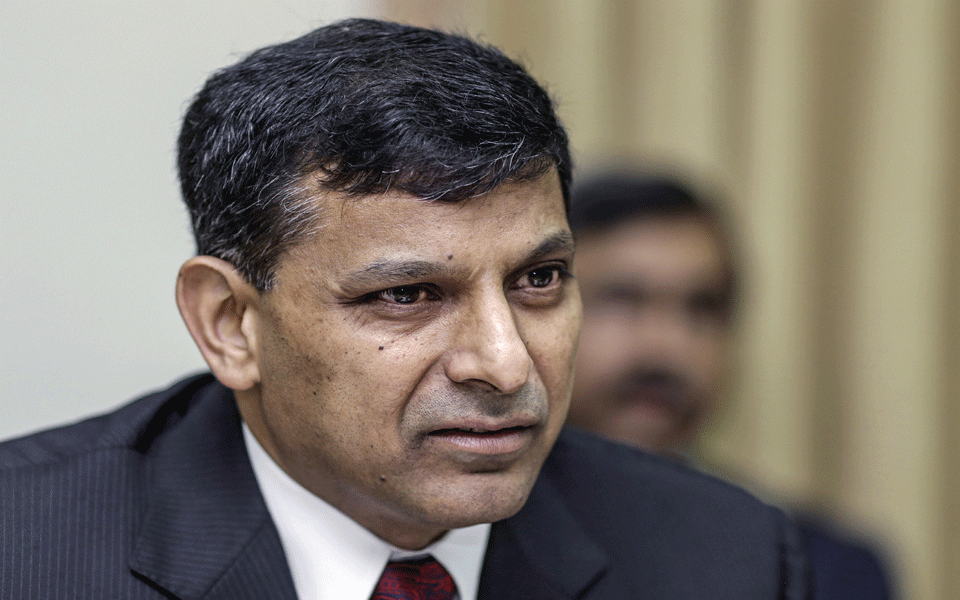
New Delhi: Amid speculation that he may be the finance minister if an opposition alliance wins the ensuing general elections, the former RBI Governor Raghuram Rajan has said he is willing to return to take an opportunity where he could be of use.
Rajan, a former Chief Economist at the International Monetary Fund who was denied a second term as Reserve Bank Governor by the BJP-led government, said he is "very happy" where he is, but is open to opportunities.
"I am very happy where I am. But if there is an opportunity to be of use I will always be there," he said at the launch of his new book 'The Third Pillar' on Tuesday evening.
Rajan, who is currently the Katherine Dusak Miller Distinguished Service Professor of Finance at the University of Chicago's Booth School of Business in the US, was asked if he would like to return to India in public service or even a political role.
Speculation in political circles has been that he may be a choice for finance minister if the 'Grand Alliance' of opposition parties such as TMC, Samajwadi Party, BSP and TDP were to win the April/May general elections.
Congress President Rahul Gandhi had on Tuesday stated that Rajan was among top economists that his party had consulted to draft its minimum income guarantee scheme, Nyuntam Aay Yojana or NYAY.
The scheme assures up to Rs 72,000 a year or Rs 6,000 a month income to 20 per cent of India's poorest families if the Congress is voted back to power in the Lok Sabha elections next month.
In an interview to CNBC TV18 Tuesday, Rajan said it was "premature" to discuss if he was approached by any of the parties to take up a policy-making position if they were to win.
"I think it is premature to have this discussion. I really think that this is an important election for India and I also think we need a new set of reforms. I would be happy to push those ideas and we are trying to do that more broadly to anybody who listens," he had said.
Rajan, who is credited with taking some bold decisions on cleaning up of bank balance sheets as the RBI Governor, when asked what his priorities would be if he was the finance minister of the country, he said "I think there are short-term issues".
"A number of economists, of which I was one, have put together a set of policy ideas and they are out there for anybody to read. They are coming out in a book but let me say very quickly that certainly, I would focus on short-term actions that could put a lot of projects back on track," he said.
Also, cleaning up the banks as quickly as possible and set them back on credit growth, and finding two or three key reforms that could unleash growth would be his focus, he said.
"Certainly one of them has to be how we review agriculture in a way that reduces distress. Second would be the issue of land acquisition. Can we learn from the best practices of the states and find methods that seem fair and in a sense also give states the freedom to pick the method that works best for them so that we learn from each other's experiments?
"Land acquisition and bank cleanup, as well as, trying to find some key policies that would revive agriculture - these would be top priorities," he said.
Rajan was the 23rd Governor of the Reserve Bank of India between September 2013 and September 2016. Between 2003 and 2006, he was the Chief Economist and Director of Research at the IMF.
Let the Truth be known. If you read VB and like VB, please be a VB Supporter and Help us deliver the Truth to one and all.
Maharashtra sets up state vaccination task force to strengthen immunisation programme

Mumbai (PTI): The Maharashtra government has set up a State Vaccination Task Force to strengthen the regular immunisation programme and review the progress of related campaigns, a health department official said on Monday.
The State Vaccination Task Force will comprise at least 29 members and will be headed by the administrative head of the health department, he informed.
The government has also constituted separate district-level and municipal vaccination task forces to improve implementation and address challenges at the grassroots level, he said.
Municipal task forces, chaired by respective civic commissioners, have been constituted in view of the vast urban population in Maharashtra and the role of civic bodies in implementing different health programmes.
The district-level task forces will function under the chairmanship of collectors.
"Complete immunisation of children at the appropriate age is an extremely simple, cost-effective and highly effective measure to reduce child mortality and the prevalence of diseases among kids. Immunisation is a powerful tool for reducing illness in children," maintained the official.
To ensure full vaccination of all children, the state government implements various campaigns from time to time as per the central government guidelines, he pointed out.
"Active participation and cooperation of other relevant government departments are essential (in making these campaigns successful)," according to the official.
The state-level body will review the regular immunisation programme, associated campaigns and vaccine-preventable diseases in detail. It will also conduct focused assessments of high-risk districts and municipal corporations, including vacancies at district, municipal and sub-district levels, availability of cold chain equipment, resource gaps and training requirements, he noted.
The state task force will review allocation and utilisation of funds for immunisation and ensure timely action by officers concerned based on reports from district and municipal task forces and state-level monitoring mechanisms, the official said.
It will also ensure active coordination and participation of other government departments in immunisation drives, while district and municipal task forces will carry out similar functions at their respective levels, the official added.