Rahul gandhi an ordinary Congress MP, don't highlight him so much: Lakshman Singh
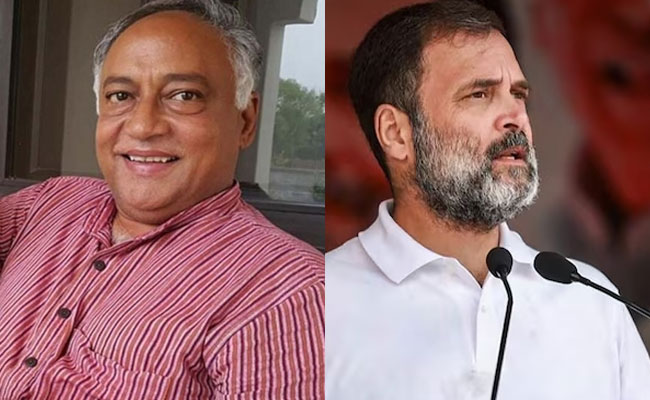
Bhopal (PTI): Former Congress MP Lakshman Singh has said Rahul Gandhi is an ordinary party worker and parliamentarian and he should not be highlighted so much.
Lakshman Singh, the younger brother of Congress veteran Digvijaya Singh, was speaking to reporters at the Congress office in MP's Guna city on Saturday.
When reporters claimed Congress MP Rahul Gandhi's face is shown less on TV when he makes a statement in the Lok Sabha, Lakshman Singh said, "Rahul Gandhi is an MP, he is not the (party) president and is a Congress worker. Apart from this Rahul Gandhi is nothing."
"You (media) people should not highlight Rahul Gandhi so much and neither should we," he said.
Rahul Gandhi is only an MP and he is equal to the rest of the party's parliamentarians, said Lakshman Singh, who has been a five-time MP and three-term MLA.
"One does not become (big) by birth but by one's actions. Don't consider Rahul Gandhi such a big leader, I don't. He is an ordinary MP. It doesn't matter whether you highlight him or not," Lakshman Singh said.
When contacted on Sunday, Lakshman Singh told PTI Rahul Gandhi himself has said he is a party worker.
"We all are party workers," Singh said without elaborating on his previous comment.
In the Madhya Pradesh polls held last month, BJP's Priyanka Penchi defeated Lakshman Singh by more than 61,000 votes from Chachoura Assembly seat in Guna district.
Let the Truth be known. If you read VB and like VB, please be a VB Supporter and Help us deliver the Truth to one and all.
India never offers any duty concessions in dairy sector under FTAs: Goyal
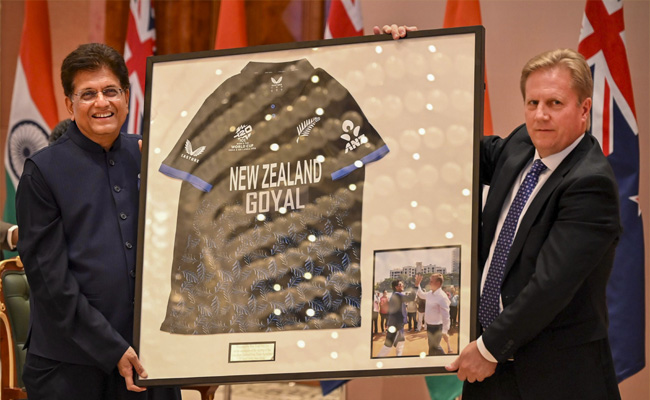
New Delhi (PTI): India has not offered any duty concessions in the dairy sector under any of its free trade agreements so far, including those with the European Union, the UK, New Zealand, and Australia, Commerce and Industry Minister Piyush Goyal on Monday.
He said India's dairy sector is driven by very small and marginal farmers with limited landholdings who own only a few cattle.
These farmers has a "very" low production and needs to be protected against large farms that Europe, America, Australia, or New Zealand have.
"India has had a very consistent stand in all our FTAs across the world, whether it is European Union, Switzerland... UK, USA, Australia, New Zealand. Never has India opened the dairy sector. Everybody in this room knows it. Everybody in the world knows it," he told reporters here after signing a trade pact with New Zealand.
This is a known position, and there is nothing new in this, he said.
However, he added that as per India's foreign trade policy, the government allows foreign firms to bring raw materials or ingredients into India, process them to make high-quality products and then re-export 100 per cent of those goods.
That product is not allowed to be sold in the country, he said.
"So it doesn't hurt the Indian market, doesn't hurt the Indian farmers, but adds to our foreign exchange income, adds jobs to our youth, provides opportunities for our farmers also to possibly supplement for further re-export. So it's a win-win for both countries," Goyal said.
The India-New Zealand trade pact has an investment arrangement under which firms from the Oceania country can bring raw materials or ingredients from the dairy sector into India, process them to make high-quality products and then re-export 100 per cent of those goods.
These dedicated fast-track arrangements will be used exclusively for the manufacture of products destined solely for export, thereby safeguarding the interests of the domestic industry.
New Zealand is one of the world's largest dairy exporters. Its dairy exports to India in FY25 totalled just USD 1.07 million, consisting of milk and cream (USD 0.40 million), natural honey (USD 0.32 million), mozzarella cheese (USD 0.18 million), butter (USD 0.09 million) and skimmed milk (USD 0.08 million).
Under the FTA, India would grant quota-based duty concessions on Albumins (a milk protein product) and bulk infant formula from New Zealand with Minimum Import Price and other safeguards.
Tariffs on bulk infant formula and other dairy-based preparations, and peptones (a dairy-based product) would be phased out by India in over seven years, according to New Zealand's Foreign Affairs and Trade ministry statement.