New Delhi, April 23: Congress President Rahul Gandhi on Monday questioned Prime Minister Narendra Modi on associating spirituality with cleaning of toilets and also took a jibe at him on frying of 'pakodas'.
"The Prime Minister sees spirituality in cleaning of toilets and making 'pakodas'. But, for Modi, becoming the Prime Minister only is spirituality," the Congress leader said at the nationwide 'Save the Constitution' campaign launched here.
Quoting Modi from his book "Karmyogi", Gandhi said: "This quote reflects his thinking and ideology."
The Congress leader further quoted Modi as saying: "What is the spirituality of a person working to clean toilets? Has anyone experienced the spirituality of a man of the Valmiki samaj, who has to remove human excreta and dirt everyday.
"I do not believe that he accepted the task merely to fill his belly. He would not have stayed for so long in that profession, and certainly not from generation to generation. Probably, sometime for happiness of God and society, he would have thought it is his responsibility to keep the environment clean and he accepted the work and continues to do the work for generations out of his spirituality."
Gandhi said: "This is the thinking of our Prime Minister -- 'a person from the Valmiki community who cleans the toilet doesn't do it to fill his stomach but for spirituality'. Every poor and every person has to understand -- this is our PM's thinking."
Gandhi said that the Dalits were angry with Modi because of this ideology.
"You may garland B.R. Ambedkar's statue or a picture, but with such thinking you can never respect him. And every Dalit understands this. They know that this person (Modi) has no place for Dalits, weaker sections, and women, in his heart," the Congress chief said.
Rahul Gandhi also claimed that atrocities on Dalits were increasing in Uttar Pradesh, Madhya Pradesh, Maharashtra, and elsewhere. "They are being crushed, lynched, and attacked."
He said: "There is violence against Dalits in Una (in Gujarat), and the man (Modi) who sees spirituality in cleaning of toilets doesn't speak even a word. When we raised our voice, after three days, he (Modi) came on stage and tears rolled down."
Prompted by a party worker on the issue of the BJP promise to create two crore jobs every year if the party came to power, Rahul Gandhi took a jibe at the Prime Minister: "There is spirituality in making 'pakodas' also -- you should understand this. This is the truth in the country."
Let the Truth be known. If you read VB and like VB, please be a VB Supporter and Help us deliver the Truth to one and all.
Govt in talks with social media platforms on age-based restrictions, issue of deepfakes: Vaishnaw
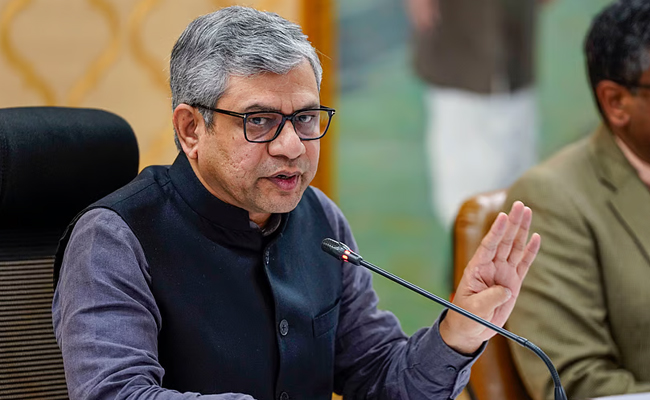
New Delhi (PTI): The government is discussing issues of age-based restriction as well as deepfakes with social media platforms to determine the way forward, Union IT Minister Ashwini Vaishnaw said on Tuesday as he advocated the need for stronger regulations to protect children, and safeguard society at large from user harms.
The minister emphasised that any company -- be it Netflix, YouTube, Meta, or X -- must abide by the legal framework and the Constitution of India. He noted that the problem of deepfakes is growing day by day and asserted that stronger regulation is needed.
The minister said discussions are underway with social media platforms on tackling deepfakes and age-based restrictions to determine the most appropriate way forward on the issue.
"... and right now, we are in conversation regarding deepfakes, regarding age-based restrictions with the various social media platforms, and what is the right way, what is the right way to go," the minister said during a briefing at the India AI Impact Summit.
He called for stronger regulations on deepfakes.
"I think we need a much stronger regulation on deepfakes. It is a problem growing day-by-day. Certainly there is a need for protecting our children and our society from these harms... we have initiated a dialogue with industry on what kind of regulation will be needed beyond what we already have," Vaishnaw, who is also the Minister for Information and Broadcasting, said.
The parliamentary committee, too, has studied the issue in depth, he pointed out.
"We need much stronger regulations on deepfakes and we must definitely create that consensus within Parliament for creating those significantly stronger restriction on deepfakes so society can be protected from these harms," the minister said.
He further pointed out that many countries have accepted the need for age-based restrictions.
"...this is something that has been accepted by many countries, that age-based regulation has to be there. It was part of our DPDP (Digital Personal Data Protection legislation)... when we created this age-based differentiation on the content which is accessible to students and to young people. So that time itself, we took that forward-looking step," he said.
Countries, including Australia, France and the United Kingdom, have either introduced or proposed age restrictions and stricter parental consent rules to limit children's access to social media platforms and enhance online safety safeguards.
Last month, Indian government's Economic Survey said age-based access to online platforms should be considered while also cutting down online teaching to avoid digital addiction.
The Survey, tabled in Parliament, had said online platforms should be made responsible for enforcing age verification, and simpler devices should be promoted for children to access educational content with safeguards to address the rising problem of digital addiction.
"Policies on age-based access limits may be considered, as younger users are more vulnerable to compulsive use and harmful content. Platforms should be made responsible for enforcing age verification and age-appropriate defaults, particularly for social media, gambling apps, auto-play features, and targeted advertising," the Survey had said.
Vaishnaw on Tuesday also highlighted that it is crucial for multinational companies to understand the cultural context of the countries in which they operate, noting that practices considered normal in one country could be prohibited in another, and vice versa. He added that while most companies strive to be sensitive to local contexts, there is always a learning curve in that journey.
He said that copyright is a complex matter, particularly as most AI models are trained on content available in the public domain. The minister stressed that content creators, especially news creators, must receive "fair remuneration" for the material they create, adding that this is government's firm belief and public policy too should be oriented towards that.
Vaishnaw further informed that discussions are underway with major platforms, many of which have shown an inclination to establish mechanisms to ensure fair remuneration for content creators, especially news creators who are part of conventional media.
He emphasised the need for fair revenue distribution when conventional media content is used by digital platforms, and said the government remains in continuous dialogue with big tech companies on the matter.
"We believe that there has to be a fair distribution of the revenue which comes out of the big efforts that the conventional media teams put. We believe in that, and we are constantly in dialogue with the big platforms on that," Vaishnaw said.