Rahul Gandhi questions surge in Adani's fortunes, claims it happened after BJP came to power
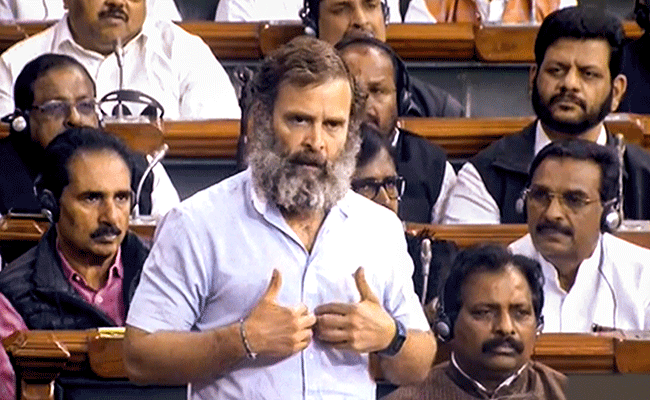
New Delhi (PTI): A belligerent Rahul Gandhi Tuesday led a blistering opposition attack in Lok Sabha over the Hindenburg report, claiming that the meteoric rise in Gautam Adani's fortunes happened after the BJP came to power in 2014 as he rose in the global rich list from the 609th to the second spot eventually.
The Congress leader's remarks drew a sharp response from the treasury benches, with Law Minister Kiren Rijiju asking him not to level "wild allegations" and to furnish proof of his claims.
Outside Parliament, BJP leader Ravi Shankar Prasad accused Rahul Gandhi of making baseless, shameless and reckless allegations and charged that the Congress and the Gandhi family were involved in "big scams" that "tarnished" the image of the country.
Speaker Om Birla disapproved of the Congress leader displaying certain pictures in the House.
"If you show posters, they (BJP) will show posters of the Rajasthan chief minister (with Adani). Parliament is not for these things," Birla said.
Participating in the debate on the Motion of Thanks to the President's Address in Lok Sabha as the first Opposition speaker, Gandhi made a barrage of allegations against Modi.
He asked how much money Adani has given to the BJP in the last 20 years, including through electoral bonds.
Speaker Birla asked Gandhi to focus on the President's address.
"There should be a case study on Adani by business schools such as Harvard, on how the relationship between business and politics works, India is a case study," Gandhi said.
He also hit out at Modi for slamming the Opposition over its criticism of the Rafale deal by allegedly overlooking the capabilities of Hindustan Aeronautics Limited (HAL).
"Yesterday, the prime minister said at HAL that we hurled wrong allegations. But in reality, HAL's contract of 126 aircraft went to Anil Ambani, who then went bankrupt," Gandhi said.
Gandhi, who just completed his over 4,000-km Bharat Jodo Yatra, said people asked him how Adani got into so many businesses and succeeded.
"From Tamil Nadu, Kerala to Himachal Pradesh, Kashmir, we have been hearing one name everywhere 'Adani'. Across the entire country, it's just 'Adani', 'Adani', 'Adani'...," Gandhi said.
He said that during the yatra people also asked him how Adani's net worth increased from USD 8 billion to USD 140 billion between 2014 and 2022.
"In 2014, he was in 609th spot on the list of richest people and climbed to the second spot," the former Congress chief said.
Gandhi also raised the issue of the report by US-based Hindenburg Research, saying it alleged that Adani has shell companies abroad.
Pointing out that Adani works in strategic sectors, he said the government must find out about these shell companies as to who controls them as this is a national security issue.
The Opposition has been demanding a joint parliamentary committee probe or a Supreme Court-monitored investigation into the allegations of fraud and manipulation made by Hindenburg Research against Adani's companies that triggered an unprecedented stock crash. The group has denied the charges.
Gandhi alleged that the government tweaked rules in favour of Adani and said the clause that no one without any prior experience would be involved in the development of airports was done away with.
"This rule was changed by the government and Adani was given six airports. After that India's most strategic, profitable airport, Mumbai Airport, was taken away from GVK using agencies," he alleged.
"The result is 24 per cent of India's air traffic and 31 per cent of air freight passes through Adani's airports," Gandhi said.
The treasury benches repeatedly asked Gandhi to authenticate his claims, saying that such allegations cannot be levelled against the government without documentary evidence.
"Adani never made drones while HAL used to do it and other companies do it. They have four defence firms and had not done this work before, small arms, sniper rifles, all are made by Adani," he said.
Adani group has a 30 per cent market share in the airports business and also controls 90 per cent of Israel-India defence cooperation, he claimed.
"I was asked by the people during the Yatra as to why LIC's money is being put into the Adani group. They also asked why LIC's funds are being put in Adani's shares, which are volatile," he said.
Participating in the debate, Gandhi also questioned the Agniveer scheme for recruiting defence personnel claiming that youths aspiring to be in the army were not on the same page as the government on the scheme.
Senior officers have said the scheme will weaken the army and it came from outside the Army, from the RSS and Home ministry, he claimed.
"They said that the Agniveer scheme came from outside and (National Security Advisor) Ajit Doval had forced it on the forces," Gandhi said, evoking objections from the treasury benches which claimed that the official's name should not be taken.
He said the main concerns of the people such as unemployment and price rise were not even mentioned in the president's address.
Speaker Birla said that comments should not be made outside the House that mics are turned off, to which Gandhi said, "It is the reality that you do turn off the mics."
Congress and its leaders were involved in all big scams which tarnished the image of India, he alleged.
Let the Truth be known. If you read VB and like VB, please be a VB Supporter and Help us deliver the Truth to one and all.
India, New Zealand ink free trade agreement
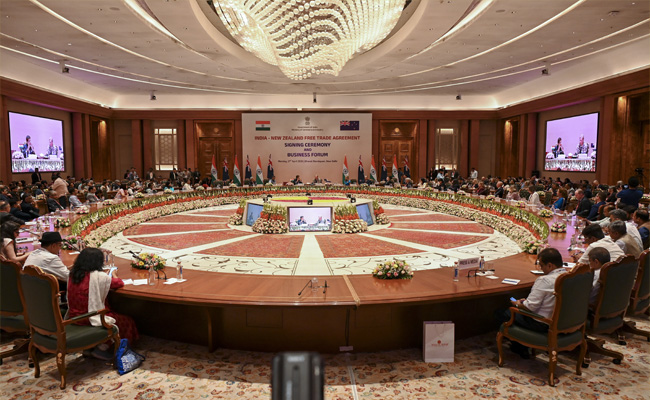
New Delhi (PTI): India and New Zealand on Monday inked a free trade agreement, aimed at boosting two-way commerce and investments.
The pact was signed by Commerce and Industry Minister Piyush Goyal and visiting New Zealand's Trade and Investment Minister Todd McClay.
The FTA provides duty-free access for 100 per cent of India's exports to New Zealand, covering all tariff lines or produce categories, and is expected to significantly boost MSMEs and employment by enhancing competitiveness in labour-intensive sectors such as textiles, apparel, leather, footwear, gems and jewellery, engineering goods, and processed foods.
Earlier, New Zealand maintained peak tariffs of up to 10 per cent on key Indian exports, including ceramics, carpets, automobiles, and auto components.
With zero-duty market access from entry into force as New Zealand's other trade partners, Indian products will be fully competitive in that country, enjoying a level playing field.
ALSO READ: Cal HC urges EC to dispose of TMC complaint over police observer's meeting with BJP nominee
Significantly, India also secured duty-free inputs for its manufacturing sector, including wooden logs, coking coal, and waste and scraps of metals, lowering production costs and enhancing the global competitiveness of the Indian industry.
On the other hand, India has offered tariff liberalisation on 70.03 per cent of tariff lines covering 95 per cent of bilateral trade value, while keeping 29.97 per cent of tariff lines excluded to protect India's sensitive sectors.
The products that are kept in exclusion are mainly -- dairy (milk, cream, whey, yoghurt, cheese etc.), animal products (other than sheep meat), agricultural products (onions, chana, peas, corn, almonds), sugar, artificial honey, animal, vegetable or microbial fats and oils, arms and ammunition, gems and jewellery, copper and articles thereof (cathodes, cartridges, rods, bars, coils), aluminium and articles thereof (ingots, billets, wire bars) among others.
On 30 per cent of tariff lines of New Zealand, India will provide duty elimination on goods such as wood, wool, sheep meat, and leather-raw hides.
Similarly, 35.60 per cent of tariff lines are subject to phased elimination over 3, 5, 7, and 10 years, including petroleum oil, malt extract, vegetable oils, selected electrical and mechanical machinery, and peptones.
New Zealand products which enjoy tariff reductions include wine, pharmaceutical drugs, polymers, aluminum, iron and steel articles, and goods that only 0.06 per cent fall under tariff rate quotas, including Manuka honey, apples, kiwi fruit, and albumins, including milk albumin.
The FTA also includes a commitment to facilitate USD 20 billion in investment into India.
A rebalancing clause is incorporated into the Agreement to provide a framework for addressing any shortfall in investment delivery, thereby ensuring robust and tangible economic outcomes.
Total bilateral trade in goods and services reached USD 2.4 billion in 2024.