Rahul Gandhi unveils 5 poll guarantees for Kerala, targets PM Modi and CM Vijayan
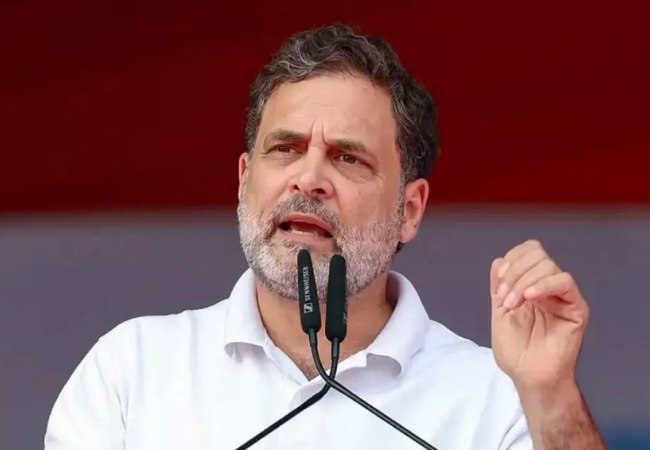
Thiruvananthapuram (PTI): In a high-stakes campaign here, Congress leader Rahul Gandhi on Saturday combined five populist electoral pledges with a fierce assault on Kerala’s ruling Communists, alleging Chief Minister Pinarayi Vijayan is being "controlled" by Narendra Modi in the same manner Donald Trump exerts influence over the Prime Minister.
Speaking at the valedictory function of the state-wide ‘Puthuyuga Yatra’ led by Leader of Opposition V D Satheesan as part of the Congress-led UDF’s preparations for the upcoming Assembly elections, Gandhi said, “The same way Trump is controlling Modi, the Prime Minister is controlling the Chief Minister of Kerala."
Announcing five guarantees for the people of poll-bound Kerala, he said, “The first guarantee is free travel for all women in KSRTC buses."
The other guarantees announced by him were a monthly financial assistance of Rs 1,000 for college-going girl students, increase of welfare pension to Rs 3,000 per month, a new health insurance scheme worth Rs 25 lakh coverage for every household in the name of former chief minister Oommen Chandy and interest-free loans of up to Rs 5 lakh for youngsters who want to start businesses.
In addition, he said a dedicated ministry would be created for the welfare of senior citizens.
Launching a scathing attack on Pinarayi Vijayan, Gandhi said PM Modi is "controlling the Chief Minister".
He alleged that even CPI(M) workers were aware of this and would admit it.
“I want to understand why the CBI and ED take action against opposition politicians but do not take action against the Chief Minister of Kerala,” he said.
Gandhi said there were 36 cases against him and that he was interrogated by the Enforcement Directorate for 55 hours.
“Why has the ED taken no action against the Chief Minister and his family? The reason is they are working together,” he alleged.
According to him, in Kerala, it was not the CPI(M) and BJP, but the “CJP” that was working together to defeat the UDF.
Gandhi also accused the LDF government of "functioning in the interests of big corporates".
“This is the most corporatist government Kerala has ever seen. It is against the interests of workers, small businesses and farmers and is working for the interests of the biggest businessmen,” he alleged.
He said the CPI should be renamed the “Corporate Party of India”.
“At least stand for what you say you are,” he said.
Referring to the alleged gold theft at Sabarimala temple, Gandhi claimed that the investigation was prevented from reaching the top leadership.
“Don’t worry, we will take strict action against those who dishonoured Sabarimala."
He also alleged that the LDF government had created a serious unemployment situation in the state.
“Modi has destroyed the employment system in India and the CPI(M) has destroyed it in Kerala,” he said.
Taking on the Centre, Gandhi alleged that the Prime Minister had “let the country down”.
“He has betrayed the country,” Gandhi said.
He said he was using the word deliberately and believed the Prime Minister had "betrayed the country" by signing the trade deal with the United States.
Gandhi claimed that the consequences of the agreement would be borne by the people of India.
“No Prime Minister before him opened our agriculture to American agriculture. Large American mechanised firms are going to compete with small Indian labour-intensive firms,” he said.
He said the deal would lead to devastation for farmers cultivating crops such as cotton, corn, pulses, fruits and soybeans.
Gandhi also claimed that the Prime Minister had "compromised" the country’s energy security.
“Imagine the Prime Minister of India committing to President Trump that we will buy oil from where America wants us to. Imagine a country as powerful as ours having to take permission from the US if we want to buy oil from Russia,” he said.
Referring to the trade deal, he said the US could extract data from India, which he described as the "most valuable asset" in the era of artificial intelligence.
“AI is all about data and India, with 1.4 billion people, is the largest producer of data. All of it has been signed away by Prime Minister Modi,” he alleged.
Earlier in the day, during a dialogue with the Information Technology (IT) Fraternity at Technopark here, Gandhi said that if India had said that its data was the most valuable in the world, there would have been no taxes on agriculture or on small and medium businesses.
He claimed that, except him speaking out against it, there was "not a peep" in India when its data was "handed over" to the US as part of the deal signed by the central government.
During his interaction with the tech professionals, the LoP in Lok Sabha also said that China has built a "superb and unmatched" industrial system in the world, but the neighbouring nation was "coercive and undemocratic".
He was also concerned that China dominated the electric motors and batteries technology which saw wide usage in the Ukraine-Russia war and the ongoing conflict in West Asia.
"That is a huge problem," he said, adding that he was confident that if aligned properly, an Indian company can take on the Chinese in that space.
Let the Truth be known. If you read VB and like VB, please be a VB Supporter and Help us deliver the Truth to one and all.
PM to reach Sikkim on Monday to attend 50 years of statehood ceremony, launch Rs 4,000 cr projects
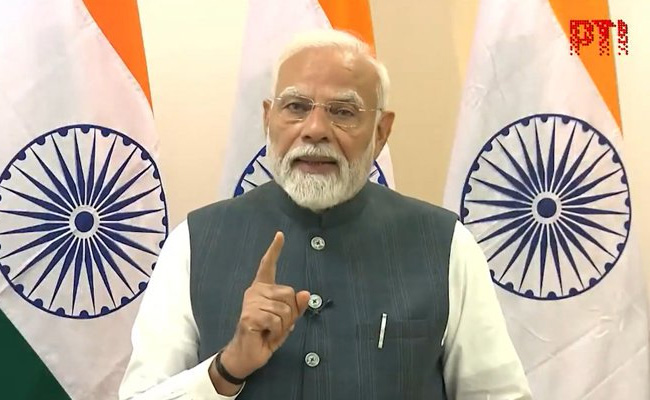
Gangtok (PTI): Prime Minister Narendra Modi is scheduled to reach Sikkim on Monday for a two-day tour, during which he will hold a roadshow, attend the closing ceremony of 50 years of statehood and launch projects worth Rs 4,000 crore, officials said.
Elaborate security arrangements have been put in place in the state capital and surrounding areas in view of Modi's visit, they said.
According to the itinerary of his visit, Modi will arrive in Gangtok around 3 pm and will hold a roadshow to Lok Bhawan here soon after landing at Libing helipad.
The Prime Minister will visit the Orchidarium in Gangtok the next day. To showcase the ecological and floral heritage of the state, a "Swarnajayanti Maitri Manjari Park" has been developed as a world-class Orchid Experience Centre on the golden jubilee of Sikkim's statehood.
He will launch multiple development projects worth over Rs 4,000 crore across the state while participating in the closing ceremony of Sikkim's 50th year of statehood at Paljor Stadium.
The projects span a wide range of sectors, including infrastructure, connectivity, healthcare, education, power, urban development, environment, tourism and agriculture, the officials said.
The Prime Minister will also address the gathering on the occasion, the officials said.
Modi had been scheduled to be present at the opening ceremony of the year-long celebrations of 50 years of Sikkim's statehood at Paljor Stadium last year, but he could not reach the venue due to inclement weather. He, however, addressed the gathering through video conferencing from Bagdogra in neighbouring West Bengal.