Rahul leads Opposition's 'Bharat Bandh' protest against fuel price hike
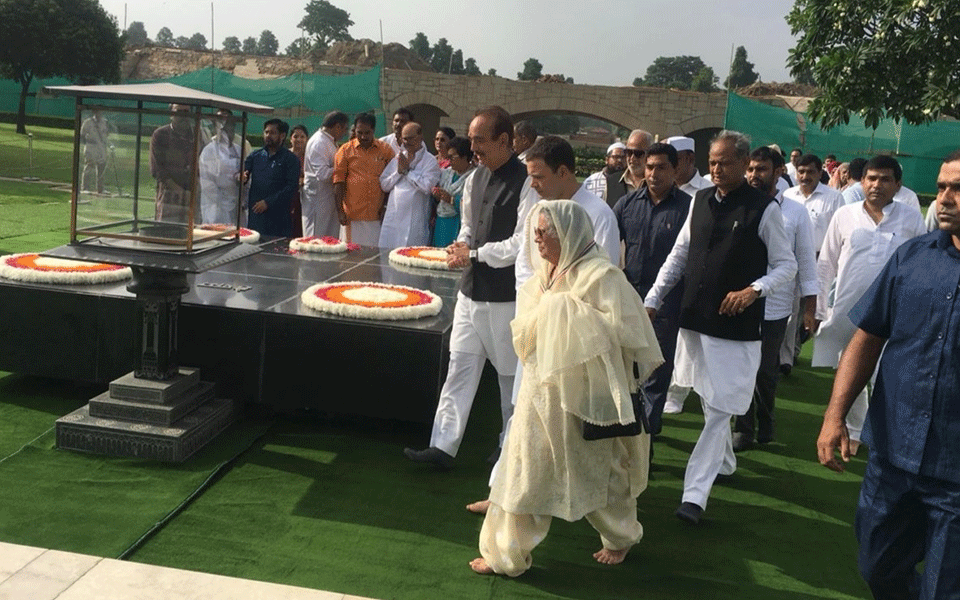
New Delhi, Sep 10: A united Opposition, led by Congress President Rahul Gandhi, on Monday staged a foot march here in support of a nationwide shutdown protest or 'Bharat Bandh' called by his party against rising fuel prices.
The 1.8-km march was held between Rajghat and Zakir Husain College.
Janata Dal-Secular (JD-S), Trinamool Congress, Rashtriya Janata Dal (RJD), Nationalist Congress Party (NCP), Loktantrik Janata Dal (LJD), Rashtriya Lok Dal, All India United Democratic Front, Revolutionary Socialist Party and Aam Aadmi Party (AAP) were among the opposition parties that participated in protest.
The Congress President paid tributes to Mahatma Gandhi at his memorial at Rajghat.
He also offered water at the memorial which he brought from Kailash Mansarovar yatra before joining other opposition leaders including Congress leaders Ghulam Nabi Azad, Ashok Gehlot, Anand Sharma, Ambika Soni, Ahmed Patel, Randeep Singh Surjewala, Abhishek Manu Singhvi, Shailja Kumari, Meira Kumar, Jairam Ramesh; NCP's Tariq Anwar, LJD's Sharad Yadav and RJD's Manoj Jha in the nationwide shutdown.
This was Gandhi's first public appearance since he returned from the yatra. He had embarked on the yatra on August 31.
Delhi's ruling AAP, which had refused to join the shutdown, also sent its leader Sanjay Singh.
The protest has been called by Congress and Left parties against the spiralling petrol and diesel prices which have reached record levels.
After the end of the march, all the opposition leaders gathered at an Indian Oil petrol pump near the Ramlila Maidan where UPA Chairperson Sonia Gandhi and former Prime Minister Manmohan Singh joined them.
Later, over 200 political leaders and supporters gathered at the ground from where Manmohan Singh and others spoke against the Central government over its failure to curb the price hike.
"The runaway prices of fuel and the free fall in the value of the Rupee shows that the Modi government has completely failed in managing the economy," the Congress had tweeted earlier in the day.
Let the Truth be known. If you read VB and like VB, please be a VB Supporter and Help us deliver the Truth to one and all.
CM Siddaramaiah alleges ‘criminal conspiracy’ in Sringeri recount, vows legal action
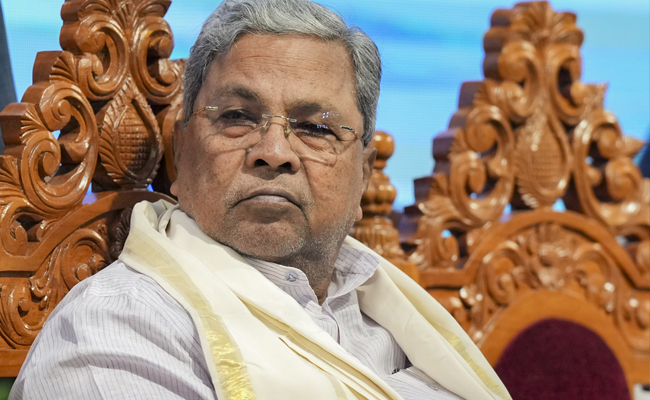
Bengaluru (PTI): Alleging a “criminal conspiracy” by BJP candidate D N Jeevaraj in the Sringeri Assembly poll recounting, Karnataka CM Siddaramaiah on Tuesday said the outcome was manipulated after valid postal ballot votes in favour of Congress leader T D Raje Gowda were tampered with during the recounting process.
Following a Karnataka High Court order on an election petition filed by Jeevaraj, challenging Raje Gowda’s election, the reverification and recounting were conducted on Saturday.
After the reverification and recount of postal ballots for the Sringeri Assembly constituency, votes polled in favour of Raje Gowda were reduced by 255, the returning officer said.
A report on the matter has been submitted to the Election Commission of India for further action, the officer added.
Congress leader Raje Gowda had won the 2023 Assembly polls from Sringeri by 201 votes, defeating his nearest rival Jeevaraj.
Addressing a press conference in Bengaluru, Siddaramaiah said the High Court had directed the recounting of postal ballots and that irregularities were noticed during the exercise conducted on May 2.
“This is a clear case of criminal conspiracy,” Siddaramaiah said, alleging that valid votes cast in favour of Raje Gowda were altered after being accepted by counting agents of all parties, including Congress, BJP, and JD(S).
He claimed that during the recounting of postal ballots, 255 votes were initially accepted as valid by all agents but were later tampered with by subordinate officials.
“There is a second mark on the votes polled in favour of Raje Gowda. They had accepted these as valid votes. Subsequently, another mark was made by officials. This is a clear case of criminal conspiracy,” he said.
When asked who was behind the alleged conspiracy, the CM replied, “It was hatched by Jeevaraj and others. It is planned.”
Siddaramaiah further alleged that the returning officer acted improperly by declaring the result despite the presence of an Election Commission observer during the recounting.
“Immediately after the counting, the returning officer announced the result. He should not have done so; this is against the law,” he said.
He pointed out that Raje Gowda had originally won by 201 votes, but after the recounting, the BJP candidate was declared the winner by 52 votes.
“The BJP has committed a criminal act of conspiracy. This is not vote chori but vote dacoity,” he alleged.
The CM said a police complaint had already been filed by Raje Gowda’s election agent, Sudhir Kumar, and emphasised the need for electoral integrity.
“We want transparency and free and fair elections. That is what our Constitution mandates,” he added.
Stating that the government would pursue legal remedies, Siddaramaiah said, “We are preparing an appeal challenging the returning officer’s announcement in a court of law.”
Responding to a separate query on elections in other states, the CM said there appeared to be an anti-incumbency factor in West Bengal, while results in Tamil Nadu were “surprising,” adding that Vijay’s party was emerging as the largest there.
Following the victory of party candidates in Bagalkote and Davanagere South, Siddaramaiah expressed confidence about future electoral prospects in Karnataka.
“Even in 2028, we will win the Assembly elections. We will come back,” the CM said.
Siddaramaiah added that he would order a forensic examination into the alleged tampering of postal ballots.