Rahul tutored by NGOs that good days will come for Cong; he is not interested in running Par: Rijiju

Tawang (PTI): Parliamentary Affairs Minister Kiren Rijiju on Monday claimed that Congress leader Rahul Gandhi is not interested in the smooth functioning of Parliament, and some NGOs have tutored him that "good days" will come for his party and that is why he has been stalling the House.
Rijiju also said that the government is not going to take any more extra steps to "placate" the Congress to defuse the situation in Parliament as he had made "many attempts" so that the House functions properly, but in vain.
"Rahul Gandhi is not interested in running the House. He is interested in making issues. Rahul Gandhi was tutored by some NGOs that your days will come. But their days won't come. In the next elections, their tally (in the Lok Sabha) will further go down," he told PTI in an interview here.
ALSO READ: Delhi summit 'important moment' to unlock full benefits of AI, says UK Deputy PM
Rijiju, who is on a visit to his Lok Sabha constituency Arunachal West, said the ruling alliance has no problem with the opposition stalling the House as he had made many attempts to defuse the situation, including speaking to senior Congress leader K C Venugopal and a few others.
"We are not going to do anything extra to placate the Congress. The Congress is frustrated because the party is losing election after election. They are desperate to change the situation," he said.
The Union minister claimed there was pressure on the Congress from the smaller parties in Parliament to not stall the House because they lose out their time to speak.
"All opposition is not with the Congress. Smaller parties are not being able to utilise their respective party time. Smaller parties are unhappy with Rahul Gandhi. Some of them have not even signed the motion against the Speaker," he said.
Rijiju said some members of other political parties kept telling him that they wanted the House to function.
Most days of the first part of the Budget Session in the Lok Sabha witnessed disruptions and adjournments after Gandhi was disallowed by the Chair from quoting an article based on excerpts of former Army chief M M Naravane's "unpublished memoir", which has references to the India-China conflict of 2020.
Eight opposition members were suspended for the remainder of the Budget Session for unruly behaviour in the House.
The opposition also moved a No-confidence Motion against Speaker Om Birla for his removal from office, alleging that he had acted in a "blatantly partisan" manner.
The Speaker last week decided to step aside from his role as the presiding officer of the House, hours after the opposition submitted the motion for his removal from office, alleging that he had acted in a "blatantly partisan" manner.
The Budget Session, which started with the President's address to the joint sitting of Parliament, on January 28 and went on recess on February 12. The Budget 2026 was presented on February 1. The session will be reconvened on March 9 and will end on April 2.
Let the Truth be known. If you read VB and like VB, please be a VB Supporter and Help us deliver the Truth to one and all.
Two killed as college tour bus crashes into parked tanker, lorry near Maravanthe
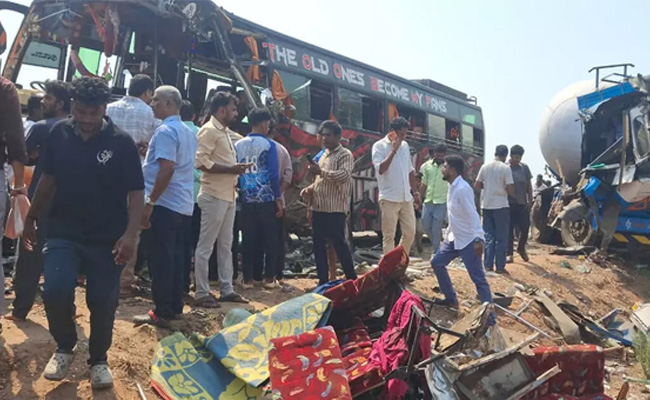
Kundapur: Two persons died and several students were injured after a college tour bus rammed into a tanker and a goods lorry parked by the roadside near Maravanthe Beach in Trasi on Wednesday afternoon.
The bus was carrying final-year B.Com students of Rambhapuri College from Shivamogga district. According to sources, the group had left for the tour two days ago.
There were around 50 persons in the bus, including 24 male students and 23 female students.
The students had visited Murdeshwar and were travelling towards Udupi on Wednesday when the accident occurred.
Police said the bus driver reportedly lost control of the vehicle, following which the bus first hit a parked gas tanker and then crashed into a goods lorry stationed ahead.
The front portion of the bus was badly mangled in the impact. Preliminary information said the bus cleaner and a cooking assistant travelling with the group died in the accident. Several injured students were shifted to different hospitals in Kundapur for treatment.