Railway orders 15-day intensive safety drive
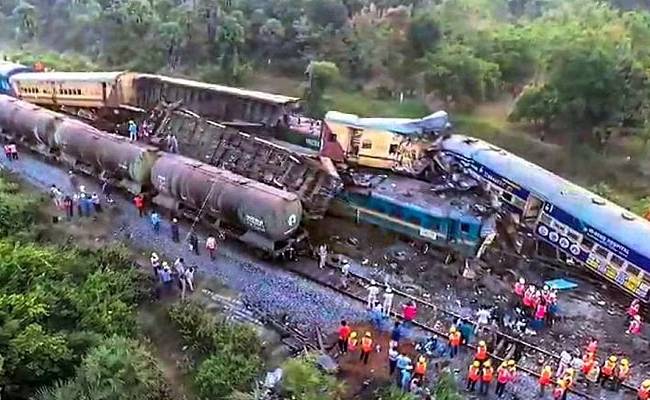
New Delhi (PTI): In the wake of the Sunday collision between two trains in Andhra Pradesh that killed at least 14 people, the Railway Board has issued directions to all zones to conduct an intensive two-week safety dive from October 31.
"Recent cases of SPADs (signal passed at danger) and accidents call for a resolve to strengthen alertness and enforcement of laid down practices and protocols in train operations," the board said in a letter sent to the general managers of all railway zones on October 30.
"Towards this, an Intensive Safety Drive of 2 weeks is to be launched immediately from 31-10-2023 to 14-11-2023, involving officers at all levels," the letter, accessed by PTI, added.
The board has listed 23 safety aspects and directed the zonal railways to emphasise these during the drive. It says that the officers and loco inspectors should randomly travel in the engine, especially at night, to see if safety norms are obeyed by the crew.
It has further said that loco inspectors should check physically as well as with the monitoring of the Crew Voice and Video Recording System (CVVRS) whether the crew -- loco pilot (LP) and assistant loco pilot (ALP) -- are calling out all signals loudly and clearly to each other (one of the crucial operation safety norms).
The loco inspectors are also asked to see whether the crew is using mobile phones while driving the train as the use of mobile phones is strictly prohibited for the drivers while the train is in operation.
The board wants the crew to be specifically monitored for their ability to handle the train at the yellow signal and in gradients so that they can stop promptly at red signals.
"The letter has asked loco inspectors to see how the crew controls the train in an automatic block system in which signals automatically work by the passage of the trains," a senior officer from one of the zones said, requesting anonymity.
He added, "Besides, the Board directs zones to monitor if the crew is following all speed restrictions meticulously and using the right braking technique for different types of loads. Crew medical conditions are also to be ascertained. The Board has also asked zones to see if qualitative family counselling sessions for the crew are being held."
The board has asked the zones to monitor whether the crew gets proper rest and if unusual instances and genuine grievances reported by them have been timely addressed.
"All the zones have to upload the weekly progress report of the drive on the system provided to them," the officer said.
But the train drivers' unions have called the board's initiative just another eyewash and a face-saving measure after two major train accidents within a fortnight.
They say that 10 to 15 per cent of posts of loco pilots are vacant in a majority of divisions and almost the same percentage is of those train drivers who are forced to work more than 12 hours.
Sanjay Pandhi, working president of the Indian Railway Loco Runningmen Organisation (IRLRO), shared a response of the Railway Board in 2010 to an application under the RTI Act in which the board had admitted that there is no provision for breakfast, lunch or dinner breaks for train drivers.
"The situation hasn't changed even today. The use of the word 'exigencies' in the working hours guidelines of the Railway goes in its favour. It says that they can use the crew beyond the limits prescribed in case of 'exigencies'," Pandhi said.
He added, "Taking passengers from one station to another is itself an exigency'. In the guise of an exigency clause, drivers are often asked to work for 15 hours or even more. There are no proper guidelines on how to relieve a running staff and who has the final authority to relieve them from work."
Pandhi also cited a circular of the Ahmedabad Railways Division dated May 2023 regarding the crew's excess working hours, which shows that 23 per cent crew worked beyond 12 hours.
"Night duties are not defined. Drivers cannot take a break to answer their natural calls as in many engines there are no washrooms," he alleged, demanding the board to also focus on these aspects.
Let the Truth be known. If you read VB and like VB, please be a VB Supporter and Help us deliver the Truth to one and all.
Rickelton's ton in vain as SRH beat MI by 6 wickets
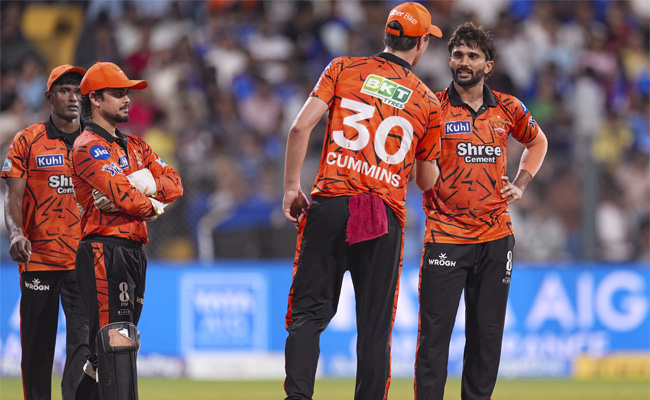
Mumbai (PTI): Ryan Rickelton's whirlwind unbeaten ton was overshadowed by Heinrich Klaasen's unbeaten 65 as Sunrisers Hyderabad defeated Mumbai Indians by six wickets in an IPL match here on Wednesday.
Chasing an imposing 244-run target, Travis Head (76 off 30) and Abhishek Sharma (45 off 24) shared 129 runs for the opening wicket to set the platform for SRH.
Klaasen (65 not out off 30 balls) then displayed his all-round hitting abilities to guide SRH home with the help of Nitish Kumar Reddy (21) and Salil Arora (30 not out off 10) in 18.4 overs.
Earlier, Rickelton's knock powered MI to 243 for five.
MI rode on a 93-run stand between Rickelton (123 not out off 55 balls) and Will Jacks (46 off 22) in 7.1 overs for the opening stand to power the side.
MI skipper Hardik Pandya scored a valuable 31 off 15 balls before being dismissed.
Praful Hinge (2/54), Eshan Malinga (1/29), Sakib Hasan (1/39) and Nitish Kumar Reddy (1/31) were the wicket-takers for SRH.
Brief Scores:
Mumbai Indian: 243 for 5 in 20 overs (Ryan Rickelton 123 not out; Praful Hinge 2/54).
Sunrisers Hyderabad: 249 for 4 in 18.4 overs (Travis Head 76, Heinrich Klaasen 65 not out; AM Ghazanfar 2/51).