Raipur stadium hosting India-Australia match has not paid electricity bills of Rs 3.16 crore
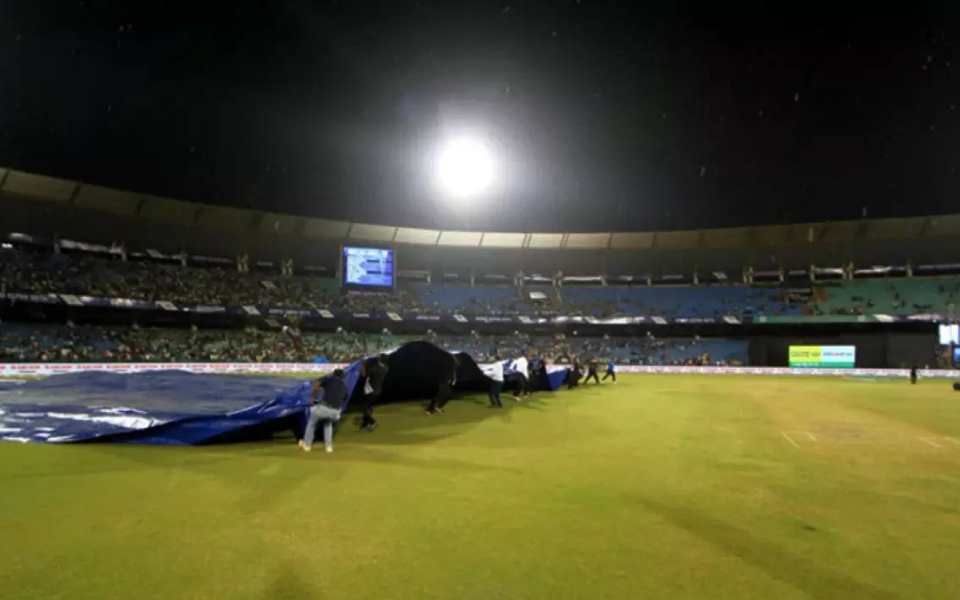
Raipur, Dec 1: The Shaheed Veer Narayan Singh International Cricket Stadium in Nava Raipur which hosted the fourth T20 match between India and Australia on Friday evening does not have a regular electricity connection because the state government authorities have not paid the power bills for the last several years.
The pending dues have now crossed Rs 3 crore. It does not affect the matches held there, however, as the Chhattisgarh State Cricket Sangh (CSCS) obtains a temporary connection from the Chhattisgarh State Power Distribution Company Limited (CSPDCL) whenever necessary.
"Power connection was provided to the stadium in 2010 on the application of the stadium construction committee. By 2018, outstanding bills had reached Rs 3.16 crore, following which the supply was disconnected," said Ashok Khandelwal, superintending engineer (Raipur circle), CSPDCL.
"Later, the stadium authority applied for a temporary connection of 200 kVA which was provided keeping in view security concerns as people visit it to watch matches," he said.
For the Friday's match too the Chhattisgarh State Cricket Sangh obtained a temporary connection and deposited Rs 10 lakh with the company, the official added.
"We have served notices to the state Sports and Youth Welfare Department for the recovery of dues. The department had earlier cited lack of budgetary provision. Recently it has assured that all the pending bills will be paid," said Khandelwal.
The Director of the Sports and Youth Welfare Department, Shweta Sinha, did not respond to calls and messages seeking her comment.
CSCS president Jubin Shah said the cricket association does not own the stadium.
"It is owned by the state government and managed by the Sports and Youth Welfare Department and Public Works Department. The association does not have any outstanding electricity bills to pay for the stadium," he said.
"Apart from the temporary power connection, we have our own external power sources. Earlier too matches were held there in the same way," Shah added.
Floodlights in the stadium are powered by generators because if the power supply gets disrupted, it takes half an hour to restart the lights, he said.
Let the Truth be known. If you read VB and like VB, please be a VB Supporter and Help us deliver the Truth to one and all.
4 held for sexually assaulting woman, girl on moving bus after social media alert in UP's Agra

Agra (UP) (PTI): Four people were arrested, after a prompt response by police following a social media alert, for allegedly sexually assaulting a woman and a girl inside a moving bus here, officials said on Tuesday.
According to an official police statement, at 12:27 am on April 27, information was received on the social media platform X about an incident of sexual assault on a bus travelling from Kanpur to Ahmedabad, which was approaching Namner crossing in Agra.
Acting under the direction of Police Commissioner Deepak Kumar, the Agra Police social media team immediately alerted the Rakabganj police station within minutes and coordinated with the victims to confirm the incident and obtain the exact location, it stated.
Police teams launched intensive checking at Namner crossing and intercepted the bus as it reached the spot. The four accused involved in the incident were apprehended on the spot, and legal action was initiated against them, the statement said.
The police said the swift response and coordination between the social media team and field units ensured timely action, bringing relief to the victims and other passengers, who expressed gratitude towards the police, it added.