Rajasthan BJP chief exhorts partymen to unite for polls
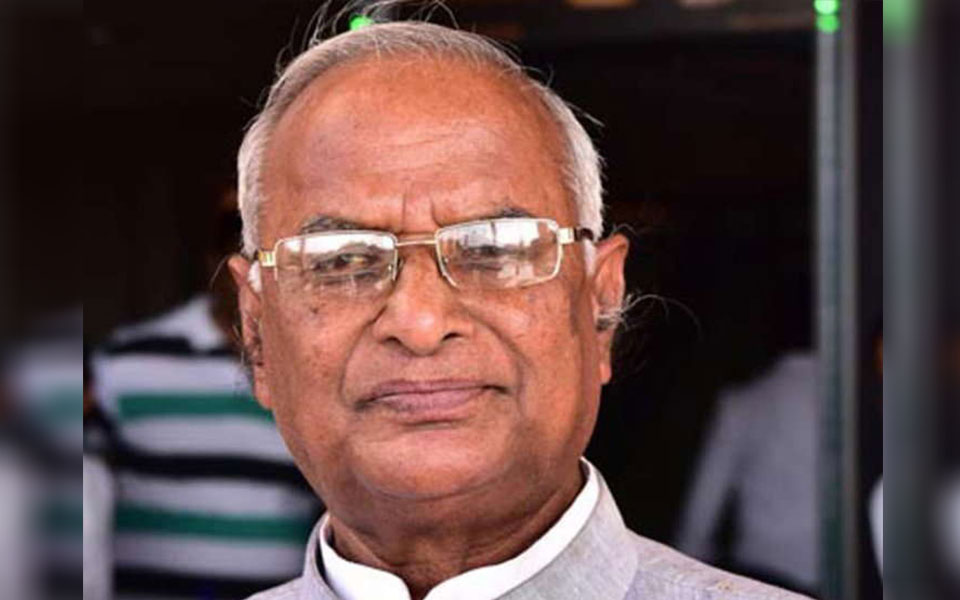
Jaipur, June 30: Madan Lal Saini on Saturday assumed the charge of Rajasthan Bharatiya Janata Party (BJP) president, a position which was lying vacant for nearly 74 days since the resignation of Ashok Parnami from the post on April 16.
The grand ceremony organised to welcome the new BJP president at the party headquarters here looked like a mega start of the political campaign for the ensuing Assembly and Lok Sabha elections.
Starting his speech on a motivating note, Saini called upon the BJP workers to forget infighting and their mutual differences in view of the upcoming elections, which according to him, will not be easy.
"Winning elections are never easy, one needs to sweat day in and out," he said, adding that he will search all old party workers who were anguished and demotivated for some reason and will motivate, reward and respect them to ensure they come and work for the party with full dedication in the coming elections to achieve "Mission 180" set by Chief Minister Vasundhara Raje for the assembly elections.
The new state BJP chief asked all members to end negativity around and work like a family, saying: "Party's all MLAs and MPs are a part of the family and hence we need to respect them. Coming time is tough and we need to win the elections.
"We have to break the chain in Rajasthan where one party wins election for one tenure while the other party wins the next election. We also need to sweep 25 seats in the Lok Sabha elections."
He also thanked PM Modi and BJP chief Amit Shah for trusting him with a big responsibility.
Sharing his principles and ideologies, he said: "I am a farmer and I feel proud to plough my fields. I have been travelling by bus from Sikar to Jaipur and will continue doing same. I don't prefer running after chair race. For me, that partially broken plastic chair of a worker is more comfortable where I can talk to my fellow workers."
He said that he would work on the principles of Jana Sagh whom he had seen collecting funds to build this party.
Vasundhara Raje also choose this platform to target the rival Congress, claiming that unlike them, the BJP cares for its grassroots workers.
"We appreciate the work of even the smallest worker of the party who works with dedication, unlike Congress where there is only one family representing the party since years.
"The PM of the country was once a small worker of the party who was elevated to the biggest rank looking at his dedicated and honest working. Similarly, we picked Madan Lal Saini who has been a grassroot worker.
"Earlier, we did shock Saini by nominating him for the post of Rajya Sabha MP and now we again shocked him by giving him party responsibility in Rajasthan looking at his hard work."
The Chief Minister said he has been handling the work of disciplinary committee with utmost dedication as he himself was a disciplined leader and under his directions, "I am confident that BJP will touch new heights and will attain Mission 180 in Assembly elections and Mission 25 in Lok Sabha elections."
Vasundhara also praised Ashok Parnami, former BJP president, on the occasion and lauded his prompt action in giving resignation on being asked to do so by party big command.
Attacking the Congress once again, saying unlike the spirit shown by Parnami, the Congress leaders cry before leaving their post. Even after resigning, Parnami continued giving all his services, she added.
Speaking to IANS, Archana Sharma, Vice President, Rajasthan Pradesh Congress Committee, said that infighting and lack of consensus between central and state leadership of the party was responsible for the BJP president's post lying vacant for 74 days.
"While central leadership wanted Gajendra Singh Shekhawat to be the state BJP president, the Rajasthan BJP was not ready with its proposal. The entire state as well as the nation was witness to this weird infighting within the party. Fed up with such infightings of the party, the people of the state will ensure a clear exit of the ruling party in the ensuing elections," said Sharma.
Let the Truth be known. If you read VB and like VB, please be a VB Supporter and Help us deliver the Truth to one and all.
Neutrality of polls can't be assured if EC dependent on contestants: Justice Nagarathna
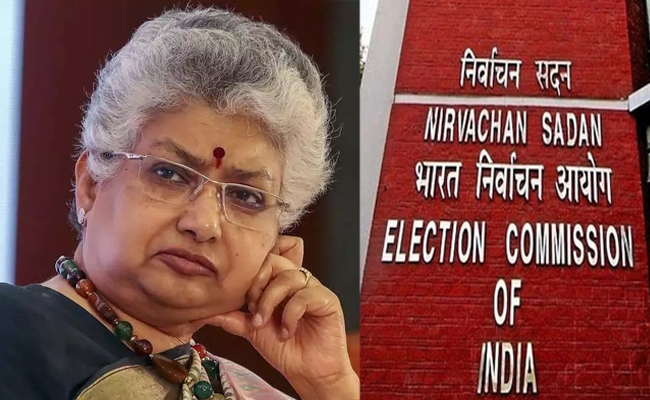
New Delhi (PTI): Supreme Court judge Justice BV Nagarathna, while highlighting that the Election Commission is the primary institution entrusted with maintaining the integrity of polls, has said if those who conduct elections are dependent on those who contest them, the neutrality of the process cannot be assured.
The apex court judge raised a critical concern regarding the structural independence of those tasked with overseeing the ballot while delivering the Rajendra Prasad Memorial Lecture at the Chanakya Law University in Patna on Saturday.
Citing a 1995 verdict where the Supreme Court recognised the Election Commission as a constitutional authority of high significance, entrusted with ensuring the integrity of elections, she said, "The concern, once again, was structural: if those who conduct elections are dependent on those who contest them, the neutrality of the process cannot be assured."
Justice Nagarathna said elections are not merely periodic events but a mechanism through which political authority is constituted.
"Our constitutional democracy has amply demonstrated smooth changes in government due to elections being held on a timely basis. Control over that process is, in effect, control over the conditions of political competition itself," she said.
The Supreme Court judge said power is not exercised only through formal institutions but also through the processes that sustain them, including elections, public finance, and regulation.
"A constitutional structure that seeks to restrain power must therefore go beyond its classical forms and address these fourth-branch institutions. A set of institutions, while not always fitting within the classical tripartite scheme, is nonetheless central to the maintenance of constitutional order," she said.
Justice Nagarathna said the unmistakable lesson of history is that constitutional collapse occurs through the disabling of its structure, and the violation of rights merely follows.
"The dismantling of structure, in turn, occurs when institutions stop checking each other. At that moment, elections may continue, courts may function, laws may be enacted by Parliament, and yet, power is effectively not restrained because the structural discipline no longer exists," she said.
The apex court judge also urged the Centre to view states as "coordinates and not subordinates" and asserted that the separation of powers was a "constitutional arrangement of co-equals."
Justice Nagarathna also called for keeping aside "inter-party differences" in the matter of "Centre-state relations", underscoring that governance must not depend on "which party may be ruling the Centre and which other party may be ruling at the state level".