Rajasthan Budget proposes Rs 6,800 cr to provide tap water, Rs 3,000 cr for solar parks
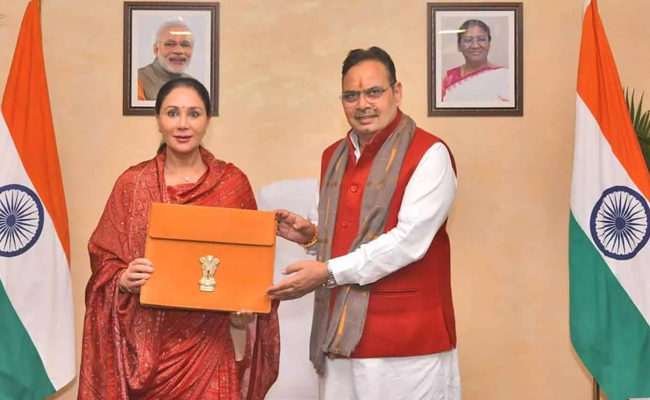
Jaipur (PTI): Rajasthan Deputy Chief Minister Diya Kumari on Wednesday proposed Rs 6,800 crore to provide tap water to the rural and urban population and around Rs 3,000 crore for building solar parks in Bikaner and Jaisalmer in the state Budget for 2026-27.
Presenting the Budget for the year 2026-27, the finance minister Kumari highlighted the impact of structural reforms and prudent financial management undertaken by the present government and said the state's economic size has expanded significantly.
She said under the CM Jal Jeevan Mission villages will be covered and every household will be connected to tap water. This will cost Rs 4,500 crore. Drinking water will be provided in cities at a cost of Rs 2,300 crore.
New solar parks will be built in Bikaner and Jaisalmer at Rs 2,950 crore.
Under the CM Self-Employment Scheme, interest-free loans and grants up to Rs 10 lakh will be provided. This will benefit 30,000 youth.
Moreover, Rs 1,400 crore will be spent on non-patchable roads and Rs 600 crore on missing link roads.
The Finance Minister said Rajasthan's economy is estimated to touch Rs 21,52,100 crore in 2026-27, and the per capita income of the state will also rise from Rs 1.67 lakh to Rs 2.02 lakh by the end of 2025-26.
Kumari said the growth reflects the government's focus on strengthening the economy through fiscal discipline and policy reforms.
She said Inspired by Prime Minister Narendra Modi, the state government is continuously striving to take the state forward on the path of economic prosperity, sustainable and inclusive development, embracing the core principles of "Sabka Saath, Sabka Vikas, Sabka Vishwas, Sabka Prayas."
In her budget speech, she said, "To realize the vision of a developed Rajasthan by 2047, our government, under the able leadership of Chief Minister Bhajan Lal Sharma, has prioritized service, dedication, and good governance, keeping in mind the important role of the poor, youth, farmers, and women in this development journey."
Let the Truth be known. If you read VB and like VB, please be a VB Supporter and Help us deliver the Truth to one and all.
Rickelton's ton in vain as SRH beat MI by 6 wickets

Mumbai (PTI): Ryan Rickelton's whirlwind unbeaten ton was overshadowed by Heinrich Klaasen's unbeaten 65 as Sunrisers Hyderabad defeated Mumbai Indians by six wickets in an IPL match here on Wednesday.
Chasing an imposing 244-run target, Travis Head (76 off 30) and Abhishek Sharma (45 off 24) shared 129 runs for the opening wicket to set the platform for SRH.
Klaasen (65 not out off 30 balls) then displayed his all-round hitting abilities to guide SRH home with the help of Nitish Kumar Reddy (21) and Salil Arora (30 not out off 10) in 18.4 overs.
Earlier, Rickelton's knock powered MI to 243 for five.
MI rode on a 93-run stand between Rickelton (123 not out off 55 balls) and Will Jacks (46 off 22) in 7.1 overs for the opening stand to power the side.
MI skipper Hardik Pandya scored a valuable 31 off 15 balls before being dismissed.
Praful Hinge (2/54), Eshan Malinga (1/29), Sakib Hasan (1/39) and Nitish Kumar Reddy (1/31) were the wicket-takers for SRH.
Brief Scores:
Mumbai Indian: 243 for 5 in 20 overs (Ryan Rickelton 123 not out; Praful Hinge 2/54).
Sunrisers Hyderabad: 249 for 4 in 18.4 overs (Travis Head 76, Heinrich Klaasen 65 not out; AM Ghazanfar 2/51).