Rajasthan govt introduces three bills to negate impact of Centre's farm laws
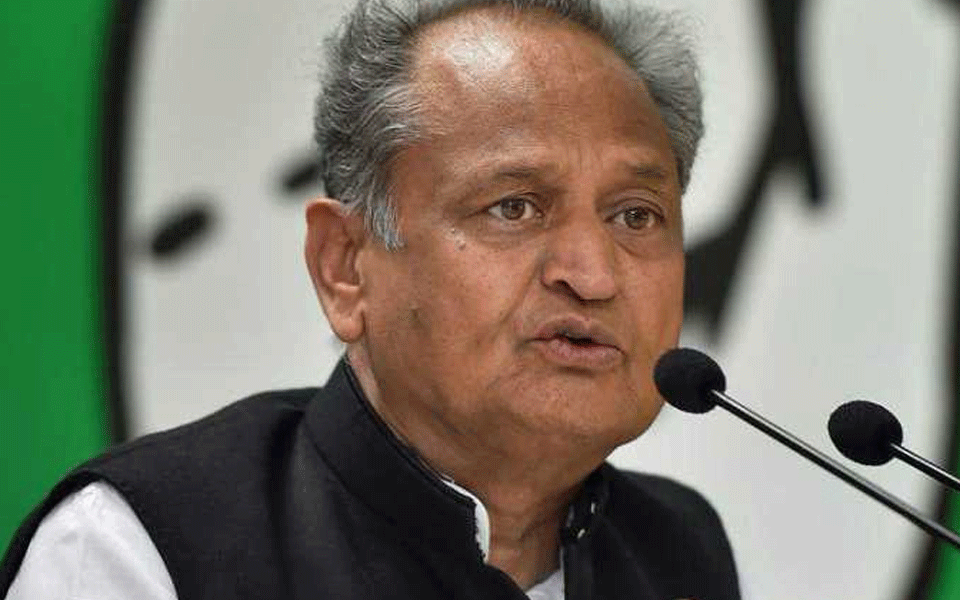
Jaipur: The Rajasthan government on Saturday introduced three bills in the Assembly to negate the impact of the farm laws enacted by the Centre recently.
The move comes after the Punjab Assembly earlier this month adopted a resolution against the farm laws and unanimously passed four bills to counter the Centre's contentious legislations.
Rajasthan's Parliamentary Affairs Minister Shanti Dhariwal introduced the Essential Commodities (Special Provisions and Rajasthan Amendment) Bill 2020, the Farmers (Empowerment and Protection) Agreement on Price Assurance and Farm Services (Rajasthan Amendment) Bill 2020 and the Farmers Produce Trade and Commerce (Promotion and Facilitation and Rajasthan Amendment) Bill 2020.
He also introduced the Code of Procedure (Rajasthan Amendment) Bill 2020 on the first day of the Assembly session.
A number of provisions to protect the interests of farmers, including sale or purchase of a crop under farming agreement on a price equal or greater than minimum support price and imprisonment of three to seven years for harassment of farmers, have been included in the bills.
The Congress leadership has suggested that states where it is in power should pass laws of their own to counter the central legislations that had triggered farmers' protests in several parts of the country.
In the Farmers (Empowerment and Protection) Agreement on Price Assurance and Farm Services (Rajasthan Amendment) Bill, a provision states, "Provided further that no Farming Agreement for the sale or purchase of a crop shall be valid unless the price paid for such agricultural produce is equal to, or greater than, the prevailing Minimum Support Prices, announced by the Central Government for that crop.
Apart from a few other amendments, three new sections have been added as special provisions for Rajasthan, providing for punishment for harassment of farmers and powers to the state government to give directions.
The bill proposes punishment of imprisonment from three to seven years with or without a fine of Rs five lakh if any person, company or corporate house or any other association or body of persons harasses farmers.
"There has been extraordinary outrage amongst the farmers, farm labourers and all others engaged in incidental and ancillary agricultural activities. Since the direct consequences of the Central Act would be to nullify the minimum support price mechanism that has stood the test of time and introduce several other infirmities and distortions operating to the grave detriment and prejudice of agriculture and the communities associated with it," the statement of the bill said.
"The Parliament has also introduced a mechanism for production, trade and commerce in agricultural produce through this Central Act, that is vulnerable to encroachment and manipulation by vested corporate interests through provisions such as contract farming minus a guarantee of minimum support price and leaving the farmer open to the vagaries of market forces for getting a remunerative price for agricultural produce, fruits and vegetables. No check has been provided against exploitation of farmer, it said.
In the Farmers Produce Trade and Commerce (Promotion and Facilitation and Rajasthan Amendment) Bill, one of the proposed amendments pertains to regulation of notified agriculture produce, which says that the state government may notify a Fee/Cess/Cesses/Charges on notified agricultural produce, brought or bought or sold, by a corporate or trader for trade and commerce in a trade area.
The Rajasthan government also introduced three other bills on the first day of the session -- the Rajasthan Epidemic Diseases (Amendment) Bill-2020, the Code of Civil Procedure (Rajasthan Amendment) Bill-2020 and the Rajasthan University of Veterinary and Animal Sciences (Amendment) Bill-2020.
The House was adjourned for the day after obituary references on the death of former president Pranab Mukherjee and other leaders who passed away recently.
After the House was adjourned, deputy leader of opposition Rajendra Rathore told reporters that the BJP will oppose the bills and will prove during the debate on Monday that the central laws are in favour of farmers.
State Congress president Govind Singh Dotasra said that Prime Minister Narendra Modi had promised, during election campaigns, doubling the income of farmers but after winning the elections he worked to serve the interests of the corporate houses and anti-farmers legislations were enacted.
The three central farm bills -- the Farmer's Produce Trade and Commerce (Promotion and Facilitation) Bill, 2020, the Farmers (Empowerment and Protection) Agreement of Price Assurance and Farm Services Bill, 2020 and the Essential Commodities (Amendment) Bill, 2020 -- were passed by Parliament recently. Subsequently, President Ram Nath Kovind gave his assent to the bills.
The Centre has asserted that these new laws will be beneficial for farmers and will increase their income.
Earlier, Rajasthan Chief Minister Ashok Gehlot had said his state would follow Punjab in bypassing the "anti-farmer laws".
"INC under the leadership of Smt #SoniaGandhi ji& #RahulGandhi ji stands absolutely with our annadatas and will continue to oppose the anti-farmer laws passed by NDA Govt. Today Congress Govt in #Punjab has passed Bills against these laws & #Rajasthan will follow soon, Gehlot tweeted on October 20.
Let the Truth be known. If you read VB and like VB, please be a VB Supporter and Help us deliver the Truth to one and all.
Bengal: Over 55 pc turnout till 1 pm in repoll in 15 booths of 2 assembly seats
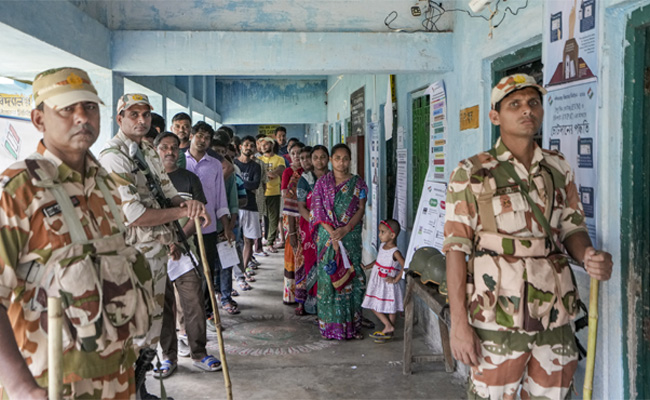
Kolkata (PTI): Over 55 per cent turnout was recorded till 1 pm in repoll in 15 booths of two assembly constituencies in West Bengal's South 24 Parganas district on Saturday, an official said.
Voting was underway more or less peacefully at 11 polling stations of Magrahat Paschim assembly constituency and four in Diamond Harbour, where the EC ordered repoll a day ago, following reports of electoral malpractices.
However, at booth number 179 at Chanda Primary School of Diamond Harbour seat, the Trinamool Congress alleged that a specially abled voter and his mother were harassed by central forces. The alleged incident sparked protests by party workers and locals.
The TMC claimed that the voter's mother, who had entered the booth to assist him, and her son were detained for a considerable time by central forces over alleged rule violations.
ALSO READ: Man arrested for duping Delhi resident of Rs 2 lakh in online car sale fraud
"TMC leaders Manmohini Biswas and Pratik Ur Rahman reached the spot and led the protests, with residents terming the action unwarranted harassment. The matter has been taken care of by our officials there," an official of the poll body said.
Polling was otherwise peaceful across 15 booths in the area, he added.
Voting began at 7 am and will continue till 6 pm, the official said, adding that till 1 pm, the turnout was 55.57 per cent.
Magrahat Paschim registered 56.33 per cent voter turnout, while in Diamond Harbour, it was 54.9 per cent, a poll official stated.
Voting in these two assembly constituencies was held in the second phase of the state elections on April 29.
The repoll order was based on reports received from returning officers and observers of the two constituencies and "material circumstances", the Election Commission official said.
In Magrahat Paschim, TMC's Md Samim Ahamed Molla is pitted against BJP nominee Goursundar Ghosh, while Abdul Majid Halder of the Congress and ISF candidate Abdul Aziz Al Hassan are also in the fray.
TMC candidate Panna Lal Halder is contesting against Dipak Kumar Halder of the BJP in the Diamond Harbour seat. Goutam Bhattacharya of the Congress and CPI(M)'s Samar Naiya are among other candidates.
The BJP had alleged rampant electoral malpractices in certain polling stations of both the assembly seats under the Diamond Harbour Lok Sabha constituency, which is represented by TMC national general secretary Abhishek Banerjee.
The EC had deputed its special observer, Subrata Gupta, to fact-check the allegations from the ground.
The poll panel will decide on repolling in the Falta assembly constituency on Saturday.
The West Bengal assembly elections were held in two phases -- April 23 and April 29 -- amid unprecedented security arrangements.
Counting of votes will take place on May 4.