Rajnath questions Pakistan's ability to handle nuclear weapons
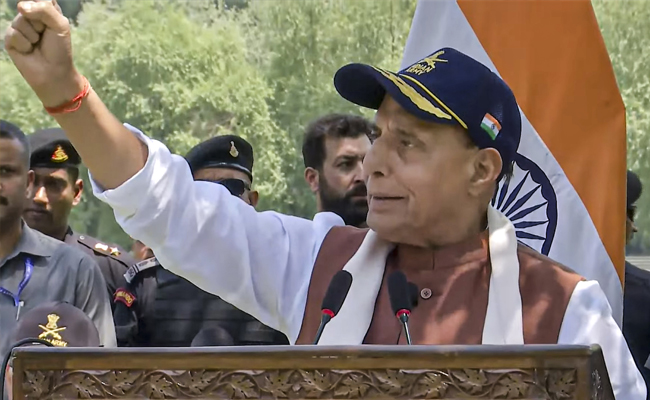
Srinagar (PTI): Defence Minister Rajnath Singh on Thursday questioned the safety of nuclear weapons in the hands of Pakistan, and said they should be taken under monitoring of the International Atomic Energy Agency.
Interacting with troops here in his first visit to Jammu and Kashmir since Operation Sindoor, he said the operation has made it clear to terror outfits and their masters in Pakistan that they should not consider themselves safe anywhere.
"I want to raise question before whole world: are nuclear weapons safe in hands of Pakistan, a rogue and irresponsible nation," he said.
Pakistan's nuclear weapons should be taken under monitoring of International Atomic Energy Agency (IAEA), he demanded.
IAEA is a global nuclear watchdog.
The defence minister is on a visit to Jammu and Kashmir to take stock of the overall security situation, especially along the Line of Control (LoC) and International Border.
Top military officials will brief the defence minister on various aspects of the prevailing security situation, officials said.
The defence minister will review the overall situation as well as combat readiness of the frontline troops at the Indian Army's XV Corps in Srinagar.
India carried out precision strikes on terror infrastructure early on May 7 following which Pakistan attempted to attack Indian military bases on May 8, 9 and 10.
The Pakistani actions were strongly responded to by the Indian side. The Indian military targeted eight Pakistani air bases with missiles and other long-range weapons on May 10 in retaliation for Pakistan's attempts to strikes 26 military facilities.
The hostilities ended with an understanding on stopping the military actions following talks between the Director Generals of Military Operations of both sides on the afternoon of May 10.
Let the Truth be known. If you read VB and like VB, please be a VB Supporter and Help us deliver the Truth to one and all.
Karnataka: Three held for murder of Tibetan man in Dharwad district

Dharwad (Karnataka) (PTI): Three people were arrested on Monday in connection with the murder of a Tibetan man in this district, police said on Monday.
Tashi Dhondup (39), a Buddhist monk and resident of Mundagod, was found dead near Haliyal Bridge on the Dharwad bypass on April 29, they said.
Police said the body bore injury marks on the face, indicating foul play.
Upon receiving information about an unidentified body within the limits of Dharwad Rural Police Station, a highway patrol team and emergency services rushed to the spot and alerted senior officials.
Following inspection and identification of the deceased, a case of murder was registered the same day based on visible injuries and findings from the scene of crime team, a senior police officer said.
Superintendent of Police Gunjan Arya said the motive appears to be “murder for gain”. The accused allegedly demanded money from the victim and assaulted him when he failed to comply, leading to his death.
Three accused, all from Kolhapur district in neighbouring Maharashtra, have been arrested, while efforts are on to nab two others involved in the crime.
Further investigation is underway.