Rajnath Singh commissions ICG's 1st indigenously built pollution control vessel 'Samudra Pratap'
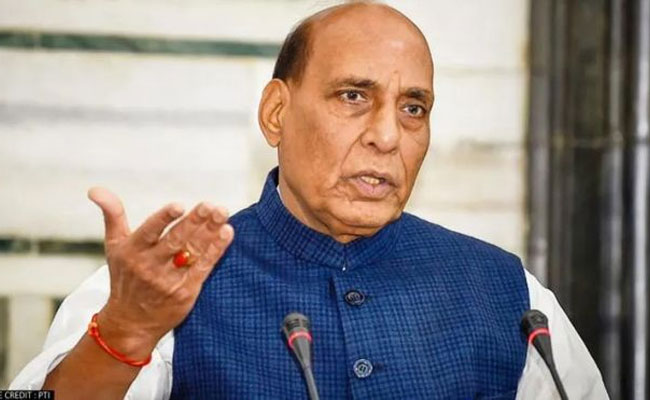
Panaji (PTI): Defence Minister Rajnath Singh commissioned the Indian Coast Guard's (ICG) first indigenously designed and built pollution control vessel 'Samudra Pratap' in Goa on Monday.
The 114.5-metre vessel, built by the Goa Shipyard Limited (GSL), has over 60 per cent of indigenous content. The 4,200-tonne vessel boasts a speed of more than 22 knots and an endurance of 6,000 nautical miles, officials said.
It will serve as a critical platform for enforcing marine pollution control regulations, maritime law enforcement, search and rescue operations, and safeguarding India’s Exclusive Economic Zone.
As the largest and most advanced pollution control vessel built in India, Samudra Pratap stands as a testament to the nation's shipbuilding excellence and long-term vision for a cleaner, safer, and self-reliant maritime future, the ICG said in a statement.
The vessel was formally delivered in December to the Coast Guard at GSL.
Defence Minister Singh on Monday commissioned the ship at GSL, Vasco, in South Goa.
Chief Minister Pramod Sawant, Union Defence Secretary Rajesh Kumar Singh and ICG Director General Paramesh Sivamani were present on the occasion.
Singh said this occasion is connected to India's great maritime vision.
"India believes that marine resources are not the property of any one country; they are the shared heritage of humanity," he said.
"When heritage is shared, its responsibility is also shared. This is why India has today become a responsible maritime power," he added.
Singh noted that Samudra Pratap is India's first indigenously designed pollution control vessel.
ALSO READ: Bengaluru: Juvenile held for filming inside women’s washroom at cinema theatre
"It is the largest vessel in the Coast Guard fleet to date," he said.
More than 60 per cent indigenous material has been used in it. "In itself, this is a strong step forward in the direction of a self-reliant India. The true meaning of 'Make in India' is visible in projects like this," he said.
Singh said that "even in such a complex platform, we have achieved this level of indigenous content, which shows that our defence industrial ecosystem has now become quite mature."
"But it needs to become even more mature. I want not just 60 per cent, but up to 90 per cent indigenous content in our ships. This is our endeavour," he commented
India has achieved such capabilities in defence manufacturing that today it is able to handle even complex challenges related to manufacturing, he said.
Singh said that in recent years, marine pollution has been seen emerging as a serious challenge.
"It is obvious that as marine pollution increases, it will affect the livelihood of fishermen, the future of coastal communities, and the safety of our coming generations," he pointed out.
Singh also said that ensuring adequate participation of women is the goal of their government.
"I am happy that, keeping this vision in mind, the Coast Guard has given due attention to women's empowerment. This is a matter of pride for us," he said.
He noted that women officers have been appointed to important responsibilities such as pilot, observer, air traffic controller, and logistics officer.
"Not only this, they are being trained for hovercraft operations. They are being actively deployed in frontline operations. Today, women are not only in support roles, but are also serving as front-line warriors," he said.
The commissioning of 'Samudra Pratap' marks a major step forward in India's pursuit of 'atmanirbharta' (self-reliance) in shipbuilding and maritime capability development, the ICG said.
Samudra Pratap, meaning Majesty of the Seas, reflects the Indian Coast Guard's resolve to ensure safe, secure and clean seas while safeguarding the nation's maritime interests. The ship represents a major advancement in indigenous ship design and construction, it said.
The vessel has been entirely conceived, designed, and built in India with over 60 per cent indigenous content.
Measuring 114.5 meters in length and 16.5 meters in beam, the ship can achieve speeds exceeding 22 knots and is equipped with advanced automation and computerised control systems, underscoring India's growing capability in complex shipbuilding, the ICG said.
Displacing approximately 4,200 tons, the ship is powered by two 7,500 kW diesel engines driving indigenously developed controllable pitch propellers and gearboxes, offering superior manoeuvrability, flexibility and endurance of 6,000 nautical miles.
The vessel's primary role is pollution response at sea, supported by state-of-the-art systems including side-sweeping arms, floating booms, high-capacity skimmers, portable barges, and a pollution control laboratory, the ICG said.
The ship is also fitted with an external fire-fighting system (Fi-Fi Class 1) and integrates advanced systems such as dynamic positioning, integrated bridge system, integrated platform management system, and automated power management system to enhance automation and mission efficiency.
Its armament includes a 30 mm CRN-91 gun and two 12.7 mm stabilised remote-controlled guns supported by modern fire-control systems.
Commanded by Deputy Inspector General Ashok Kumar Bhama, the ship, to be based at Kochi, has a complement of 14 officers and 115 personnel. The complement includes the maiden appointment of two women officers who will be performing duties shoulder to shoulder with their male counterparts, the ICG said.
Let the Truth be known. If you read VB and like VB, please be a VB Supporter and Help us deliver the Truth to one and all.
Sringeri postal ballot recount: Cong MLA Raje Gowda’s tally reduced by 255 votes
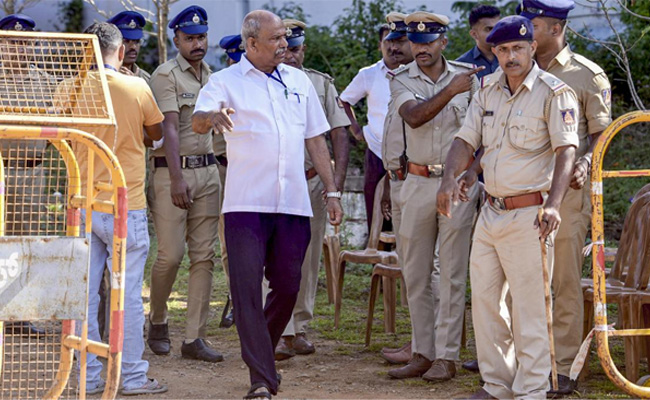
Chikkamagaluru (Karnataka) (PTI): After the reverification and recount of postal ballots for the Sringeri Assembly constituency, votes polled for Congress MLA T D Raje Gowda were reduced by 255, the returning officer said.
A report on the matter has been submitted to the Election Commission for further decision, he said.
Following a Karnataka High Court order on the election petition filed by BJP’s defeated candidate D N Jeevaraj challenging Raje Gowda’s election, the reverification and recounting took place on Saturday and continued until midnight.
Raje Gowda had won the 2023 Assembly polls from Sringeri by 201 votes.
“The High Court on April 6 had ordered reverification and recounting. As per that order, the exercise has been completed. The court order did not direct us to announce the results; it also did not refer to EVM votes. The order was specific only to postal ballots,” returning officer Gaurav Kumar Shetty said.
Speaking to reporters late on Saturday night, he said, “During the 2023 vote counting, Jeevaraj had received 692 votes, while Raje Gowda had received 569 votes. Now, after reverification and recounting, Jeevaraj has 690 valid votes, which is two votes less than earlier, while Raje Gowda has 314 votes, a difference of 255 votes.”
After the reverification and recounting as per the court order, the strong room was sealed, and a report was sent to the Election Commission.
The returning officer said that as per Election Commission rules, there are clear guidelines on how to accept or reject a vote, and the procedure was followed accordingly.
Regarding allegations of vote tampering, he said the allegations are criminal in nature and do not fall under his jurisdiction.
Jeevaraj, speaking to reporters, said, “As per the current count, I have the majority. Officials have said that the Election Commission will make the formal announcement. I will wait for the Commission’s order.”
Raje Gowda expressed doubts about “vote tampering” and demanded a detailed inquiry into Jeevaraj and others. He said he would file a case in this regard.
“There are markings on the ballots polled in my favour. Different ink has been used; it is clearly visible. During the 2023 counting, all those ballots were deemed valid in the presence of counting agents of all parties. Now, such votes have been declared invalid, bringing down my tally,” he told reporters.
Raje Gowda and his supporters had earlier celebrated on Saturday, claiming the results were in their favour.
Meanwhile, Deputy Chief Minister and state Congress president D K Shivakumar on Sunday alleged a “big conspiracy” in Sringeri.
Speaking to reporters in Bengaluru, he said the Congress would take up the matter legally and would pursue all possible steps from the government.
“No one can imagine that they (the BJP) will indulge in such criminal activity. This is evidence of how former MLA Jeevaraj misused officials close to him. I have received a report, and I am studying it. It is systematic criminal activity. I will go through the report and take further action. I had been watching developments overnight,” he added.
State BJP president B Y Vijayendra said that, as per his information, the Congress was pressuring officials not to declare the results.
Speaking to reporters in Tumakuru, he said, “Jeevaraj, after losing the election, went to court. Now, after the High Court order, recounting has happened, and Jeevaraj has won by 56 votes. There appears to be a conspiracy by the ruling Congress to delay the announcement of results to allow Raje Gowda time to approach the High Court.”
Jeevaraj has already faced “injustice” for about three years by being denied the MLA post, Vijayendra said. “The injustice should not continue, and the Congress should accept the mandate of the people.”
Leader of Opposition R Ashoka accused the Congress and its leader, Rahul Gandhi, of “vote theft.”
“The Congress, which has been illegitimately enjoying power in the Sringeri Assembly seat for the past three years, now faces humiliation. This is not merely the victory of one individual; it is the victory of democracy. It is a hard-earned triumph for the value of the votes cast by Sringeri’s voters,” he posted on X, congratulating Jeevaraj.