Rajya Sabha passes 7 key bills in three and half hours
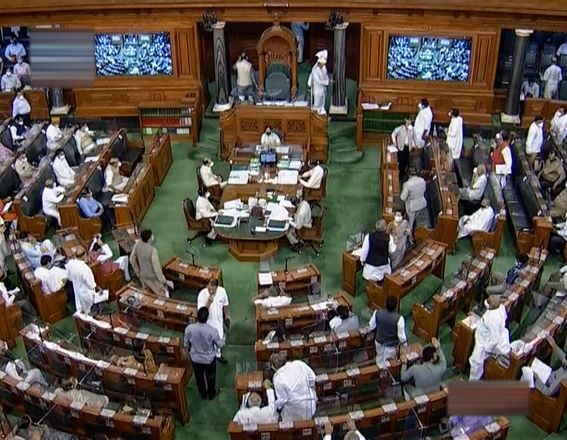
New Delhi: In one of the most productive days in its history, Rajya Sabha on Tuesday in a matter of three and half hours passed seven key bills including one that removes cereals, pulses and onion from the essential commodities list and another that abolishes penalty for certain offences by companies.
This after most of the opposition including the Congress, Left parties, the TMC, the Samajwadi Party and the NCP decided to boycott House proceedings in protest against the suspension of eight MPs for the remainder of the session for unruly behaviour.
Only members from the ruling BJP and its ally JD-U and those of parties such as AIADMK, BJD, YSR-Congress and TDP, which have been extending support to the Modi government on various issues, participated in the debates on the bills.
In most bills, the members participation was sparse and the minister's reply brief.
The Upper House took up government legislative business after nearly an hour of discussion over the conduct of opposition MPs during the passage of two agriculture reform bills on Sunday, with Chairman M Venkaiah Naidu saying the suspension could be revoked if the members expressed regret over their action.
First, it passed a bill to declare five newly-established Indian Institutes of Information Technology (IIITs) as institutions of national importance.
The crucial Essential Commodities (Amendment) Bill, which removes cereals, pulses, oilseeds, edible oils, onion and potatoes from the list of essential commodities and removes stockholding limits on them, was passed next.
This bill is part of the agriculture reforms bills that the government is pushing to raise farm incomes.
The bills passed on Sunday gave farmers the freedom to sell produce anywhere in the country and enter into forward contracts with companies.
Rajya Sabha also passed amendments to the Bank Regulation Act to bring cooperative banks under the supervision of the RBI in a bid to protect the interest of depositors.
Thereafter the Companies (Amendment) Bill, 2020, which removes the penalty for certain offences, was passed.
The National Forensic Sciences University Bill, 2020 and the Rashtriya Rakash University Bill were passed in quick succession.
Thereafter the Taxation and Other Laws (Relaxation and Amendment of Certain Provisions) Bill, 2020 to relax time limit on compliance with tax laws, GST payment and filing in view of the coronavirus pandemic.
The Essential Commodities (Amendment) Bill, 2020 as well as the Taxation and Other Laws (Relaxation and Amendment of Certain Provisions) Bill, 2020 replace emergency ordinances.
The sitting of the Rajya Sabha was extended by just over an hour beyond the scheduled time to allow the passage of the bills. The legislative business started at 10.29 hours and ended at 14.03 hrs - 214 minutes in all.
All the seven bills have already been passed by Lok Sabha and will now be sent to the President for assent. Once he gives his assent, they will become the law.
Let the Truth be known. If you read VB and like VB, please be a VB Supporter and Help us deliver the Truth to one and all.
AIITA welcomes Karnataka’s ban on obscene songs in school events
Bhatkal: The Karnataka unit of the All India Ideal Teachers Association (AIITA) has welcomed the Karnataka government’s decision to strictly ban school children from dancing to obscene songs during educational and cultural programmes in government, aided, and private schools across the state.
AIITA Karnataka State President M. R. Manvi congratulated the government for taking what he termed an important step to preserve the sanctity of education.
“Such decisions to safeguard the dignity of school children and uphold the values of education are the need of the hour. This rule should not be limited to government schools alone but must be strictly implemented in all private educational institutions as well,” he said.
He further urged the government to address other concerns within school programmes.
“The government should not only prohibit obscene dances in the name of school anniversaries, but also ensure that plays and dialogues that incite religious hatred are avoided. Schools should be centres of harmony, not platforms for spreading hatred,” he added.
According to a recent circular issued by the Department of School Education and Literacy, obscene dances are adversely affecting the mental health and moral values of students.
In this regard, schools have been advised to use songs that promote nationalism, positive thinking, the greatness of Kannada culture, and value-based traditions instead of inappropriate content during programmes.
The circular also emphasises that students should be dressed in decent attire.
AIITA also backed the department’s warning that disciplinary action would be taken against head teachers if such guidelines are violated. The association has further demanded that district Deputy Directors of Public Instruction strictly monitor the implementation of these rules.