Rajya Sabha passes bill to remove Bhogta caste from SC list
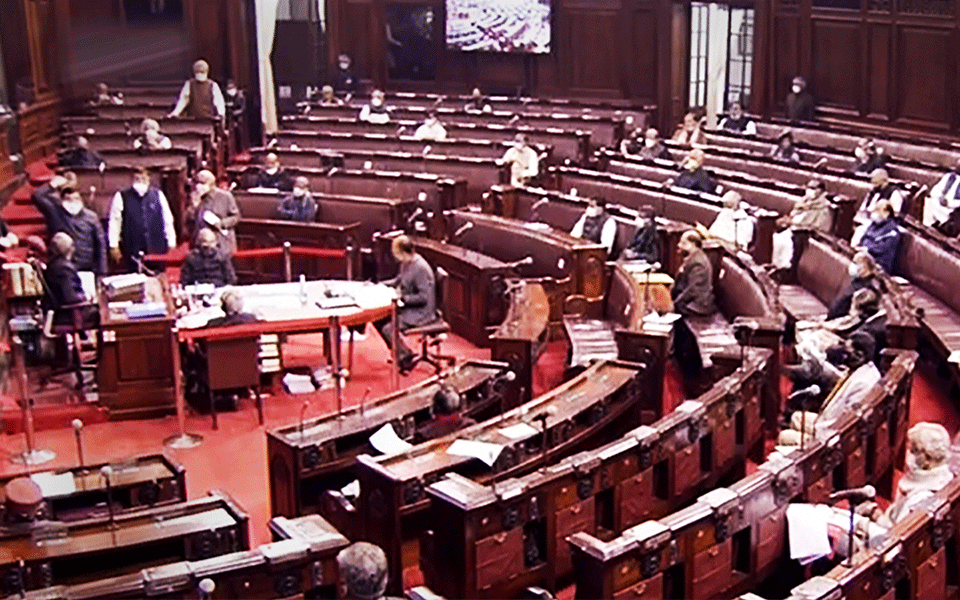
New Delhi (PTI): The Rajya Sabha on Wednesday approved a bill that seeks to remove the Bhogta caste from the list of Scheduled Castes (SCs) and include certain communities in the list of Scheduled Tribes (STs) for Jharkhand.
The Constitution (Scheduled Castes and Scheduled Tribes) Order (Amendment) Bill, 2022 was introduced in the Upper House of Parliament on February 7. It was passed by a voice vote on Wednesday.
Replying to the debate of the bill, Tribal Affairs Minister Arjun Munda said, "We will bring such amendments related to more states in the House. We have done (such amendments for) Arunachal Pradesh and Karnataka. Now, it is being done in case of Uttar Pradesh, Tripura and Jharkhand. We are doing research on Odisha. We have completed the work in Chhattisgarh, but we are working on some observations given on that by the law ministry."
He said the Centre is concerned about the development of tribal people and the aspirational district programme is a step in that direction as the main objective is to bridge the gap between the rich and the poor.
"Be it Chhattisgarh, Maharashtra or Gujarat, for all the states, the Centre is earnestly and seriously working to address the issues, while also assuring that the government will share the status on the demand for the inclusion of different communities from West Bengal, Goa and Tamil Nadu," the minister said.
The bill also aims at helping people get more benefits from the provisions of reservation in education and government jobs. The bill amends the Constitution (Scheduled Castes) Order, 1950 and the Constitution (Scheduled Tribes) Order, 1950.
The Scheduled Castes order specifies the castes, races and tribes deemed to be Scheduled Castes in various states and Union territories, while the Scheduled Tribes order specifies the same for tribes and tribal communities.
The bill amends the schedule to the Scheduled Tribes order to include the Deshwari, Ganjhu, Dautalbandi (Dwalbandi), Patbandi, Raut, Maajhia, Khairi (Kheri), Tamaria (Tamadia) and Puran communities in the Scheduled Tribes list of Jharkhand.
Further, the schedule to the Scheduled Castes order is being amended to omit the Bhogta community from the list of Scheduled Castes. The community is instead being included in the list of Scheduled Tribes in the state.
The government keeps amending the lists originally notified in 1950 based on the requests made by various states.
Let the Truth be known. If you read VB and like VB, please be a VB Supporter and Help us deliver the Truth to one and all.
TN seeks duty-free cotton imports to support textile sector: CM Vijay writes to PM
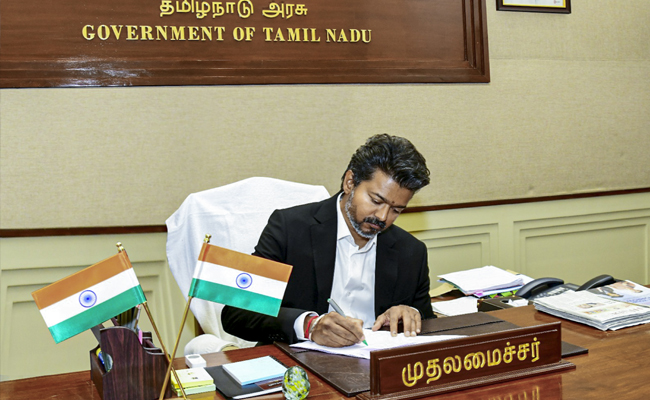
Chennai (PTI): Tamil Nadu Chief Minister C Joseph Vijay on Thursday urged Prime Minister Narendra Modi to remove the import duty on cotton.
In his first letter to Modi after taking over as chief minister of the state, he said Tamil Nadu is the country’s largest textile and apparel exporting state.
Lakhs of people are dependent on this sector for both direct and indirect employment, especially women from rural and semi-urban backgrounds, Vijay pointed out.
Stating that the industry is facing a severe crisis due to an increase in cotton prices and consequently yarn prices, he said, “I understand this is caused primarily due to a shortage in cotton production and increased trading activity in the country.”
Pointing out that the price of cotton has increased from Rs 54,700 to Rs 67,700 per candy—an increase of 25 per cent over the last two months—while yarn prices have increased from Rs 301 to Rs 330 per kg, he said, “In this situation, the continued supply of raw material can be ensured only through imports.”
However, there is an import duty of 11 per cent on cotton, he said, adding that in such a situation, permitting duty-free cotton imports will help the industry meet increasing export commitments and remain globally competitive.
Vijay said that after agriculture, the textile and apparel sector is one of the largest employment-generating sectors.
“There is a significant responsibility on the government to safeguard the employment of lakhs of people and ensure the sustainability of the textile value chain," he said.
“Hence, I request your intervention to remove the import duty on cotton from the existing 11 per cent to 0 per cent to ensure the availability of raw material. This measure will enable the textile and apparel industry to remain globally competitive, enhance exports, and protect jobs,” he added.