Raziyya Sultan, Nur Jehan dropped from new Class 8 history textbook

New Delhi: Controversy does not seem to end regarding the new NCERT Class 8 history textbook as influential women icons Raziyya Sultan, who once ruled the Delhi Sultanate, and Nur Jehan from the Mughal era, have reportedly been omitted.
Earlier, students learned about the Delhi Sultanate and the Mughal era in Class 7, but the new Class 7 textbooks now conclude before the 12th century, as reported by The Hindu. The content has now been included in Part One of the new Class 8 textbook, where the omission of these key female figures has raised concerns.
In previous textbook, Raziyya Sultan, who ruled from 1236 to 1240, was portrayed as a capable ruler, more "able" and "qualified" than her brothers. It was also stated that Raziyya mentioned on her inscriptions and coins that she was the daughter of Sultan Iltutmish, in contrast to queen Rudramadevi of the Kakatiya dynasty who changed her name on inscriptions and pretended to be a man, added the report.
However, the new Class 8 textbook that features Delhi Sultanate and the Mughals in Chapter 2 - Reshaping India's Political Map does not mention any women ruler or queen of the time. Similarly, the old textbook recognised Emperor Jahangir's wife Nur Jehan for her "influence in Jahangir’s court," noting that she issued seals in her name, granting her equal status with the emperor. This mention has also been removed from the new edition.
Meanwhile, some new figures have been added in the latest textbook, such as Rani Durgavati, the queen of the Garha Kingdom, and Tarabai, the Maratha warrior queen. The textbook mentions that Rani Durgavati "led her troops and fought bravely" against Akbar's attempts to attack her kingdom in 1564.
“A section on Begum Hazrat Mahal of Awadh had been included. She has been called a "heroine", and one who joined the rebels during the 1857 uprising,” The Hindu quoted Michel Danino, NCERT's Curricular Area Group head for Social Science textbooks, as saying.
He also explained that the decision to exclude certain figures was driven by space constraints and the mandate to reduce syllabus content. "We would have liked to include more such influential women icons, however at one point the question was that of simply space,” he said.
Additionally, the textbook skips the mention of Tipu Sultan, Haidar Ali or the Anglo-Mysore wars of 1700s in its chapter on India’s colonial era, which has been described as time when “one of the richest lands of the world had become one of the poorest”.
Let the Truth be known. If you read VB and like VB, please be a VB Supporter and Help us deliver the Truth to one and all.
Cong slams Modi govt as 'anti-worker', calls for review of new Labour code
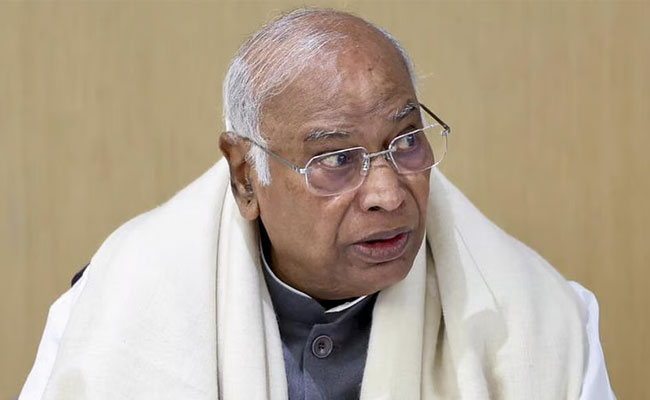
New Delhi (PTI): The Congress on Friday accused the Modi government of being "anti-worker" and demanded that the new labour code be reviewed, MGNREGA be revived as well as a national minimum wage of Rs 400 per day be established.
On International Labour Day, Congress president Mallikarjun Kharge took a swipe at the government and said unemployment in India today is a direct consequence of the 'Hum Do, Hamare Do' policies.
"Driven by the 'Hum Do, Hamare Do' policy, the Modi government implemented an anti-worker Labour Code. As a result, unrest has erupted everywhere - be it in Noida, at the IOCL facility in Panipat, Adani's factory in Raikheda, NTPC Patratu, or the Samsung factory in Sriperumbudur," Kharge said in a post in Hindi on X.
Instead of ensuring job security, this Code promotes policies such as contract labour and 'Hire & Fire' practices, Kharge said and called for a review of the new Labour Code.
The Modi government has effectively dismantled MGNREGA by forcibly pushing legislation through Parliament, he alleged.
"Mr. Modi has shifted 40% of the wage burden onto the State governments. State governments are unable to bear this financial strain and will eventually be forced to stop providing work," he claimed.
The Modi government has compelled workers into a state of unemployment and pushed them towards 'gig work', Kharge said.
Currently, 69% of the workforce is working for wages below the statutory minimum wage, he said.
The Modi government has engineered a crisis of stagnant wages, Kharge alleged.
"When adjusted for inflation, the wages of the majority of India's workers have grown by less than 1% annually over the last decade (from 2014-15 to 2022-23)," he said.
The Modi government has created a massive unemployment crisis among the educated workforce, specifically, among graduates, Kharge claimed and added that jobs have been eliminated through the sale of Public Sector Undertakings (PSUs).
"The government has refused to fill approximately 30 lakh vacant government positions. Furthermore, the government's policy blunders have led to the decimation of Micro, Small, and Medium Enterprises (MSMEs)," the Congress chief said.
The Congress reiterates its five demands for India's workers including revival of MGNREGA and its expansion to urban areas, Kharge said.
He said a national minimum wage of Rs 400 per day should be established, with MNREGA included within its scope.
Kharged demanded that a 'Right to Health' law must be enacted, providing Universal Health Coverage of up to Rs 25 lakh for laborers and workers.
"'Life Insurance and Accident Insurance' coverage must be provided for all unorganized workers. Preventing the contractualization of employment must be made a core priority of the government, and the new Labour Codes must be reviewed," Kharge asserted.