RBI to allow retail investors to directly enter govt securities market
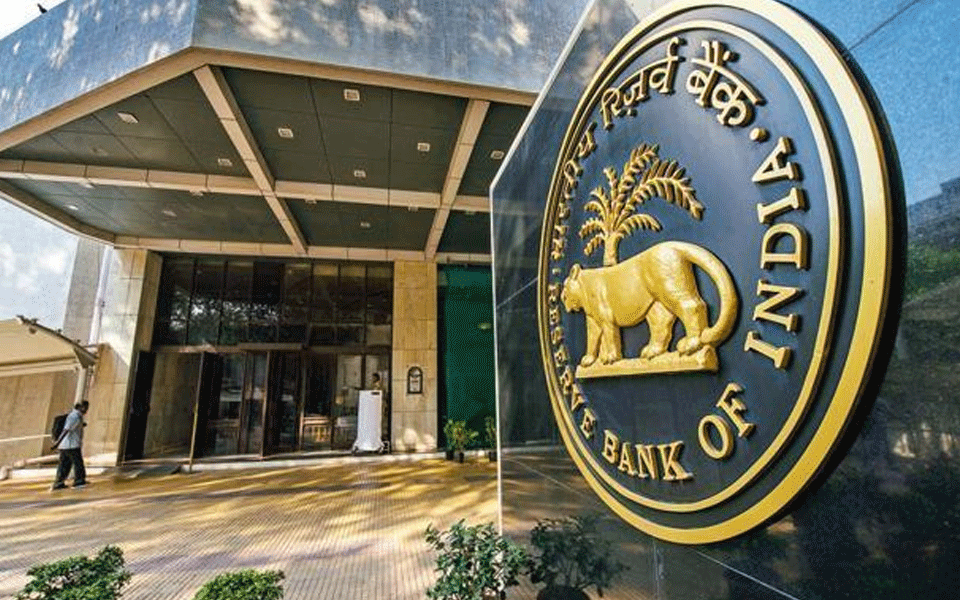
Mumbai: In a major move aimed at encouraging small investors to become direct investors in government bonds or stated simply to an infinite source of lending to the government, the Reserve Bank on Friday said it will allow them to directly buy government debt, making India the first Asian country to do so and among a handful globally.
The central bank, tasked with managing a whopping Rs 12 lakh crore in government borrowing target next fiscal, hopes the move will allow greater depth to the gilt market in particular and the overall debt market in general thus deepening the financial markets as lack of depth has been the biggest bane of the domestic debt market all this while.
In effect the RBI has opened a long, endless tap for the government to borrow from-- just as is done in the domestic stock market now, with the only difference being this will be under direct the watch of the RBI.
Currently, the RBI allows small investors to buy government bonds via the Gobid platform on BSE and NSE, but it has not gained any traction.
While no country allows a direct retail participation as the RBI has promised now, Britain, Brazil and Hungary allow small investors to buy/sell through third-party controls.
This is the second major step that the RBI is taking to encourage retail investors to enter the gilt market after it had allowed entry through the stock exchanges a few years back but did not elicit the intended result.
Under the new plan, all an investor needs to do is to open a gilt securities account ('retail direct') with the RBI is all what it said, as details of the facility will be issued separately.
As part of continuing efforts to increase retail participation in government securities and to improve ease of access, it has been decided to move beyond aggregator model and provide retail investors online access to government securities market, both primary and secondary, along with the facility to open a gilt securities account (retail direct) with the RBI, Governor Shaktikanta Das said while announcing the monetary policy.
It can be noted RBI has been encouraging retail participation in the government securities market for long with several initiatives like introduction of non-competitive bidding in primary auctions, permitting stock exchanges to act as aggregators/facilitators for retail investors and allowing odd-lot segment in the NDS-OM (negotiated dealing system-order matching) secondary market, among others, in the past.
Let the Truth be known. If you read VB and like VB, please be a VB Supporter and Help us deliver the Truth to one and all.
Maharashtra sets up state vaccination task force to strengthen immunisation programme

Mumbai (PTI): The Maharashtra government has set up a State Vaccination Task Force to strengthen the regular immunisation programme and review the progress of related campaigns, a health department official said on Monday.
The State Vaccination Task Force will comprise at least 29 members and will be headed by the administrative head of the health department, he informed.
The government has also constituted separate district-level and municipal vaccination task forces to improve implementation and address challenges at the grassroots level, he said.
Municipal task forces, chaired by respective civic commissioners, have been constituted in view of the vast urban population in Maharashtra and the role of civic bodies in implementing different health programmes.
The district-level task forces will function under the chairmanship of collectors.
"Complete immunisation of children at the appropriate age is an extremely simple, cost-effective and highly effective measure to reduce child mortality and the prevalence of diseases among kids. Immunisation is a powerful tool for reducing illness in children," maintained the official.
To ensure full vaccination of all children, the state government implements various campaigns from time to time as per the central government guidelines, he pointed out.
"Active participation and cooperation of other relevant government departments are essential (in making these campaigns successful)," according to the official.
The state-level body will review the regular immunisation programme, associated campaigns and vaccine-preventable diseases in detail. It will also conduct focused assessments of high-risk districts and municipal corporations, including vacancies at district, municipal and sub-district levels, availability of cold chain equipment, resource gaps and training requirements, he noted.
The state task force will review allocation and utilisation of funds for immunisation and ensure timely action by officers concerned based on reports from district and municipal task forces and state-level monitoring mechanisms, the official said.
It will also ensure active coordination and participation of other government departments in immunisation drives, while district and municipal task forces will carry out similar functions at their respective levels, the official added.