RBI's Guwahati General Manager allegedly commits suicide in hotel room in Odisha

Bhubaneswar: A general manager of the Reserve Bank of India's (RBI) Guwahati branch allegedly committed suicide by hanging himself at a hotel in Odisha's Jajpur, the police said on Friday.
The incident occurred at Chandikhola on Friday morning. The dead man has been identified as Asish Ranjan Samal, a resident of Naraharipur village in Jajpur district.
The man had come to his native village on Thursday to meet his mother. Thereafter, he went to Bhubaneswar to meet his wife, a doctor at the Kalinga Institute of Medical Science (KIIMS), and son, a 12th standard student.
The police said that Mr Samal had checked into the hotel on Thursday afternoon. On Friday morning, when the hotel staff knocked at the door of the room, he did not answer following which the hotel staff called the police. The police found him hanging from the ceiling fan of the room.
The identity of the dead man was ascertained by the documents provided by Mr Samal at the time of check-in, said the Inspector-In-Charge of Barachana police station, Deepak Kumar Jena.
Courtesy: IANS
Let the Truth be known. If you read VB and like VB, please be a VB Supporter and Help us deliver the Truth to one and all.
Tribals, Scheduled Castes preserved India's identity and soul despite foreign invasions: Bhagwat
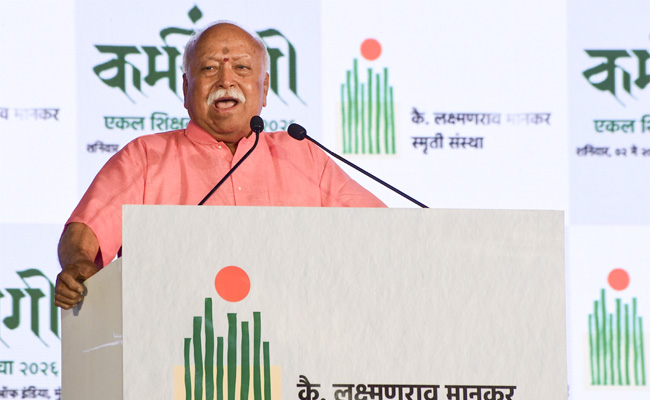
Mumbai (PTI): RSS chief Mohan Bhagwat has said that despite foreign invasions and hardships, tribal communities and Scheduled Castes preserved the country's identity and soul, stressing the need to integrate them into the mainstream development process.
He was speaking on Saturday at the Karmayogi awards ceremony in Mumbai, where Union Road Transport and Highways Minister Nitin Gadkari was also present.
"Human life is defined by giving back to the world, as we are all part of one great family. A person works and spends for the betterment of society, not as a favour, but out of duty. In serving others, we foster our own development. By helping others to thrive, we elevate ourselves and grow as human beings. This principle is the core value of this Indian land, commonly known as a Hindu society," Bhagwat said.
"This is the society's enduring ethos, which has survived for thousands of years. For various reasons, partly because of our indifference and partly because of foreign invasion, those who preserved this ethos paid a heavy price," he said.
The foreign invaders found that this ethos, this value system of the society is its soul and the key to keeping it alive. So they ensured that those who tried to preserve this soul would be uprooted and face extreme hardships, the Rashtriya Swayamsevak Sangh (RSS) chief noted.
But despite foreign invasions and hardships, tribal communities and Scheduled Castes preserved the country's identity and its soul, he said.
"Despite such adversities, the country's core identity remained intact among tribal communities and those belonging to SC and ST groups," he said, emphasising the need to integrate them into the mainstream development process while ensuring they receive equal access to services and facilities.
Referring to global developments, Bhagwat said the present world is "stumbling forward" and struggling to maintain balance, and asserted that India could emerge as a stabilising force.
The country must not only safeguard its own interests but also extend support to the world, he said.
"The world should get to see that the country is not only solving its own misery and sorrow but also helping the world to address similar issues," he said.
The RSS chief stressed that service to society is not a favour but a duty that contributes to one's own development.
Helping others grow also elevates individuals and strengthens the collective fabric of society, he said.
The so-called educated and developed sections have, over time, distanced themselves from these communities, Bhagwat pointed out, and called for the need to bridge this gap.
The identities preserved by these communities represent the true identity of Indian society, he said and underlined that without identity, existence itself is at risk.