Red Fort metro station to remain closed on Wednesday: DMRC
_vb_24.jpeg)
New Delhi (PTI): The Delhi Metro Rail Corporation (DMRC) on Tuesday said that the Lal Quila Metro Station will remain closed on Wednesday as a precautionary measure, a day after a blast occurred near the Red Fort area.
In a post on X, the DMRC said, "Due to security reasons, the Lal Quila Metro Station shall continue to remain closed on November 12. All other stations are functional as normal."
The Red Fort metro station is closed for commuters today, after a blast in the area killed at least nine people, while traffic restrictions have also been imposed in the area, officials said on Tuesday.
A high-intensity explosion ripped through a slow-moving car at a traffic signal near the Red Fort metro station on Monday evening kill 12. Twenty people were also injured in the blast that gutted several vehicles, they added.
Additionally, parts of the Chandni Chowk market near to the Red Fort and other market areas nearby were closed today.
Service Update
— Delhi Metro Rail Corporation (@OfficialDMRC) November 11, 2025
Due to security reasons the Lal Quila Metro Station shall continue to remain closed on 12th of November also.
All other stations are functional as normal.
Please follow our social media channels for further updates.
Let the Truth be known. If you read VB and like VB, please be a VB Supporter and Help us deliver the Truth to one and all.
Allen, Raghuvanshi, Green power KKR to 29-run win over GT
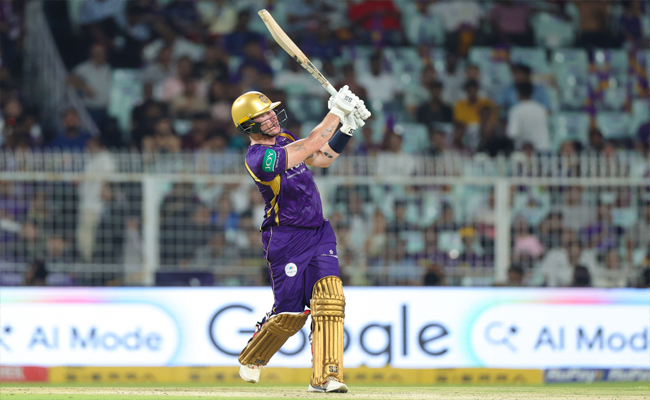
Kolkata (PTI): Finn Allen blasted a 35-ball 93, while Angkrish Raghuvanshi hit an unbeaten 44-ball 82 as Kolkata Knight Riders kept their playoff hopes alive with a 29-run win over Gujarat Titans in the IPL match here on Saturday.
Sent in to bat, Allen went on a six-hitting spree, smashing 10 maximums and four boundaries to add 95 off 41 balls with Raghuvanshi (82).
Raghuvanshi then shared another 108 off 53 balls with Cameron Green (52 not out) to power KKR to a challenging 247 for 2.
In reply, GT could manage 218-4, riding on skipper Shubman Gill's 49-ball 85 and a 35-ball 57 from Jos Buttler. Opener Sai Sudarsan was retired hurt but returned to make a 28-ball 53 not out.
Sunil Narine (2/29) claimed two wickets and Saurabh Dubey snapped one for KKR.
For GT, Mohammed Siraj (1/50), Sai Kishore (1/38) were the wicket-takers.
Brief Score:
KKR: 247 for 2 in 20 overs (Finn Allen 93, Angkrish Raghuvanshi 82 not out, Camero Green 52 not out; Mohammed Siraj 1/50).
GT: 218 for 4 in 20 overs (Shubman Gill 85, Sunil Narine 2/29).