Release grant for Vizhinjam seaport without seeking repayment: Kerala CM to Union FM
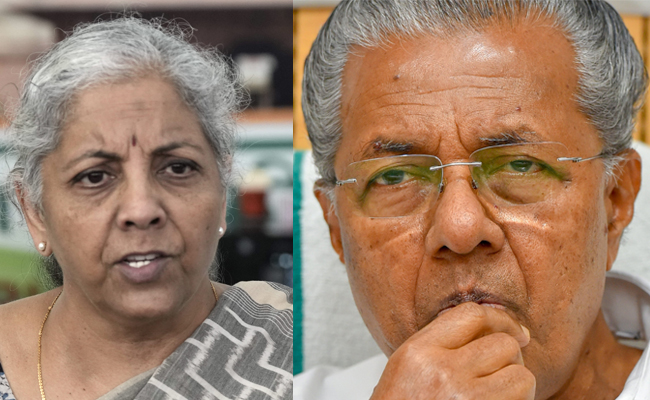
Thiruvananthapuram (PTI): Kerala Chief Minister Pinarayi Vijayan has urged Union Finance Minister Nirmala Sitharaman to release the Centre's share of Rs 817.80 crore in the Viability Gap Funding (VGF) for the Vizhinjam seaport here without imposing the condition that the state has to repay it later.
Vijayan, in a letter to the FM, said the condition imposed by the Empowered Committee constituted by the Department of Economic Affairs, that the VGF amount should be repaid by Kerala in Net Present Value (NPV) terms by way of premium (revenue) sharing, would result in a huge loss of Rs 10,000 to 12,000 crore to the state exchequer.
"The state is investing resources to the tune of Rs 5,595 crore out of the total project outlay of Rs 8,867 crore. I am sure, the Hon'ble Minister would appreciate that given the financial situation of a small state, like Kerala with limited financial resources, this scale of investment involves tremendous sacrifice on the part of the state.
"In addition, as the repayment of Rs 817.80 crore is to be made on NPV basis, this would involve a further loss of Rs 10,000 to 12,000 crore to the state exchequer in actual terms, computed on projected interest rates and revenue realisation from the port over the period of repayment," the CM said.
He further said that the VGF was a financial support mechanism that was introduced to encourage Public-Private Partnerships (PPPs) in infrastructure projects that are economically justified but not financially viable without additional financial support.
The VGF is invariably provided as a grant, not a loan and its defining elements are that "the payment to the concessionaire is non-repayable, it is a one-time grant and that it is over the construction period of the project", the CM said.
Thus, the condition that the VGF has to be repaid, "defies the rationale" behind it, he added.
"..the government of India and government of Kerala, as the two project proponents, have jointly decided to give this grant to the concessionaire.
"But to further stipulate the condition that one of the project proponents, viz.- the government of India, will advance this money as a deferred 'loan' to the other project proponent viz.- the state government, defies the rationale behind the VGF itself," he said in the letter.
Vijayan further said that such a condition of VGF repayment was not imposed on the Outer Harbor project of VOC Tuticorin Port which is "structured on similar lines as the Vizhinjam International Seaport".
"In the light of the facts outlined above, I request you to kindly accord the same treatment for Vizhinjam International Seaport as has been done for Tuticorin Port referred to above," he said.
The CM also pointed out in his letter that ports in India account for a lion's share of the Customs duties collected in the country and even on a modest assessment, "if Vizhinjam seaport were to account for Rs 10,000 crore annually by way of Customs duties, the government of India would derive additional revenue of Rs 6,000 crore every year".
"I seek your kind intervention for the release of the share of the government of India in the VGF for the Vizhinjam International Seaport, without imposing the condition that the state must repay it later and help avoid the huge financial loss of approximately Rs 10,000 to 12,000 crore in nominal terms to the state exchequer," the CM said in his letter to Sitharaman.
Let the Truth be known. If you read VB and like VB, please be a VB Supporter and Help us deliver the Truth to one and all.
Sujit Nair raises concerns over speculation of DMK-AIADMK understanding to block TVK
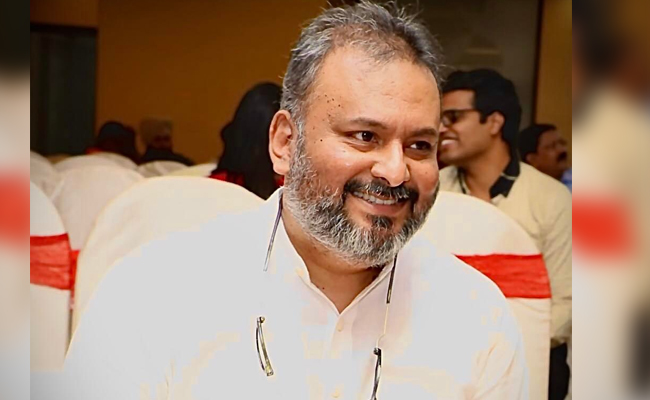
Chennai: Journalist and political commentator Sujit Nair has expressed concern over speculation that the Dravida Munnetra Kazhagam and the All India Anna Dravida Munnetra Kazhagam could explore a post-poll understanding to prevent Vijay-led Tamilaga Vettri Kazhagam from forming the government in Tamil Nadu.
In a social media post, Sujit Nair said the election verdict in Tamil Nadu reflected a clear public demand for political change and argued that the mandate should be respected irrespective of political preferences.
Referring to reports and political discussions surrounding a possible understanding between the DMK and AIADMK, he said he hoped such developments remained only speculative conversations and did not turn into reality.
Nair stated that if such an alliance were to take shape, it would raise serious questions about ideological politics in the country. He said TVK had emerged through a democratic electoral process and that the legitimacy to govern in a parliamentary democracy comes from the people’s verdict.
According to him, attempts to prevent an electoral winner from forming the government through unexpected political arrangements may be constitutionally valid, but many people could view them as politically opportunistic.
He further said that such a move could particularly affect the political image of the DMK, which has historically projected itself around ideology, social justice and opposition politics. Nair said that in ideological terms, the DMK appeared closer to TVK than to the AIADMK, and joining hands with its long-time political rival only to remain in power could weaken its broader political narrative.
He added that the same questions would apply to the AIADMK as well, as the party had spent decades positioning itself against the DMK and such an arrangement could create discomfort among its cadre and supporters.
Drawing a comparison with Maharashtra politics in 2019, Nair said he had expressed similar views when the Shiv Sena formed an alliance with the Indian National Congress and the Nationalist Congress Party after the Assembly elections.
He said post-poll alliances between long-standing political rivals often create a public perception that ideology and electoral mandates become secondary when political power equations come into play.
Nair also said such developments increase public cynicism towards politics and reinforce the belief among voters that ideology is often sidelined after elections.
He maintained that the Tamil Nadu verdict was emphatic and said respecting both the spirit and substance of the mandate was important for the credibility of democratic politics.