Reports on election commissioner Lavasa recusing himself from meetings 'unsavoury': CEC
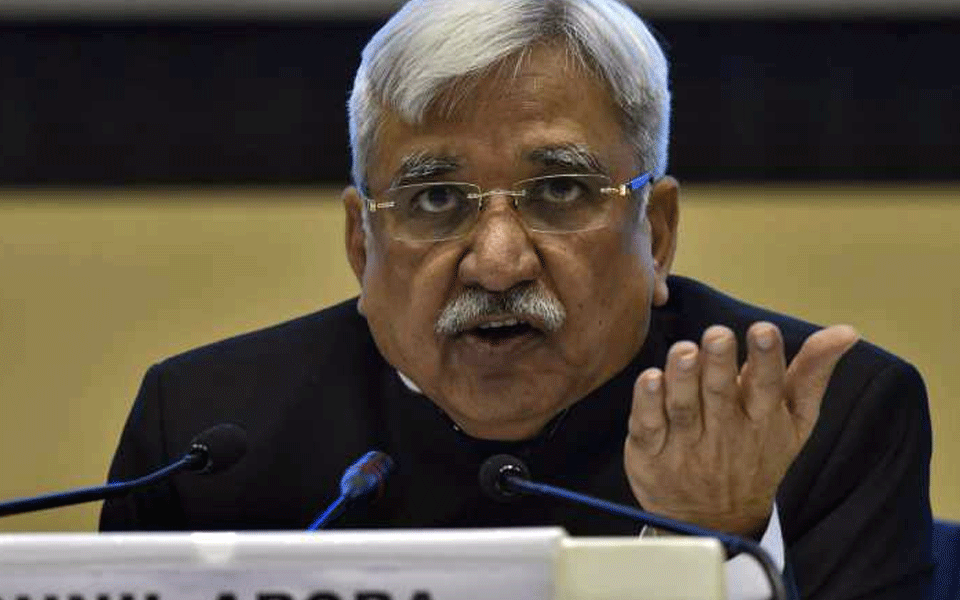
New Delhi: Chief Election Commissioner Sunil Arora Saturday described as "unsavory" and "avoidable" reports that fellow commissioner Ashok Lavasa has decided to recuse himself from meetings related to model code violations till he is not allowed to record his dissent.
He also said in the last meeting of the commission on May 14, it was "unanimously" decided to form groups to deliberate issues which arose in the course of conduct of Lok Sabha elections.
"Out of the 13 issues/areas which were identified, model code of conduct is one of them," Arora said in a statement.
He said the report on Lavasa's decision not to take part in model code related issues comes at a time when the poll watchdog is gearing up for the last phase of Lok Sabha polls and counting of votes.
"The three members of the ECI are not expected to be template or clones of each other. There have been so many times in the past when there has been a vast diversion of views as it can and should be. But the same largely remained within the confines of the ECI," Arora said.
The poll panel's laws suggest preference for an unanimous view, but provide for a majority ruling in the absence of unanimity.
In a strongly-worded letter to Arora on May 4, Lavasa is learnt to have said he is being forced to stay away from the meetings of the full commission since minority decisions are not being recorded.
He is also learnt to have said his participation in the meeting is "meaningless" as his dissent remained unrecorded.
Lavasa said his notes on the need for transparency have not been responded to so he has decided to stay away from model code related complaints.
The EC's legal division had opined that dissent cannot be recorded on decisions as model code violations are not part of a quasi judicial hearing where all the three -- the CEC and two fellow commissioners sign.
The majority view is conveyed to the parties concerned.The dissent remains recorded in the file only and not made public.
Lavasa had dissented in some of the 11 decisions the EC took on complaints against Prime Minister Narendra Modi and BJP chief Amit Shah for alleged model code violations.
The two were given a clean chit in all the decisions.
Let the Truth be known. If you read VB and like VB, please be a VB Supporter and Help us deliver the Truth to one and all.
UP man gets life term for electrocuting mentally challenged wife to death in Bareilly
Bareilly (UP) (PTI): A local court here has sentenced a man to life imprisonment for murdering his mentally challenged wife by repeatedly electrocuting her while she was tied to a cot, lawyers said on Thursday.
Additional district government counsel Harendra Singh Rathore said Additional Sessions Judge Avinash Kumar Singh on Wednesday convicted Vinod Kumar (45) for killing his wife, Satyavati, in Chaina village of Bareilly district and imposed a fine of Rs 15,000 on him.
According to the prosecution, he was allegedly frustrated with his wife Satyavati's mental illness and often assaulted her.
Rathore said the prosecution examined nine witnesses to establish the charges against him.
As per court records, on the night of May 1-2, 2022, when Satyavati was asleep, Vinod tied her hands and legs to a cot using ropes and then connected an aluminium cable to an electric board to repeatedly administer electric shocks to her.
"She writhed in pain, but the accused continued to electrocute her until she died," the prosecution said.
The court observed that the murder was carried out in an inhuman manner.
After committing the crime, the accused threw the rope and cable on the roof and left for work at a brick kiln around 2 am to create a false alibi.
He later tried to mislead the police and the victim's family by claiming that Satyavati, whose mental condition was unstable, had accidentally died by suicide after grabbing a live electric wire.
However, the victim's brother, Sanjeev, a resident of Shahjahanpur district, suspected foul play and lodged an FIR under sections 498A (husband subjecting wife to cruelty) and 302 (murder) of the Indian Penal Code at Nawabganj police station.
During the trial, the prosecution relied on the post-mortem report prepared by Dr Faraz Anwar, who stated that multiple electrocution marks found on different parts of the victim's body could not have been self-inflicted.
The police also recovered the rope and electric wire used in the crime on the accused's identification, officials said.