Request Sonia Gandhi to return Nehru's letters to Prime Ministers' Museum: Minister Shekhawat
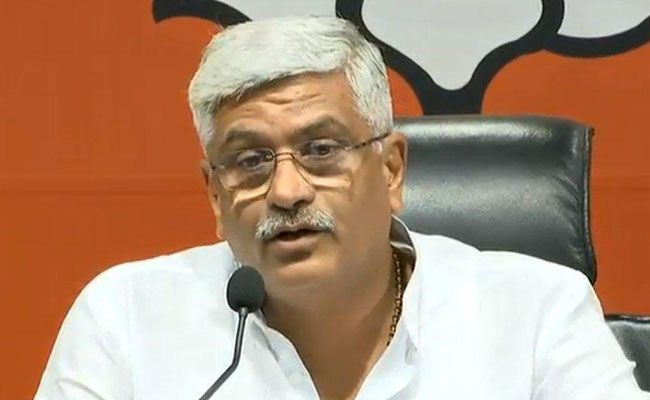
New Delhi (PTI): Union Minister of Culture and Tourism Gajendra Singh Shekhawat on Sunday urged former Congress president Sonia Gandhi to return the correspondences and documents of first prime minister Jawaharlal Nehru to the Prime Ministers' Museum and Library, stating that they belonged to the country and not to any individual.
In an interview with PTI Videos, Shekhawat also said Aravalli Hills controversy was a classic example of the Congress creating an issue out of a non-issue.
Talking about Nehru's letters and documents, the minister said, "The Prime Ministers' Museum and Library (PMML), which was formerly the Nehru Memorial Museum and Library (NMML), was established after the death of Prime Minister Jawaharlal Nehru. A society was created (to manage the museum) but it did not function properly. Subsequently, the NMML was renamed as PMML (in 2023)."
ALSO READ: Armed robbers flee with gold jewellery worth several kilos from Hunsur showroom
The culture minister said that over a 20-year period from 1970 to 1990, all non-official documents related to Nehru were brought to the museum; this included the personal letters Nehru wrote to people, the replies received, and his personal comments and notes.
"Similar documents of all the prime ministers are preserved in the Prime Ministers' Museum. There are approximately 2.5 crore such documents. Of these, 4 lakh are related to Pandit Jawaharlal Nehru alone," Shekhawat said.
While documents of other prime ministers are the permanent property and heritage of the Prime Ministers' Museum, it has been written that Nehru's documents were not given to it as a loan or gift, but for safe custody, Shekhawat said.
He said that on April 29, 2008, on the instructions of Sonia Gandhi, her representative M V Rajan wrote a letter requesting that she wished to take back all the private family letters and notes of Nehru.
Subsequently, it was then decided that since these were kept in the museum for safe custody, whichever letters the family wanted should be returned to them. Hence, around 57 cartons containing around 26,000 documents were taken away from the museum.
"We have requested their return. Sonia Gandhi has said that she will look into the matter. Because naturally, these ministerial documents cannot be the personal property of any individual. We have written two letters to her, we once again urge that they be returned," Shekhawat said.
On the digitisation initiatives of the Ministry of Culture, Shekhawat said, "About a-year-and-a-half ago, we started a digitisation mission at the National Archives. The world's largest digitisation activity took place. We digitised millions of files, securing them."
As far as the preservation of manuscripts is concerned, he said, "We have undertaken the task of preserving this invaluable heritage of the country, which were begun to be written many centuries ago. Some are on palm leaves, some on tree bark, some on silk paper, and some are handwritten on paper. Some even carry illustrations."
The minister said millions of such manuscripts, containing a rich heritage of knowledge, are kept in the Prime Ministers' Museum and it is important to digitise and conserve them.
"Realising this need, Prime Minister Narendra Modi initiated the 'Gyan Bharatam Mission'. We organised a national conference. We invited subject matter experts and other stakeholders and discussed this. We created a portal to store the digitised content, so that anyone can access it," he said.
On the Aravalli Hills controversy, Shekhawat said, "This matter is a classic example of the Congress creating an issue out of a non-issue; the court's statements appropriated in an attempt score political brownie points under the garb of saving Aravalli. But as soon as a clarification notice was issued, everything got cleared."
A controversy erupted when the Supreme Court, on November 20, accepted the definition proposed by the Centre for Aravalli hills and ranges. According to the new definition, "Aravalli hill is any landform in the designated Aravalli districts with an elevation of 100 metres or more above its local relief" and an "Aravalli range is a collection of two or more such hills within 500 metres of each other".
On the Viksit Bharat-Guarantee for Rozgar and Ajeevika Mission (Gramin) (VB-G RAM G) Act, which replaced the UPA-era rural employment scheme Mahatma Gandhi National Rural Employment Guarantee Act (MGNREGA), Shekhawat said that as the nation changes, policies must evolve.
The minister said it must be acknowledged that India in 2005 and India today are not the same. "The country has transformed. When MGNREGA was launched in 2005, its need and social context were different," he said.
"Over the last 11 years, the Government of India, under the leadership of Prime Minister Narendra Modi, has taken decisive action across sectors. Major decisions such as the Citizenship Amendment Act and the abrogation of Article 370 reflect this approach. There is hardly any issue on which the government has not acted firmly," he said.
He said that today, due to the Modi government's policies and effective implementation of schemes, nearly 300 million people have been lifted out of poverty.
"Schemes that were becoming prone to corruption needed reforms to make them more effective, productive and performance-driven," he said, "These changes reflect the government's commitment to a changing and developing India, taken without fear and without concern for political consequences, under the leadership of Prime Minister Narendra Modi."
Shekhawat said heritage conservation is at the centre of the government's 'Viksit Bharat' vision.
On the culture ministry's priorities next year, he said, "There is only one priority. We will work to increase the level of tourism, the number of tourists, and improving the tourist experience. We will advance Prime Minister Modi's vision of creating 50 iconic, world-class destinations. A major responsibility that the Prime Minister has entrusted on us is to create the world's largest museum, 'Yuge Yugeen Bharat' in our iconic North and South Blocks. We will work on its construction."
VIDEO | PTI Exclusive: Union Minister Gajendra Singh Shekhawat (@gssjodhpur) says, “The Prime Minister's Museum, which was formerly the Nehru Memorial Museum and Library, was established after the death of Prime Minister Jawaharlal Nehru. A foundation was created, but that… pic.twitter.com/w76CDsN8EA
— Press Trust of India (@PTI_News) December 28, 2025
Let the Truth be known. If you read VB and like VB, please be a VB Supporter and Help us deliver the Truth to one and all.
LIVE | Panchayat Election Results: Countdown to vote counting....
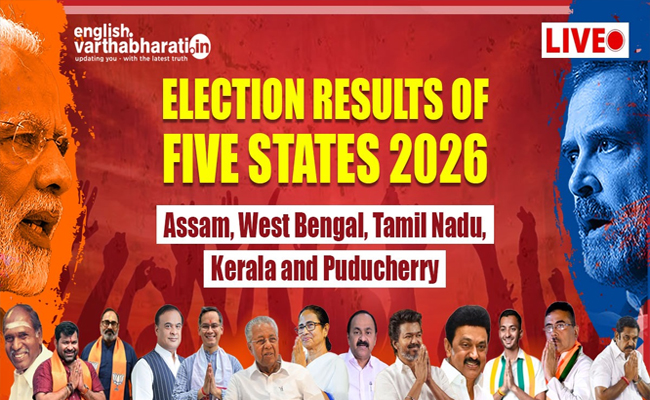
New Delhi: The countdown has begun for the counting of votes for the Assembly elections in five states that have captured the attention of people across the country.
The counting of votes for the Assembly constituencies of West Bengal, Tamil Nadu, Kerala, Assam and the Union Territory of Puducherry will begin simultaneously at 8 am, and the fate of candidates in a total of 824 constituencies will be decided shortly.
The counting of postal ballots will take place first, followed by the counting of EVM votes in several rounds.
- Five-state elections: Postal vote counting begins
- TMC, BJP lead in one seat each in West Bengal
- In Tamil Nadu, DMK leads in 3 constituencies, while TVK leads in 1
- UDF leads in 5 seats in Kerala, BJP in 1, LDF in 1
- BJP leads in 2 seats, AIUDF in 1 in Assam
- AINRC leads in 1 constituency in Puducherry
- TMC leads in 5 seats in West Bengal; Mamata Banerjee’s party maintains initial lead
- Tamil Nadu Chief Minister M.K. Stalin leads in Kolathur
- BJP takes early lead in Assam
- Congress-led UDF leads in Kerala
- In Tamil Nadu, TVK chief Vijay leads in the Perambur constituency, lags in Tiruchirappalli South
- BJP leads in 10 seats in Assam