Reside in Mumbai, no gathering of visitors at home: Court's bail conditions for Varavara Rao

Mumbai(PTI): A special court here has directed poet-activist P Varavara Rao, an accused in the Elgar Parishad-Maoist links case who was recently granted bail on medical ground by the Supreme Court, to reside in Mumbai and not to leave the city without its permission.
It also restricted Rao from having a "gathering of visitors" at his residence in Mumbai, and asked him not to indulge in any "criminal activities, similar to the case against him or otherwise" and not to contact any co-accused in the case or any other person involved in similar activities.
The apex court had granted bail to Rao on August 10.
His bail conditions were set by the special court hearing cases related to the National Investigation Agency (NIA) recently, the details of which were made available on Saturday.
The bail conditions mandate Rao to reside within the area of greater Mumbai and not leave the city without prior permission of the NIA court.
He shall furnish the detailed address of his residence in greater Mumbai and his contact number, along with the numbers of his three close relatives and persons residing with him, the court said.
It directed the accused not to make any statement to media - be it print, electronic and social - regarding to the case.
He shall not commit any other offence either of similar or any other nature and not indulge in any activity regarding which present crime is registered against him, the court said.
Further, Rao has been directed not to contact or communicate with the co-accused or any other person involved in similar activities.
He shall not make any call either domestic or international to any person indulging in similar activities through any mode of communication, Rao's bail condition reads.
The accused has been asked not to tamper the prosecution witnesses, either personally or through any other person.
He shall not abscond or try to flee away from justice. There shall not be any gathering of visitors where applicant shall reside at greater Mumbai, the court said.
The court has asked the accused to furnish a fresh bond of Rs 50,000 with two solvent sureties in the like amount.
The case relates to alleged inflammatory speeches made at the Elgar Parishad conclave held in Pune on December 31, 2017, which the police claimed triggered violence the next day near the Koregaon-Bhima war memorial on the outskirts of the western Maharashtra city.
The Pune Police had also claimed the conclave was organised by people with alleged Maoist links. The National Investigation Agency (NIA) later took over the probe in the matter.
Rao was arrested on August 28, 2018 from his Hyderabad residence and is an under-trial in the case. An FIR was lodged by the Pune Police on January 8, 2018 under various sections of the Indian Penal Code and the Unlawful Activities (Prevention) Act.
Let the Truth be known. If you read VB and like VB, please be a VB Supporter and Help us deliver the Truth to one and all.
Massive turnout in assembly polls across states, women voters outnumber men: EC data
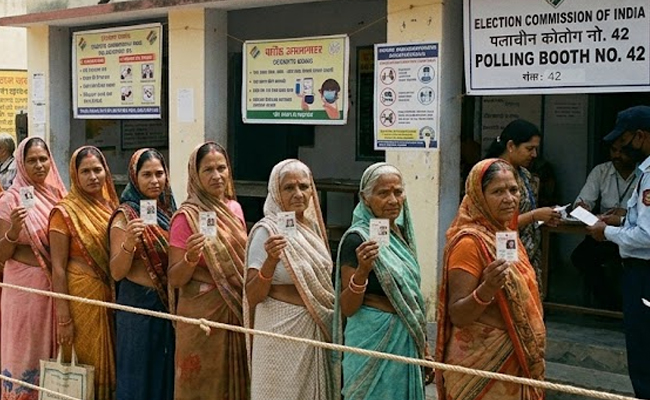
New Delhi (PTI): The recently-concluded assembly elections witnessed exceptionally high voter participation across states, with women voters outnumbering men in turnout percentages, according to Election Commission data.
West Bengal recorded the highest voter turnout among states, with 93.71 per cent polling in 293 constituencies where counting has been completed. The state saw over 6.38 crore votes cast, including postal ballots, against a total of more than 6.81 crore electors.
Women voters recorded a turnout of 93.8 per cent in the West Bengal Assembly polls, slightly higher than the 92.06 per cent participation among men.
The data for West Bengal does not include the figures for the Falta assembly constituency, which is scheduled for repolling.
Tamil Nadu registered an 85.01 per cent turnout, with nearly 4.8 crore votes polled from an electorate of 5.74 crore. Women voters recorded a turnout of 86.2 per cent, higher than the 83.77 per cent among men.
Assam also witnessed robust participation, with the final turnout touching 85.74 per cent. More than 2.15 crore votes were cast in the state, while female turnout at 86.53 per cent marginally exceeded the 84.95 per cent recorded among male voters.
Kerala registered a turnout of 78.11 per cent, with over 2.12 crore votes polled. Female voter participation stood at 81.17 per cent against 74.9 per cent among men.
Puducherry recorded a turnout of 89.82 per cent, with women voters again leading participation at 91.39 per cent. More than 8.5 lakh votes were polled in the Union territory.
Yet, women's representation among elected candidates remained modest.
Tamil Nadu elected 23 women MLAs (9.83 per cent) out of 234 members, West Bengal elected 37 women legislators (12.62 per cent) out of 293, while Kerala returned only 11 women MLAs (7.85 per cent) in the 140-member House.
Only two third-gender candidates contested the elections - one each from Tamil Nadu and Kerala, and both lost, forfeiting their deposits.
The elections also reflected extensive electoral mobilisation infrastructure. West Bengal had the highest number of polling stations at 85,092, followed by Tamil Nadu with 75,064 and Assam with 31,490.
In terms of candidates, Tamil Nadu saw the largest contest with 4,023 candidates in the fray across 234 constituencies, averaging 17 candidates per seat and peaking at 79 contestants in one constituency.
West Bengal pitted 2,920 candidates for 293 constituencies, while Kerala had the fewest contestants among the major states, with 883 candidates for 140 seats.
The data also showed relatively low NOTA votes across states. Tamil Nadu recorded the lowest NOTA share at 0.4 per cent of total votes polled, while Assam recorded the highest at 1.23 per cent. In West Bengal, 0.78 per cent of the total votes polled were NOTA, while it 0.77 per cent and 0.57 per cent of the electorate opted for None of the Above (NOTA) in Puducherry and Kerala, respectively.