Row over SIR: EC can't assume role of suspicious neighbour or policeman, SC told
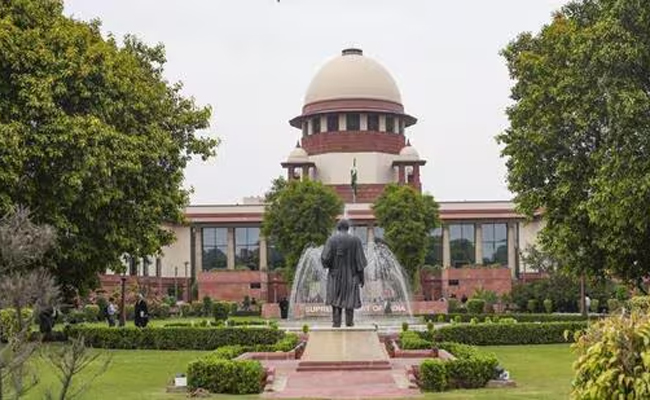
New Delhi (PTI): The Election Commission cannot assume the role of a "suspicious neighbour" or a "policeman" treating voters with doubt, the Supreme Court was told on Thursday during the final hearings on a batch of pleas challenging the Special Intensive Revision (SIR) of electoral rolls in various states.
A bench of Chief Justice Surya Kant and Justice Joymalya Bagchi heard detailed submissions from senior advocate Raju Ramachandran representing petitioners opposed to the SIR process being undertaken in several states.
Ramachandran assailed the conceptual foundation of the SIR and urged that the poll panel's constitutional mandate is to act as a facilitator and enabler of voting rights.
ALSO READ: Doctors who died on duty during COVID-19 entitled to insurance under PMGKY: SC
"The negative way of viewing one's own role is that of a disabler or that of a suspicious policeman," Ramachandran said, adding that when there is an adequate statutory scheme regarding citizenship, the poll panel cannot become a "nosy parker" instructing booth level officers (BLOs) to cast doubt on voters.
He said initiating an inquiry based on a BLO's suspicion effectively amounts to "suspending citizenship".
"Now, how does the EC view its role? Because depending on how it views its role will follow how it acts. Either it sees its role as a facilitator and enabler of the societal ideal of universal adult franchise, which would mean helping citizens to vote, proactively helping and enabling.
"The negative way of viewing one's own role is that of a disabler or that of a suspicious policeman or a suspicious neighbour. So depending on how you view your own role, your sense of fairness and how you go about a particular exercise will be apparent from that," he said.
He argued that while the right to vote may be statutory, it flows from constitutional rights including Article 19(1)(a) and Article 21.
"Removal from an electoral roll on suspicion amounts to giving a power to suspend citizenship," he said.
On the definition and implication of the term "migrant", he said that in the current socio-political discourse, the term is often loaded and used to imply "illegal migrant" or "exodus" rather than domestic movement.
Offering a broader view, Justice Bagchi said, "Migration does not have a domestic import... It is their livelihood which drives them. We have a brain drain which is also migration."
Justice Bagchi, who belongs to West Bengal, cited the example of IT professionals from his own city Kolkata taking flights to the southern states for opportunities.
The CJI added a stark reality check regarding labour migration and said, "In North India, trains are full of farm workers from Bihar... they are virtually auctioned and by the time they come to Punjab, they are in tears."
He noted that many such workers have settled in Punjab, their children have mixed with the culture, yet their roots remain in Bihar or West Bengal.
The CJI also cited a recent visit to Havelock Island, noting that out of a population of 25,000, approximately 22,000 were migrants.
ALSO READ: Enrolment in govt schools dropped by 17 lakh in 15 years in Karnataka: Minister
While the petitioners argued against the arbitrary nature of the SIR exercise, the bench said, "The SIR cannot be seen too much on procedural aspects. Let us keep in mind that they are doing something after 20 years and the SIR cannot become an annual feature. That is why we cannot intervene too much on the technical procedural aspects."
When the petitioners pressed on the "inquisitorial" nature of the process, Justice Bagchi clarified that the court's queries were "dialectical" in nature, intended to evoke responses rather than signal a conclusion.
The senior lawyer questioned the rationale behind selecting nine states and three Union Territories, including Chhattisgarh, Kerala, Rajasthan and Uttar Pradesh, for this exercise.
He termed the assumption that rapid urbanisation and frequent migration are regular features in places like Lakshadweep or the Andaman and Nicobar Islands as "facile" and a "lazy assumption" indicating non-application of the mind.
He specifically flagged the timing in Chhattisgarh, where elections are not due, arguing that rushing through the SIR process in such a "vulnerable state" under a tight timeframe called for judicial review.
At the outset of the hearing, CJI Kant directed the registry not to accept any further fresh pleas regarding the matter.
"Many are coming now just for publicity. No fresh matters are required any more," the CJI said.
The matter will continue on December 16.
Earlier, the bench asked whether the Election Commission is barred from conducting an inquiry in case of a doubtful citizen and if an inquisitorial process falls outside its constitutional power.
Let the Truth be known. If you read VB and like VB, please be a VB Supporter and Help us deliver the Truth to one and all.
Four children drown in lake while trying to catch ducks in Chikkamagaluru

Chikkamagaluru: Four children drowned in a lake in Aralaguppe village after reportedly going to catch ducks, police said.
The deceased have been identified as Mahdia, Arunus, Nayus, and Abdul Rehman. The children were aged between 5 and 14 years. Another child, Armaan (4), escaped unhurt.
Police said the incident occurred at Karanji Lake in Aralaguppe village. Rural police visited the spot and are investigating the case. A case has been registered at the local rural police station.