Rupee falls 8 paise to close at 88.79 against US dollar
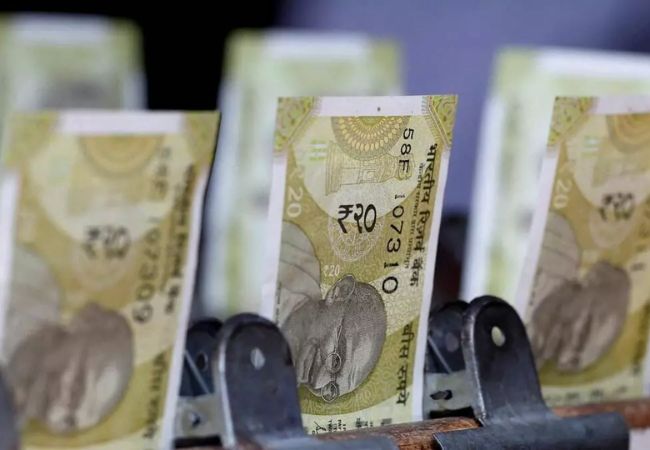
Mumbai (PTI): The rupee depreciated 8 paise to close at 88.79 against the US dollar on Friday, near its all-time low level, on dollar demand from importers and persistent foreign fund outflows.
Forex traders said the USD/INR pair is hovering around its all-time low level, weighed down by trade tensions and global uncertainties.
Moreover, persistent foreign fund outflows and the ongoing US visa fee hike issue also dragged down the domestic unit.
At the interbank foreign exchange, the rupee opened at 88.68 against the US dollar and touched an intraday low of 88.85 and finally settled for the day at 88.790, lower by 8 paise from its previous close.
On Wednesday, the rupee recovered 9 paise from its all-time closing low to settle at 88.71 against US dollar.
On Thursday, equity, forex, bullion and commodity markets were closed on account of Gandhi Jayanti and Dussehra.
On September 30, the rupee had fallen to an all-time low of 88.80 against the US dollar.
"The Indian currency steadied within a tight range over the past few days, having suffered a historic low earlier in the week. The underlying mood for the rupee remains down due to sustained capital outflow from foreign investors. Nevertheless, a rebound in local share markets and moderation in crude oil prices to lend some stability," Dilip Parmar, Senior Research Analyst, HDFC Securities, said.
"We expect the rupee to strengthen amid broad weakness in the US dollar and weakness in global crude oil prices. However, importer demand for dollar may cap sharp upside," said Anuj Choudhary, Research Analyst Currency and commodities Mirae Asset ShareKhan.
Choudhary further noted that the US dollar may weaken amid lack of economic data from the US amid the government shutdown. USDINR spot price is expected to trade in a range of 88.40 to 89.
Meanwhile, the dollar index, which gauges the greenback's strength against a basket of six currencies, was trading at 97.78, lower by 0.06 per cent, amid US government shutdown.
Brent crude, the global oil benchmark, was trading 1.03 per cent higher at USD 64.77 per barrel in futures trade.
On the domestic equity market front, the Sensex climbed 223.86 points to settle at 81,207.17, while the Nifty settled up 57.95 points at 24,894.25.
Foreign institutional investors offloaded equities worth Rs 1,583.37 crore on a net basis on Friday, according to exchange data.
Meanwhile, the Reserve Bank of India (RBI) left its key interest rates unchanged on Wednesday, as it waited for greater clarity on the impact of US tariffs as well as playout of earlier rate cuts and recent tax reductions.
RBI Governor Sanjay Malhotra, however, signalled scope for easing in the coming months to support the economy from any possible hit from US tariffs.
Let the Truth be known. If you read VB and like VB, please be a VB Supporter and Help us deliver the Truth to one and all.
J-K: Six held with drugs, assets worth Rs 73 lakh attached in Udhampur
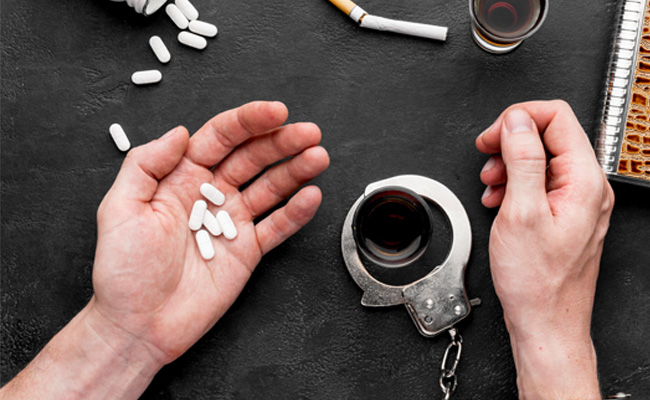
Jammu (PTI): Six persons were taken into custody during an intensified anti-narcotics crackdown, with police recovering contraband substances and over Rs 23 lakh in Doda and Kathua districts of Jammu and Kashmir, police said on Monday.
In a parallel action, properties worth over Rs 73 lakh linked to drug peddlers were also attached in Udhampur district under relevant legal provisions, the police said.
Additional Superintendent of Police, Doda, Mohd Aslam said three persons, including a woman, were detained during a raid on a house at Dak Mohalla in the main town following recovery of 85 grams of suspected brown sugar and over Rs 23 lakh on Sunday evening.
He identified the woman as Zareena Begum, stating that she had been under police surveillance following inputs indicating her involvement in drug peddling.
Besides Zareena, officials said her daughter and son-in-law were also picked up by police during the raid.
“We have taken three individuals into custody. Their roles are being examined, and based on that, arrests will be made. We are continuing raids at other suspected locations,” Aslam said.
Three drug peddlers --Pardeep Singh of Hiranagar, Rahees Butt of Billawar and Ali Sen of Amritsar (Punjab) -- were arrested along with heroin at different places in Kathua district, a police spokesman said.
He said while 2.79 gm of heroin was seized from Singh, 2.66 gm were recovered Butt. Similarly, 303 gm of heroin was seized from Sen who was intercepted near Berrian-Pattan village while moving in a private car from Bhagthali to Maggar Khad on the Jammu-Pathankot highway.
All the three were booked under the NDPS Act and further investigations are on, the spokesman said.
In Udhampur, the spokesman said properties worth Rs 73 lakh were attached in two separate cases registered under the Narcotic Drugs and Psychotropic Substances (NDPS) Act.
The attached properties included a newly constructed residential house, a car, a motorcycle and a mobile phone with a total value of Rs 65 Lakh, belonging to accused Saif Ali who was booked under the NDPS case in Majalta area early this year, he said.
In another action, movable property worth Rs 8 lakh comprising a car, belonging to accused Danish Butt of Doda has been attached under Section 68(F) NDPS Act in connection with an FIR registered at Rehambal police station, the spokesman said.