Rupee falls 9 paise to record low of 90.87 against US dollar in early trade
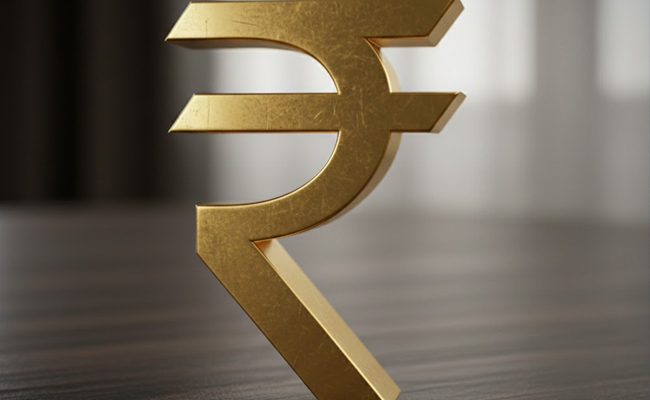
Mumbai (PTI): The rupee plunged 9 paise to a record low of 90.87 against the US dollar in early trade on Tuesday, weighed down by sustained FII outflows and no breakthrough in the India-US trade deal.
However, a weaker greenback and a decline in global crude oil prices capped further losses in the domestic unit, according to forex traders.
At the interbank foreign exchange, the rupee opened at its all-time low of 90.87 against the US dollar, down 9 paise from its previous close, and traded in a narrow range of 90.77- 90.87 in early trade.
ALSO READ: Rupee falls 9 paise to all-time low of 90.58 against US dollar in early trade
The rupee on Monday settled at a new all-time low of 90.78 against the US dollar, registering a loss of 29 paise over its previous close, weighed down by uncertainty over an India-US trade deal and persistent foreign fund outflows.
"The US-India trade deal still seems to be off by a distance with the Commerce Secretary saying the first phase will be signed before the end of the year and news that we are closest to the deal being signed. The uncertainty has clouded the recovery on the USD/INR pair as the rupee opened lower with dollar buying happening every day," Anil Kumar Bhansali, Head of Treasury and Executive Director, Finrex Treasury Advisors LLP, said.
Even a reduction in trade deficit on Monday could not bring about a recovery in the rupee with Foreign Institutional Investors (FII) outflows continuing, he added
According to the latest government data released on Monday, India's trade deficit narrowed to a five-month low of USD 24.53 billion in November, as exports rebounded by 19.37 per cent to a six-month high of USD 38.13 billion after contracting in October, driven by higher shipments of engineering and electronics goods.
At the same time, the country's imports dipped by 1.88 per cent to USD 62.66 billion due to a fall in the inbound shipments of gold, crude oil, coal, and coke.
FIIs sold equities worth Rs 1,468.32 crore on Monday, according to exchange data.
Also, wholesale price inflation stayed in the negative for the second consecutive month in November at (-) 0.32 per cent, even though there was an uptick in prices of food articles like pulses and vegetables on a month-on-month basis, government data showed on Monday.
Wholesale Price Index (WPI)-based inflation was at (-) 1.21 per cent in October and 2.16 per cent in November last year.
Meanwhile, the dollar index, which gauges the greenback's strength against a basket of six currencies, was trading 0.03 per cent lower at 98.27.
Brent crude, the global oil benchmark, was trading 0.61 per cent lower at USD 60.19 per barrel in futures trade.
On the domestic equity market front, the 30-share benchmark index, Sensex, declined 363.92 points to 84,849.44 in early trade while the Nifty was down 106.65 points to 25,920.65.
Let the Truth be known. If you read VB and like VB, please be a VB Supporter and Help us deliver the Truth to one and all.
EAM Jaishankar meets Jamaican PM, gifts over 10 BHISHM Cubes
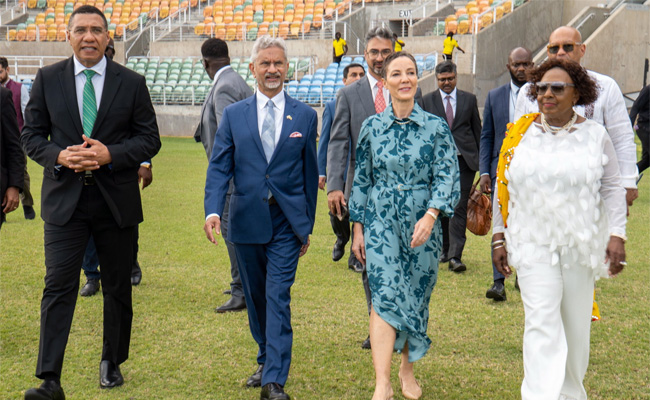
Kingston (PTI): External Affairs Minister S Jaishankar on Monday met Jamaican Prime Minister Andrew Holness and discussed ways to further deepen "political, economic and people-to-people cooperation."
Jaishankar also conveyed greetings from Prime Minister Narendra Modi to Holness.
"Pleased to call on Prime Minister @AndrewHolnessJM in Kingston. Conveyed the greetings of PM @narendramodi," Jaishankar posted on X.
"Discussed deepening our political, economic and people-to-people cooperation. Value his commitment towards further strengthening India-Jamaica relations," the post further read.
Also, the external affairs minister handed over 10 BHISHM (Bharat Health Initiative for Sahyog Hita & Maitri) Cubes as a gift to Jamaica.
"Formally handed over 10 BHISHM Cubes as a gift from India to Jamaica, in the presence of PM @AndrewHolnessJM, Health Minister @christufton and FM @kaminajsmith," Jaishankar posted on X.
"The BHISHM Cube mobile hospital system, designed for rapid deployment, will help Jamaica during disasters and emergencies. The gift of these cubes is a statement of friendship, a commitment to disaster preparedness, and an outcome of innovation," the post said.
Jaishankar arrived in Kingston on Saturday evening, marking the first leg of his nine-day tour of Jamaica, Suriname, and Trinidad and Tobago, aimed at further strengthening India's strategic and cultural ties with the Caribbean nations.
Earlier in the day, he interacted with the Indian diaspora and discussed India's ongoing transformation in infrastructure, human development and technology-driven governance and entrepreneurship with them.
He also highlighted the cricket bond between both countries as India gifted a scoreboard to Jamaica.
A scoreboard was dedicated at Sabina Park in Kingston. It is the home of the Jamaica cricket team and is the only Test cricket ground in the Caribbean island nation.
The minister expressed hope that the new scoreboard would witness many memorable innings, including those symbolising the enduring friendship between the two countries.
Cricket has long been a strong cultural bridge between India and Jamaica, which is part of the West Indies cricket team.
Jamaican players, including Chris Gayle, Courtney Walsh and Michael Holding, have played a major role in shaping the legacy of West Indies cricket in the international arena, contributing to its dominance in earlier decades and its continued global appeal.