Rupee plunges 20 paise to hit lowest-ever closing level of 84.86 against US dollar
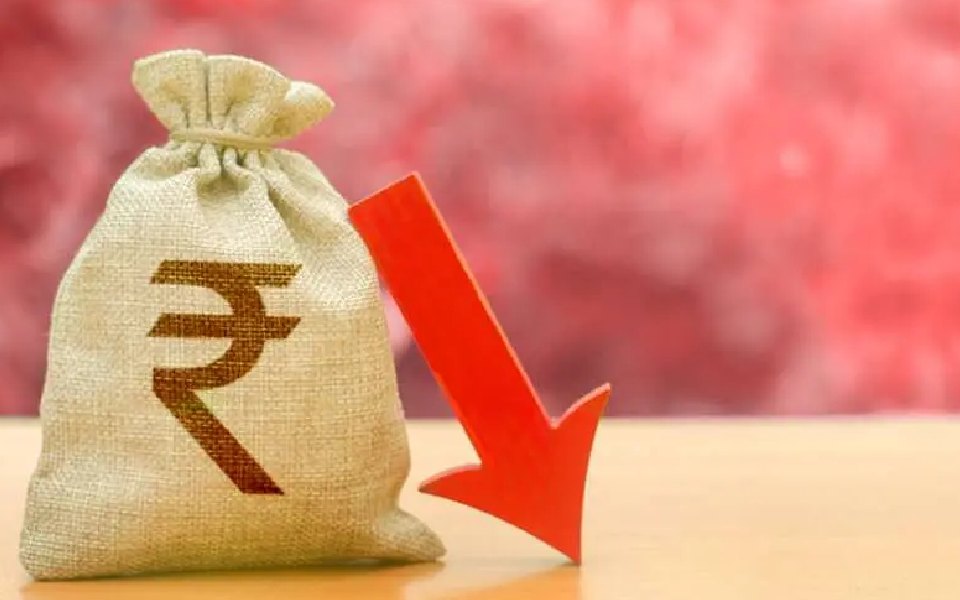
Mumbai, Dec 9: The rupee saw its steepest fall in over a month and plunged 20 paise to settle at lowest-ever level of 84.86 against the US dollar on Monday, amid volatile geopolitical situation and muted trend in domestic equities.
Forex traders said the rupee remains in a weakening mode due to dollar demand from importers and foreign banks.
At the interbank foreign exchange, the rupee opened at 84.70 and touched the lowest level of 84.86 against the greenback during intra-day trade. The unit ended the session at its all-time low level of 84.86 against the dollar, registering a sharp fall of 20 paise over its previous close.
On Friday, the rupee appreciated by 5 paise to settle at 84.66 against the US dollar.
The rupee's previous lowest closing level was at 84.75 against dollar on December 4, while the steepest fall was recorded on November 6 when it had closed 22 paise down from preceding session.
Meanwhile, the dollar index, which gauges the greenback's strength against a basket of six currencies, was trading lower by 0.09 per cent at 105.96.
Brent crude, the global oil benchmark, surged 0.89 per cent to USD 71.75 per barrel in futures trade.
According to analysts, geopolitical uncertainties after rebels ousted Syrian leader Bashar Assad pressured the rupee, while investors were also cautious ahead of the Industrial Production (IIP) and CPI data at the domestic macroeconomic front.
The Reserve Bank of India on Friday kept its key interest rate unchanged citing inflation risks, but cut the Cash Reserve Ratio that banks are required to park with the central bank, boosting money with lenders to support a slowing economy.
Jateen Trivedi, VP Research Analyst - Commodity and Currency, LKP Securities, said FII activity turned mixed, with bouts of selling observed in Indian capital markets.
He said geopolitical tensions escalated with fresh political turmoil in Syria, where rebels ousted the Bashar Assad's regime, ending a 50-year rule.
"This development has heightened political uncertainty in the Middle East, adding pressure to emerging market currencies, including the rupee," Trivedi said.
Anil Kumar Bhansali, Head of Treasury and Executive Director, Finrex Treasury Advisors LLP, said rupee ended the day weaker as demand exceeded supplies.
"RBI kept selling US dollars despite the fact that their reserves were slowly depleting. Market now awaits the release of US CPI on December 11 and while it embarks on the Federal Open Market Committee (FOMC) on December 18," he added.
On the domestic equity market front, the 30-share benchmark index Sensex closed 200.66 points, or 0.25 per cent lower, at 81,508.46 points. The Nifty fell 58.80 points, or 0.24 per cent, to 24,619.00 points.
Foreign Institutional Investors (FIIs) infused Rs 724.27 crore in the capital markets on net basis on Monday, according to exchange data.
Meanwhile, India's forex reserves increased by USD 1.51 billion to USD 658.091 billion for the week ended November 29, the RBI said on Friday.
The overall reserves had dropped by USD 1.31 billion to USD 656.582 billion in the previous reporting week.
Let the Truth be known. If you read VB and like VB, please be a VB Supporter and Help us deliver the Truth to one and all.
No need for guv: DMK leader Kanimozhi

Chennai (PTI): Senior DMK leader Kanimozhi Karunanidhi on Friday reiterated her party’s opposition to the office of the governor amid uncertainty over government formation in Tamil Nadu after a fractured election mandate.
Speaking to PTI Videos, Kanimozhi emphasised that the DMK’s demand for the abolition of the governor’s post remained unchanged, especially as questions arise over constitutional propriety during the current political transition.
"Our position that we do not need a governor at all is something the DMK has never changed at any point in time," she said.
When asked about the governor’s actions following the election results—particularly the delay in inviting the leading party to form the government—Kanimozhi pointed to what she described as the "inherent friction" between the office of the governor and the political interests of the state.
She said the current situation "raises a lot of questions" and requires introspection regarding constitutional procedures.
Kanimozhi described the election results as lacking a "clear mandate", which she identified as the primary reason for the prevailing political uncertainty in the state.
"What the people decide is supreme," she said, adding that while the mandate was not decisive, it must be respected.
The Thoothukudi MP attributed the ongoing delays and "many confusions" to the absence of a decisive majority for any single party.
She firmly dismissed rumours about the DMK potentially supporting the AIADMK from outside to help stabilise the government.
She described such reports as mere "speculation" and "rumours".
"We can’t be responding to every rumour," she said, declining to comment on the AIADMK’s claims regarding its numbers to form the government.
The political situation in Tamil Nadu remains fluid as stakeholders await the governor’s next constitutional step in an Assembly where no party has secured a clear majority.
The DMK and AIADMK—both of which suffered significant losses to the TVK—are reportedly exploring tactical manoeuvres to navigate the hung Assembly.
The TVK, with 108 seats and the support of Congress’s five MLAs, is still short of the majority mark. The DMK and AIADMK secured 59 and 47 seats, respectively.