Rupee sinks to record low, settles 66 paise down at 86.70 against US dollar
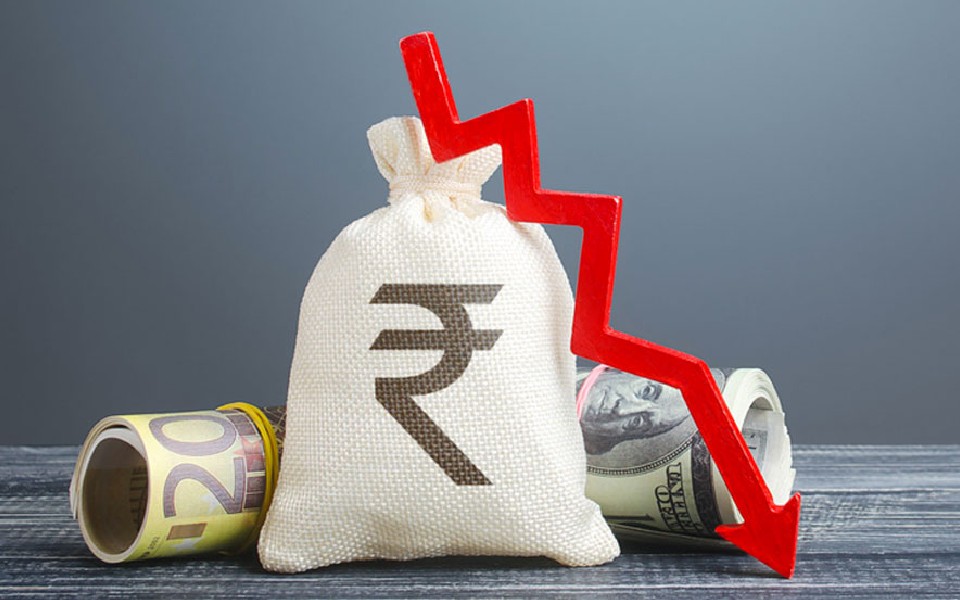
Mumbai, Jan 13: The rupee logged its steepest single-day fall in nearly two years and ended the session 66 paise down at its historic low of 86.70 against the US dollar on Monday, weighed down by a stronger American currency and surging crude oil prices.
At the interbank foreign exchange, the rupee opened at 86.12, and moved 1 paisa during intraday to 86.11 before closing the session with a loss of a staggering 66 paise at its lowest-ever level of 86.70 against the greenback.
The fall of 66 paise in one session was the steepest since February 6, 2023 when the unit had lost 68 paise.
The Indian currency has witnessed the deepest plunge of more than Re 1 in the past two weeks from the closing level of 85.52 on December 30.
Rupee had breached the 85-per-dollar mark for the first time on December 19, 2024.
On Friday, the local currency had declined 18 paise to settle at 86.04 against the US dollar, a day after registering a marginal gain of 5 paise. In the preceding back-to-back sessions on Tuesday and Wednesday, it had plunged 6 paise and 17 paise, respectively.
The unprecedented fall was attributed to the relentless chase of the US dollar by investors, which also led to a massive withdrawal of foreign capital from Indian equities.
Foreign Institutional Investors (FIIs) offloaded equities worth Rs 4,892.84 crore on Monday.
According to analysts, the Reserve Bank of India has allowed the fall in rupee's exchange rate versus US dollar amid dwindling forex reserves and declining emerging market currencies.
"RBI will allow the weakness as demand keeps moving up and supplies dwindle," said Anil Kumar Bhansali, Head of Treasury and Executive Director, Finrex Treasury Advisors LLP.
The Reserve Bank of India on Friday said the country's forex reserves dropped by USD 5.693 billion to USD 634.585 billion in the week ended January 3.
At the same time, the dollar strengthened on better-than-expected job growth in the US market, which also fuelled the rising benchmark treasury yields amid expectations of a slower interest rate cut by the Federal Reserve, analysts said.
Besides, the US has imposed more sanctions on Russia, resulting in Brent oil prices higher to USD 81 per barrel. This comes at a time when investors are already cautious in anticipation of restrictive trade measures by the new regime under President Donald Trump.
Anuj Choudhary, Research Analyst at Mirae Asset Sharekhan, said the rupee hit a fresh low on strong dollar and weak global markets. FIIs continue to remain as net sellers, while crude oil prices rose nearly 2 per cent.
Going ahead, Choudhary said, rising crude oil prices and risk aversion in global markets may weigh on the rupee. "USD-INR spot price is expected to trade in a range of 86.25 to 86.80," he said.
Meanwhile, the dollar index, which gauges the greenback's strength against a basket of six currencies, was trading up 0.24 per cent to its over two-year-high level of 109.91.
Brent crude, the global oil benchmark, surged 1.14 per cent to USD 80.67 per barrel in futures trade.
According to Jateen Trivedi, VP Research Analyst - Commodity and Currency, LKP Securities, the rupee marked its lowest level amid a rapid fall of over 1 per cent in the past week. The decline is attributed to higher crude prices, following sanctions on Russia by the Biden administration in the US.
"Elevated crude prices have further widened India's import bill, adding pressure on the rupee. The trading range for the rupee is seen with support near 87.00 and resistance around 86.25, as participants keep a close eye on geopolitical developments and commodity trends," Trivedi added.
In the domestic equity market, the 30-share BSE Sensex crashed 1,048.90 points, or 1.36 per cent, to settle at 76,330.01 points, while the Nifty tanked 345.55 points, or 1.47 per cent, to 23,085.95 points.
On the domestic macroeconomic front, retail inflation eased to 5.22 per cent in December, from 5.5 per cent in November, 2024.
The industrial production (IIP) growth accelerated to a six-month high of 5.2 per cent year-on-year in November 2024, riding on the increased festive demand and pick-up in the manufacturing sector.
Let the Truth be known. If you read VB and like VB, please be a VB Supporter and Help us deliver the Truth to one and all.
Rajnath to top commanders: Outmaneuver adversaries with strategic surprise
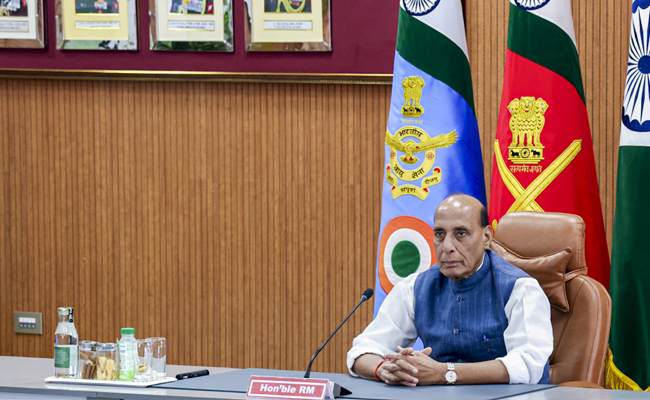
Jaipur/New Delhi (PTI): Defence Minister Rajnath Singh on Friday directed the top military commanders of the three services to integrate an "element of surprise" into modern warfare to outmaneuver India's adversaries and bolster strategic posture.
In his address at the joint commanders conference in Jaipur, Singh also described the Operation Sindoor as a testament to the "swift, precise, and joint response" of the Indian armed forces to safeguard national interests and called upon the military to remain ready to deal with any security challenges.
In their two-day deliberations, the commanders carried out a comprehensive review of the combat preparedness of the military in the wake of the evolving regional security situation.
Operation Sindoor was a demonstration of India's growing capabilities and a symbol of the nation's collective resolve and new military ethos, Singh said, a day after the first anniversary of Operation Sindoor.
He also unveiled a 'Joint Doctrine for Integrated Communication Architecture' that is aimed at strengthening doctrinal clarity, interoperability and integrated communications across the armed forces in future multidomain operations.
The joint commanders' conference, themed 'Military Capability in New Domains', brought together the top leadership of the defence ministry and the three services to deliberate on emerging security challenges and future readiness.
Comprehensive deliberations were held on future warfare, multidomain operations, technological transformation and joint capability development.
The conference witnessed extensive discussions on cognitive warfare, cyber resilience against evolving quantum and AI-enabled threats, military capability development in emerging domains, indigenous innovation and AI-enabled warfighting concepts.
It was attended by Chief of Defence Staff Gen Anil Chauhan, Chief of the Naval Staff Admiral Dinesh Kumar Tripathi, Chief of the Army Staff Gen Upendra Dwivedi, Chief of the Air Staff Air Chief Marshal AP Singh and Defence Secretary Rajesh Kumar Singh among others.
In his remarks, Singh asked the commanders to remain "future-ready" by learning from the operation as well as the current global security landscape.
He underscored the need to strengthen capabilities in artificial intelligence, autonomous systems, data analytics and secure communication networks to stay prepared in the rapidly evolving geopolitical security scenario. He emphasised that future conflicts will increasingly be shaped by hybrid threats, information dominance and operations conducted simultaneously across cyber, space, electromagnetic and cognitive domains, according to an official readout.
Highlighting the transformative impact of emerging technologies, Singh stressed on the importance of ensuring integrated national preparedness across all spectrums of conflict, it said.
Singh's remarks at the conference came a day after the first anniversary of Operation Sindoor.
The defence minister appreciated the progress achieved in enhancing jointness, integration and technological adoption across the three services, the readout noted.
Singh said that jointness constitutes a pivotal dimension within the transformative changes sweeping across the global defence sector.
"Future wars will not be won solely through weaponry, but through innovative thinking and enhanced synergy," he said.
The defence minister exhorted the commanders to cultivate the "element of surprise" to remain unpredictable to the nation's adversaries and secure a strategic edge in any given situation.
He, however, urged them to remain vigilant of the element of surprise of the enemy and always stay two steps ahead.
Singh also reiterated the Narendra Modi government's commitment to enhancing the capabilities of the defence forces through state-of-the-art weapons and platforms. He added that special focus is being laid on research in niche domains.
During the conference, he released a documentary film on Operation Sindoor.
The film reaffirms the nation's and defence forces' commitment to operational preparedness and decisive national response capabilities.
Demonstrations of advanced systems and platforms developed for intelligence fusion, operational planning and information management were also showcased during the conference reflecting growing integration of cutting-edge technologies into joint operational structures, according to the defence ministry.
The discussions will contribute significantly towards shaping India's future military transformation and integrated operational preparedness, it said.