Rupee tumbles 67 paise to 72.09 against US dollar in early trade
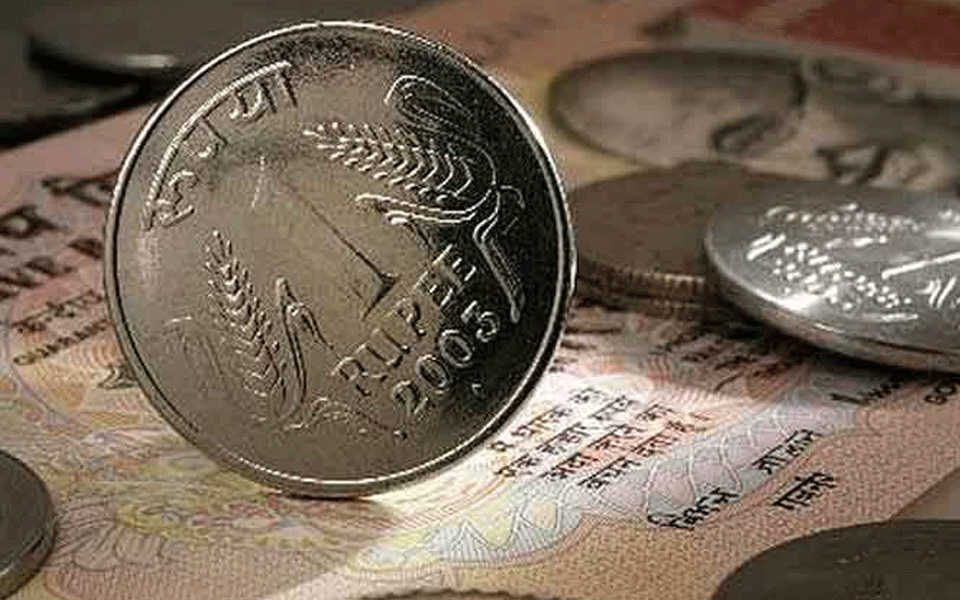
Mumbai: The rupee tumbled by 67 paise to 72.09 against the US currency in early trade on Tuesday, tracking weak opening in domestic equities amid strong dollar demand from banks and importers.
Forex traders said the US tariffs on imports from China took effect on Sunday and were followed later by Beijing's retaliation. Following this the domestic currency was under pressure.
The rupee had appreciated by 38 paise to close at a two-week high of 71.42 against the US dollar on Friday led by a rally in domestic equities and renewed hopes of the US-China trade talks. The forex market was closed on Monday on account of Ganesh Chaturthi.
At the interbank foreign exchange, the rupee opened at 72.00 then fell to 72.09 against the US dollar, showing a decline of 67 paise over its previous closing. The Indian rupee on Friday had closed at 71.42 against the US dollar.
Traders said strengthening of the greenback vis-a-vis other currencies overseas and weak opening in domestic equities weighed on the local unit. Foreign institutional investors (FIIs) remained net buyers in the capital market, putting in Rs 1,162.95 crore on Friday, provisional data with the exchanges showed.
The 30-share index was trading 371.23 points or 0.99 per cent lower at 36,961.56 and the broader Nifty fell 136.90 points or 1.24 per cent to 10,886.35.
The dollar index, which gauges the greenback's strength against a basket of six currencies, inched up 0.37 per cent to 99.28. Brent crude futures, the global oil benchmark, eased marginally by 0.02 per cent to USD 58.65 per barrel.
The 10-year government bond yield was at 6.52 per cent in morning trade.
Let the Truth be known. If you read VB and like VB, please be a VB Supporter and Help us deliver the Truth to one and all.
Man arrested with Rs 2.54-crore heroin in Mumbai

Mumbai (PTI): Police have arrested a man and seized over 500 grams of heroin worth Rs 2.54 crore in the illicit market from him in Mumbai, officials said on Friday.
The police's Anti-Narcotics Cell (ANC) made the drug seizure in Santacruz in the western suburbs. The operation was conducted by the Kandivali unit of the ANC on Thursday as part of a special crackdown against drug trafficking in the area, they said.
Acting on specific inputs, an ANC team conducted a raid in Santacruz (East) and intercepted a man. During a search, the team recovered 508 grams of high-grade heroin from his possession, an official said.
The seized contraband, a highly addictive, opioid drug derived from morphine, is estimated to be worth Rs 2.54 crore in the international market, he informed.
Following the seizure, a case was registered against the man under relevant sections of the Narcotic Drugs and Psychotropic Substances (NDPS) Act, 1985, and he was formally placed under arrest in the early hours of Friday.
The police are currently investigating the source of the drug and trying to identify the intended recipients of the consignment, he said.