Russia always ready to supply crude oil to India: Envoy
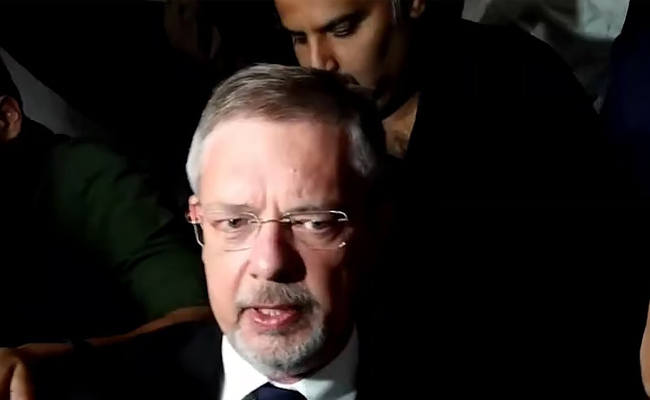
New Delhi (PTI): Russia has always been open to supplying crude oil to India, Russian Ambassador Denis Alipov said on Thursday, amid increasing concerns over spiralling prices of petroleum products in view of the West Asia crisis.
Global oil and gas prices have surged after Iran has virtually blocked the Strait of Hormuz, a narrow shipping lane between the Persian Gulf and the Gulf of Oman, that handles roughly 20 per cent of global oil and LNG (Liquefied Natural Gas).
India imports 88 per cent of its crude oil needs and roughly half of its natural gas requirement. These mostly come via the Strait of Hormuz.
Any prolonged instability in West Asia is set to be detrimental to India's national interests as the region remains a major source of New Delhi's energy security.
"We have been open to supplying crude oil to India," Alipov told reporters while responding to a question on Russian crude oil supplies to India in view of the West Asia crisis.
The US launched military strikes on Iran on February 28, killing Iranian Supreme Leader Ali Khamenei.
Following the military offensive, Iran has carried out a wave of attacks mainly targeting Israel and American military bases in several Gulf countries including the UAE, Bahrain, Kuwait, Jordan and Saudi Arabia.
In the last three days, the conflict has widened significantly with attacks and counter-attacks by both the sides.
India's procurement of crude oil from Russia has seen sharp fall in the last few weeks.
US President Donald Trump, while announcing a trade deal with New Delhi last month, claimed India has agree to not procure crude oil from Russia.
In an executive order, Trump had rolled back an additional 25 per cent tariffs on India that he imposed in August last for India's procurement of crude oil from Russia.
In the order, the US said it would monitor whether India resumed Russian oil purchases directly or indirectly and that would determine whether a 25 per cent tariff would again be re-impose.
India has been maintaining that it will procure oil from multiple sources and diversify them to ensure stability in the supply chain with national interests remaining the "guiding factor" for the procurement.
Let the Truth be known. If you read VB and like VB, please be a VB Supporter and Help us deliver the Truth to one and all.
AIITA welcomes Karnataka’s ban on obscene songs in school events
Bhatkal: The Karnataka unit of the All India Ideal Teachers Association (AIITA) has welcomed the Karnataka government’s decision to strictly ban school children from dancing to obscene songs during educational and cultural programmes in government, aided, and private schools across the state.
AIITA Karnataka State President M. R. Manvi congratulated the government for taking what he termed an important step to preserve the sanctity of education.
“Such decisions to safeguard the dignity of school children and uphold the values of education are the need of the hour. This rule should not be limited to government schools alone but must be strictly implemented in all private educational institutions as well,” he said.
He further urged the government to address other concerns within school programmes.
“The government should not only prohibit obscene dances in the name of school anniversaries, but also ensure that plays and dialogues that incite religious hatred are avoided. Schools should be centres of harmony, not platforms for spreading hatred,” he added.
According to a recent circular issued by the Department of School Education and Literacy, obscene dances are adversely affecting the mental health and moral values of students.
In this regard, schools have been advised to use songs that promote nationalism, positive thinking, the greatness of Kannada culture, and value-based traditions instead of inappropriate content during programmes.
The circular also emphasises that students should be dressed in decent attire.
AIITA also backed the department’s warning that disciplinary action would be taken against head teachers if such guidelines are violated. The association has further demanded that district Deputy Directors of Public Instruction strictly monitor the implementation of these rules.