Sabarimala missing gold case: Court grants SIT custody of prime accused Potty
Pathanamthitta (Kerala) (PTI): A local court in Ranni here on Friday granted custody of Unnikrishnan Potty, the prime accused in the Sabarimala gold missing case, to the SIT probing the matter.
The Judicial First Class Magistrate Court granted the custody of Potty to the Special Investigation Team (SIT) till October 30.
The accused claimed he had been 'trapped' by somone.
"Those who trapped me will come before the law," he told reporters while being taken out of the court.
A person in the crowd gathered outside the court hurled a footwear at Potty as he was being escorted out of the court.
Earlier in the day, the SIT arrested Potty, a Bengaluru-based businessman, after more than 14 hours of interrogation at the Crime Branch office in Thiruvananthapuram.
He was picked up from his residence in Pulimath near Thiruvananthapuram on Thursday.
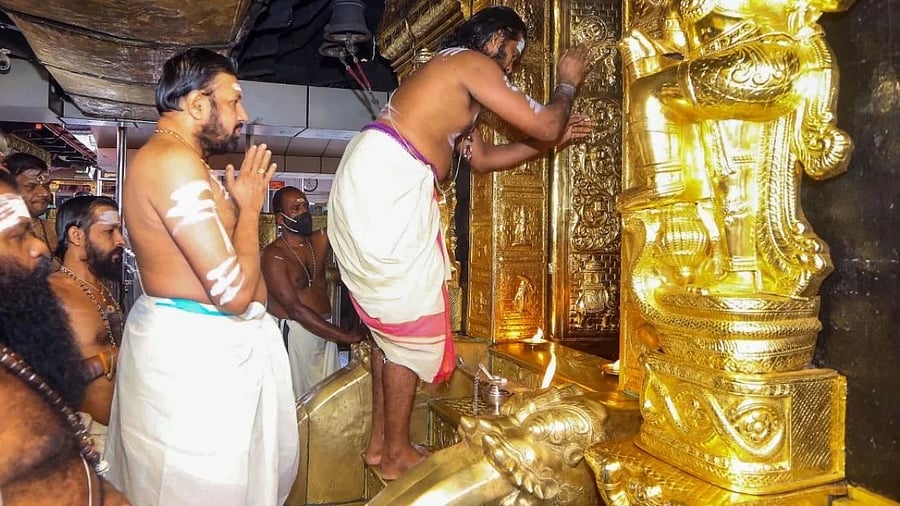
Potty had sponsored the gold electroplating of the Dwarapalaka (guardian deity) idols and the Sreekovil (sanctum sanctorum) door frames at Sabarimala in 2019 and made several donations to the temple.
The Kerala High Court recently found that the gold-clad plates of the Dwarapalaka idols weighed 42.8 kg when handed over to Potty for electroplating, but the weight reduced to 38.2 kg when it reached Chennai-based firm Smart Creations for processing.
Following these findings, the HC directed the Travancore Devaswom Board (TDB) Vigilance Wing to conduct a preliminary probe, which later led to the formation of an SIT to investigate the case.
The SIT is probing two related cases — the missing gold from the Dwarapalaka idols and the loss of gold from the Sreekovil door frames.
Potty is the prime accused in both cases, along with some TDB officials and members of the 2019 board.
Sources said Potty was arrested around 2 am and taken to the government hospital in Thiruvananthapuram for a medical examination.
Later, he was transferred to the Judicial First Class Magistrate's Court, Ranni, as part of the remand procedure.
During the hearing, the prosecution sought 14 days' custody, citing the need for detailed interrogation and evidence collection from multiple locations, including other states.
The prosecution submitted that a detailed investigation be conducted into the Chennai-bsed firm Smart Creations and the individuals involved in the conspiracy behind the gold lost from Sabarimala.
Potty's counsel opposed the request, raising concerns about his health.
The magistrate, however, accepted the prosecution's plea and granted custody till October 30. Potty was later shifted to the Pathanamthitta police camp.
Potty's lawyer said the court has directed that his client undergo a daily medical examination during the custody period.
"We had objected to the prosecution's petition seeking Potty's custody and raised concerns about his health. A bail petition will be moved later," he said.
The counsel added that Potty has agreed to cooperate fully with the investigation but declined to make any further comments.
The Kerala High Court has set a six-week deadline for the SIT to complete the probe.
Let the Truth be known. If you read VB and like VB, please be a VB Supporter and Help us deliver the Truth to one and all.
Engine issue forces SWISS Delhi flight to abort takeoff; six passengers injured

New Delhi (PTI): A Zurich-bound Swiss International Air Lines' flight carrying 232 passengers aborted take off at the Delhi airport early Sunday due to an engine issue, sources said.
Six passengers are undergoing medical evaluation, an airline spokesperson said without elaborating.
Smoke was observed from the port side of one of the landing gears of the A330 aircraft that was operating the flight LX147 to Zurich. The flight crew aborted the take off and full emergency response was initiated, the sources said.
In a detailed statement, an airline spokesperson said there were 228 passengers and four infants on board.
"Shortly after takeoff, just after 1:00 am. local time in India, an issue occurred with one of the engines. The crew rejected the takeoff and, following an assessment of the situation, decided as a precaution to evacuate the aircraft," the spokesperson said.
Six passengers were receiving medical attention, the spokesperson added.
"All passengers and crew evacuated the aircraft via the emergency slides.Six passengers are currently undergoing medical evaluation. For a small number of individuals who were unable to use the slides, stairs were provided," the spokesperson said.
According to the spokesperson, Swiss technical specialists will travel to Delhi to inspect the aircraft and initiate the next steps.
The airline is known as Swiss.
At the same time, the spokesperson said the airline was working intensively to find a swift and suitable onward travel solutions for all passengers.