Samajwadi Party's PDA strategy proves successful: 86% of MPs from Dalit, minority communities
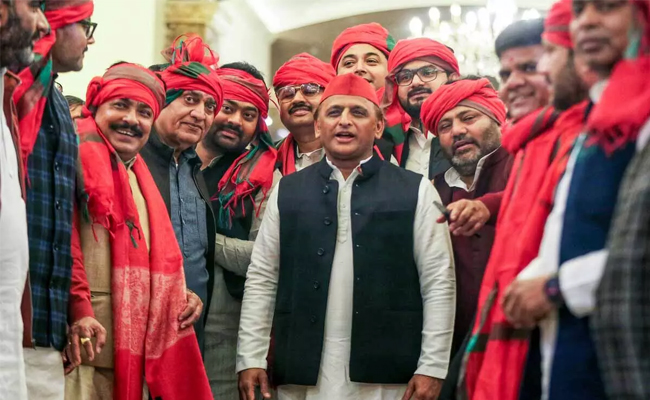
Lucknow: Samajwadi Party's (SP) strategic focus on the Pichda, Dalit, and Minority (PDA) communities in Uttar Pradesh has yielded substantial results for the party. Reports indicate that 86% of the newly elected MPs from SP hail from backward classes, Dalit, and Muslim communities.
Out of the 37 Samajwadi Party MPs, a majority of 20 belong to Other Backward Classes, with eight representing Scheduled Castes and four from the Muslim community. Additionally, one MP each hails from upper caste backgrounds including Brahmin, Vaishya, and Bhumihar communities, while representatives from the Thakur community also secured victory.
SP's innovative approach included fielding Scheduled Caste candidates in general constituencies, a strategy exemplified by the success of Awadhesh Prasad in Faizabad and Sunita Verma's loss in Meerut by a very narrow margin.
Moreover, SP's ally Congress clinched six seats, with victorious candidates from diverse backgrounds including Backward Class, Scheduled Caste, and Muslim communities, along with representatives from Kashmiri Brahmin, Bhumihar, and Punjabi communities.
Conversely, BJP's MP roster predominantly comprises individuals from upper castes, constituting 45% of its total MPs, despite representing only 20% of the electorate. The remainder of BJP's MPs hail from Backward Classes and Scheduled Castes.
Let the Truth be known. If you read VB and like VB, please be a VB Supporter and Help us deliver the Truth to one and all.
AIITA welcomes Karnataka’s ban on obscene songs in school events
Bhatkal: The Karnataka unit of the All India Ideal Teachers Association (AIITA) has welcomed the Karnataka government’s decision to strictly ban school children from dancing to obscene songs during educational and cultural programmes in government, aided, and private schools across the state.
AIITA Karnataka State President M. R. Manvi congratulated the government for taking what he termed an important step to preserve the sanctity of education.
“Such decisions to safeguard the dignity of school children and uphold the values of education are the need of the hour. This rule should not be limited to government schools alone but must be strictly implemented in all private educational institutions as well,” he said.
He further urged the government to address other concerns within school programmes.
“The government should not only prohibit obscene dances in the name of school anniversaries, but also ensure that plays and dialogues that incite religious hatred are avoided. Schools should be centres of harmony, not platforms for spreading hatred,” he added.
According to a recent circular issued by the Department of School Education and Literacy, obscene dances are adversely affecting the mental health and moral values of students.
In this regard, schools have been advised to use songs that promote nationalism, positive thinking, the greatness of Kannada culture, and value-based traditions instead of inappropriate content during programmes.
The circular also emphasises that students should be dressed in decent attire.
AIITA also backed the department’s warning that disciplinary action would be taken against head teachers if such guidelines are violated. The association has further demanded that district Deputy Directors of Public Instruction strictly monitor the implementation of these rules.