Same-sex marriage: Jamiat welcomes SC verdict, says it reinforces institution of marriage
New Delhi (PTI): Muslim organisation Jamiat Ulema-e-Hind on Tuesday welcomed the Supreme Court's refusal to grant legal recognition to same-sex marriages, saying the order "reinforces the preservation of the traditional institution of marriage."
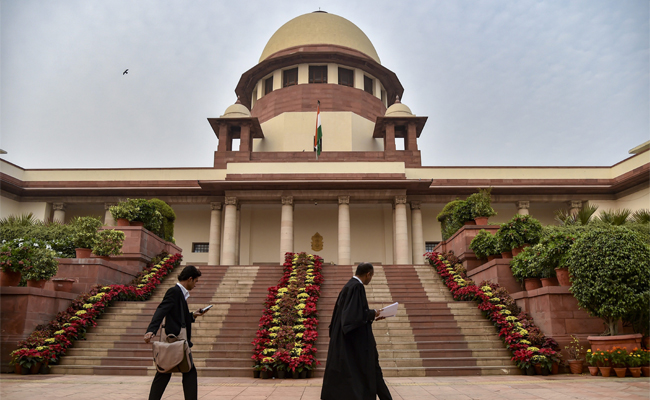
A five-judge constitution bench of the Supreme Court Tuesday unanimously refused to accord legal recognition to same-sex marriage under the Special Marriage Act, ruling that it is within Parliament's ambit.
The top court, however, recognised equal rights for queer people and their protection, as it called for sensitisation of the general public against gays.
Jamiat Ulema-e-Hindi (Maulana Mahmood Madani faction) hailed the ruling as "landmark" and noted that the court arrived at the decision after carefully examining the arguments presented by various social, governmental, and religious organisations.
In a statement, Madani welcomed the verdict and emphasised that the ruling reinforces the preservation of the traditional institution of marriage, which has been a fundamental pillar of our society for centuries.
"It underscores the importance of upholding the moral and ethical principles that have long defined our cultural identity," Madani said.
The Jamiat chief commended the court for its judgement in "maintaining a delicate balance between the protection of individual rights and the preservation of our cultural ethos."
The apex court, while passing four separate verdicts, was unanimous in holding that there is "no unqualified right" to marriage, and same-sex couples can't claim it as a fundamental right under the Constitution.
The bench headed by Chief Justice D Y Chandrachud was critical of the Centre's stand that the pleas for legal validation of same-sex marriage was reflective of an urban elitist concept.
Queerness is neither an urban nor an elite concept or characteristic, said the apex court, which pronounced the verdicts on 21 petitions seeking legal sanction for same-sex marriages.
It, however, differed on certain aspects, especially on the applicability of adoption rules for queer couples.
The five-judge bench comprising the CJI, and Justices Sanjay Kishan Kaul, S Ravindra Bhat, Hima Kohli, and P S Narasimha concurred on the main issue that the court can't accord legal validation to same-sex marriage under the Special Marriage Act, and said the task has to be performed by Parliament.
However, Justices Bhat, Kohli and Narasimha, in two separate judgements, differed with the CJI and Justice Kaul on certain legal aspects.
Let the Truth be known. If you read VB and like VB, please be a VB Supporter and Help us deliver the Truth to one and all.
AIITA welcomes Karnataka’s ban on obscene songs in school events
Bhatkal: The Karnataka unit of the All India Ideal Teachers Association (AIITA) has welcomed the Karnataka government’s decision to strictly ban school children from dancing to obscene songs during educational and cultural programmes in government, aided, and private schools across the state.
AIITA Karnataka State President M. R. Manvi congratulated the government for taking what he termed an important step to preserve the sanctity of education.
“Such decisions to safeguard the dignity of school children and uphold the values of education are the need of the hour. This rule should not be limited to government schools alone but must be strictly implemented in all private educational institutions as well,” he said.
He further urged the government to address other concerns within school programmes.
“The government should not only prohibit obscene dances in the name of school anniversaries, but also ensure that plays and dialogues that incite religious hatred are avoided. Schools should be centres of harmony, not platforms for spreading hatred,” he added.
According to a recent circular issued by the Department of School Education and Literacy, obscene dances are adversely affecting the mental health and moral values of students.
In this regard, schools have been advised to use songs that promote nationalism, positive thinking, the greatness of Kannada culture, and value-based traditions instead of inappropriate content during programmes.
The circular also emphasises that students should be dressed in decent attire.
AIITA also backed the department’s warning that disciplinary action would be taken against head teachers if such guidelines are violated. The association has further demanded that district Deputy Directors of Public Instruction strictly monitor the implementation of these rules.