Savarkar wrote mercy petitions on Mahatma Gandhi's request: Rajnath Singh
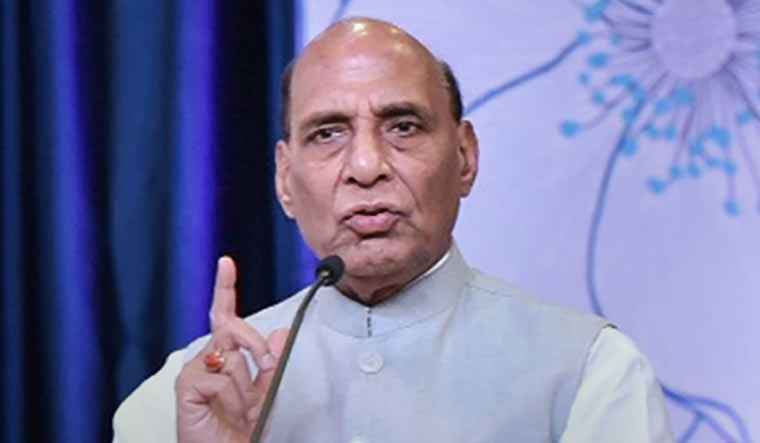
New Delhi, Oct 12: Hailing Savarkar as a staunch nationalist and India's first military strategist in the 20th century, Defence Minister Rajnath Singh on Tuesday said it was on Mahatma Gandhi's request that he wrote mercy petitions to the British and people from the Marxist and Leninist ideology wrongly accuse him as a fascist.
He described Savarkar as a "national icon" at an event to release a book on him and said he gave the country a "robust defence and diplomatic doctrine".
"He was an icon of the Indian history and will remain so. There can be a difference of opinion about him, but to look down on him as inferior is not appropriate and justifiable. He was a freedom fighter and a staunch nationalist, but people who follow the Marxist and Leninist ideology are the ones who accuse Savarkar of being a fascist...," Singh said, adding that the hatred towards Savarkar is illogical and unplaced.
Talking about Savarkar as a freedom fighter, he said his commitment for freedom was so strong that the British sentenced him to life imprisonment twice.
"Lies were spread about Savarkar repeatedly. It was spread that he filed many mercy petitions for seeking his release from jails.... It was Mahatma Gandhi who asked him to file the mercy petitions...," the defence minister said.
Savarkar was forthright in saying that India's relations with other countries should depend on how conducive those ties are to India's security and its interests, irrespective of the kind of government in those countries, he said.
"Savarkar was India's first military strategic affairs expert in the 20th century, who gave the country a robust defence and diplomatic doctrine," Singh said.
Discussing Savarkar's concept of Hindutva, he said the word "Hindu" for him was not associated with any religion and it was linked to India's geographical and political identity. For Savarkar, Hindutva was associated with cultural nationalism, he added.
"For Savarkar, an ideal state was the one where its citizens were not differentiated on the basis of their culture and religion and therefore, there is a need to deeply understand his Hindutva," the veteran BJP leader said.
Echoing similar sentiments about Savarkar, RSS chief Mohan Bhagwat said his ideology of Hindutva never suggested to differentiate between people on the basis of their culture and methodology of worshipping the god.
"Savarkar used to say, why do we differentiate? We are the sons of the same motherland, we are brothers. The different methodologies of worship have been the tradition of our country. We have been fighting for the country together," Bhagwat said.
Underlining that Savarkar was not an enemy of the Muslims, the Rashtriya Swayamsevak Sangh (RSS) chief said he had written many ghazals in Urdu.
Several people talked about Hindutva and unity in the Indian society, it was just that Savarkar spoke about it loudly and now, after so many years, it is being felt that had everyone spoken loudly, no division (of the country) would have happened, he added.
"...the Muslims who migrated to Pakistan after the partition have no prestige in that country, because they belong to India and it cannot be changed. We have the same ancestors, only our methodology of worship is different and we are all proud of our liberal culture of Sanatan Dharma. That heritage takes us forward, that is why all of us are living here together," Bhagwat said.
He also said whether it is Savarkar's Hindutva or Vivekananda's Hindutva, all are the same as they all talk about the same cultural nationalism where people are not differentiated on the basis of their ideology.
Let the Truth be known. If you read VB and like VB, please be a VB Supporter and Help us deliver the Truth to one and all.
BJP has history of ‘contradictory alliances’, says BK Hariprasad
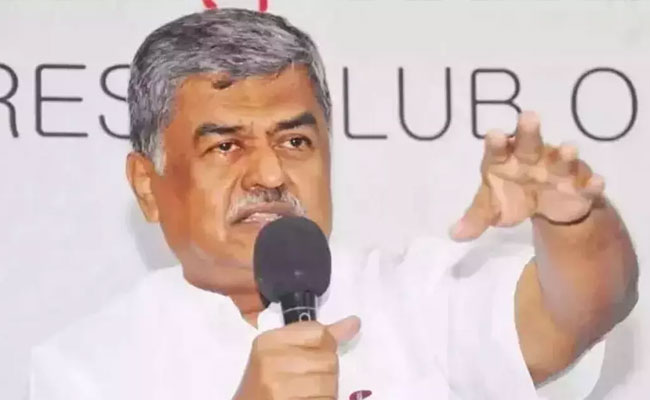
Bengaluru: Congress MLC B. K. Hariprasad has launched a sharp attack on the BJP, accusing the party of hypocrisy over its criticism of alliance politics in Tamil Nadu.
In a post on X on Friday, Hariprasad said BJP leader B. L. Santhosh criticising the Congress party’s alliance politics in Tamil Nadu was “not just laughable, but the height of political contradiction.”
He said the Congress has always joined hands with like-minded parties to protect secular and democratic values in the country.
Hariprasad questioned the BJP over several of its past and present alliances across the country. Referring to Jammu and Kashmir, Punjab, Tripura, Bihar and Maharashtra, he accused the BJP of sharing power with parties it had earlier criticised.
He alleged that the BJP had aligned with separatist and corruption-linked political forces in different states for political gains.
“The BJP, which speaks against alliances today, should first look at its own political history,” he said, adding that the party’s record was full of “contradictions and changing stands.”
Hariprasad also accused the BJP of using central agencies such as the Enforcement Directorate, Income Tax Department and CBI as political tools to target opposition leaders, topple governments and influence electoral mandates.
He further claimed that the people of Tamil Nadu had strongly rejected the BJP and its ideology in the recent election.
“Congress forms alliances to protect the Constitution, secularism and national unity, while the BJP enters into alliances only for power,” he said.